Burst Pressure Probability
Prior Post w/original data and images
UPDATE:
In the couple plots below, the minimum dimension has been changed to aspect ratio (minimum dimension/maximum dimension):
For constant perimeter: alpha=1.1930, beta=.2005, gamma= -0.1380

And for constant area: alpha= -0.1624, beta= -0.0060, gamma=0.2922

In my last post I explained an experiment where multiple features were put on a single sample and pressure was added until one of the samples broke. There were three different types of samples; minimum dimension held constant, area held constant, and perimeter held constant. While one of the properties was held constant, the other two were varied on each sample. For example, the minimum dimension was held constant at 100 um while the area and perimeter was varied. In that case, the probability of a feature breaking depends on the area and perimeter of the feature versus the sizes of the other features. An equation can be used to explain:
 Gamma acts as the y-intercept. In order to get the best fit line for this equation, the three unknown variables must be optimized (alpha, beta, and gamma). This is done by using an SSE (sum of the squared errors) function. This tells us the how much error there is between the experimental values and the values obtained by the equation. We want to minimize this error. On Matlab there is a function called ‘fminsearch’. This searches for the minimum values for a function. By using this function, we can find values for the unknown variables that will minimize the SSE function.
Here is the function and graph for the fitted equation as minimum dimension is held constant:

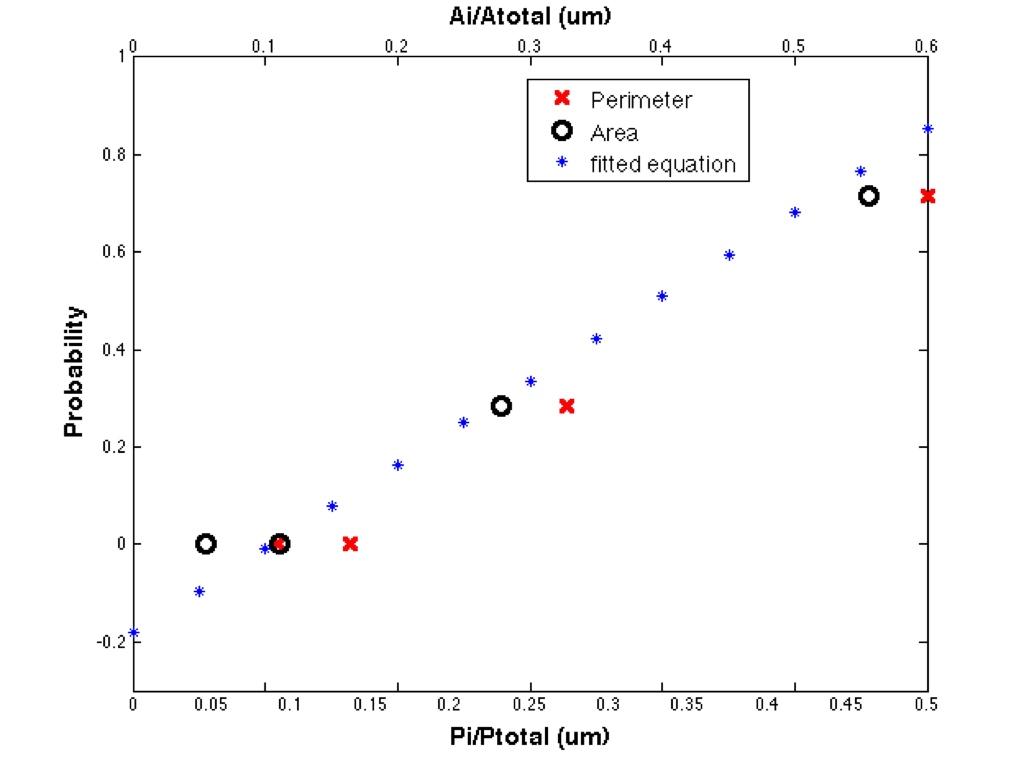
And now for area being held constant:

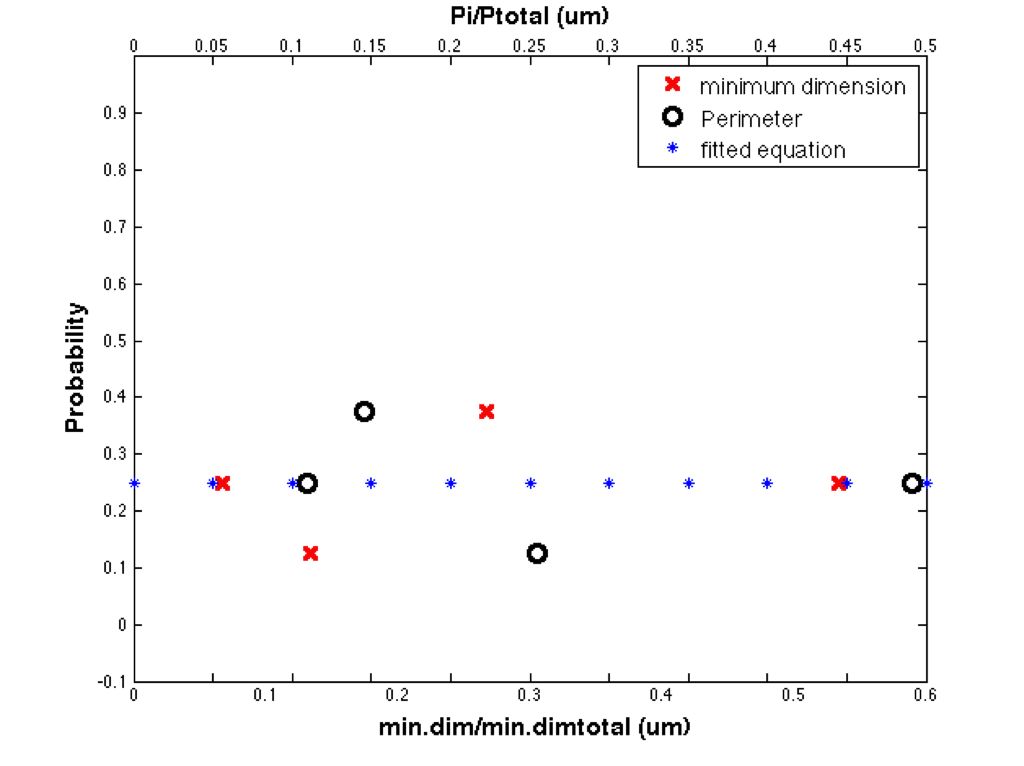
And last for perimeter being held constant:


Is this the probably of breaking at a specific applied pressure? Is there a physical basis for this function being linear? I’m having a tough time understanding what exactly you are fitting and what it is telling us about the membrane geometries.
Will this be presented at an NRG meeting? If so, my questions can wait until then.
Thank you.
I can explain this easier during the next meeting. It is not the probability of a membrane breaking at a specific pressure, it is the probability of a specific feature breaking first on a multi-feature chip.