Cell Adhesion (Trial 3)
Samples (no RTP) from W673 and W684 were taken (four from each wafer; with atleast one blank chip) in Sepcons and HUVECs were plated @ ~19,000 cells/sq. cm. density. Cells were allowed to adhere for over 4 hours and this time stained with CMFDA (instead of Calcein).
Cell types loaded with the CellTracker probes are both fluorescent and viable for at least 24 hours after loading and often through several cell divisions. Most other cell-permeant fluorescent dyes, including the acetoxymethyl (AM) esters of Calcein, are retained in viable cells for no more than a few hours at physiological temperatures. CellTracker Green CMFDA freely diffuses into the cell, where cytosolic esterases cleave the acetate groups, releasing the fluorescent product. The thiol-reactive CellTracker Green CMFDA — which is particularly easy to use as a tracer — is suitable for long-term cell labeling and has been used in a wide variety of applications, including studies of:
- Cell adhesion
- Cell communication through gap junctions
- Cell migration (chemotaxis)
- Cell tracing in mixed cultures
- Long-term viability and cytotoxicity assays
Morphology of the adhered cells have looked a bit unusual in the past couple of trials. This time the pncSi-transwell was autoclaved, whereas in previous trials I sterilized it by rinsing the assembly in 70% EtOH followed by media (EGM). But here the cells look much happier as can be seen in the following images:
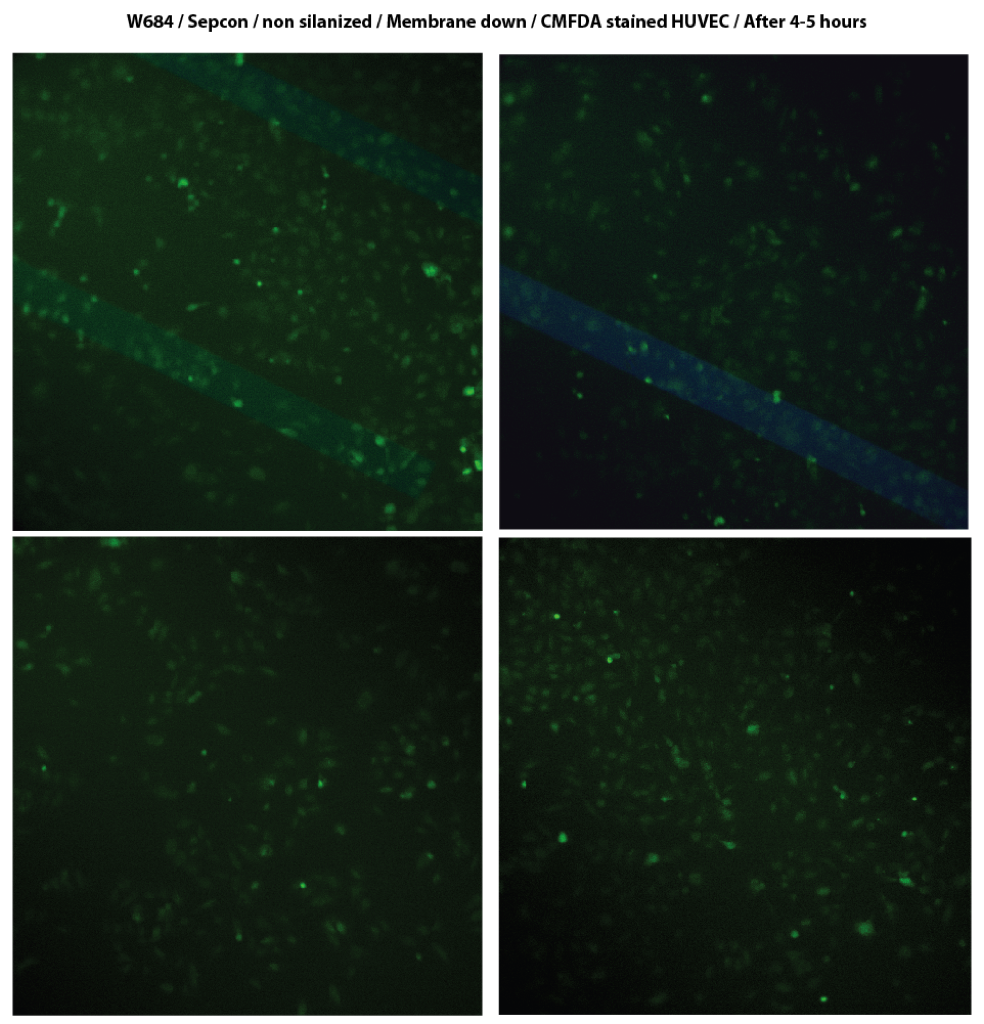
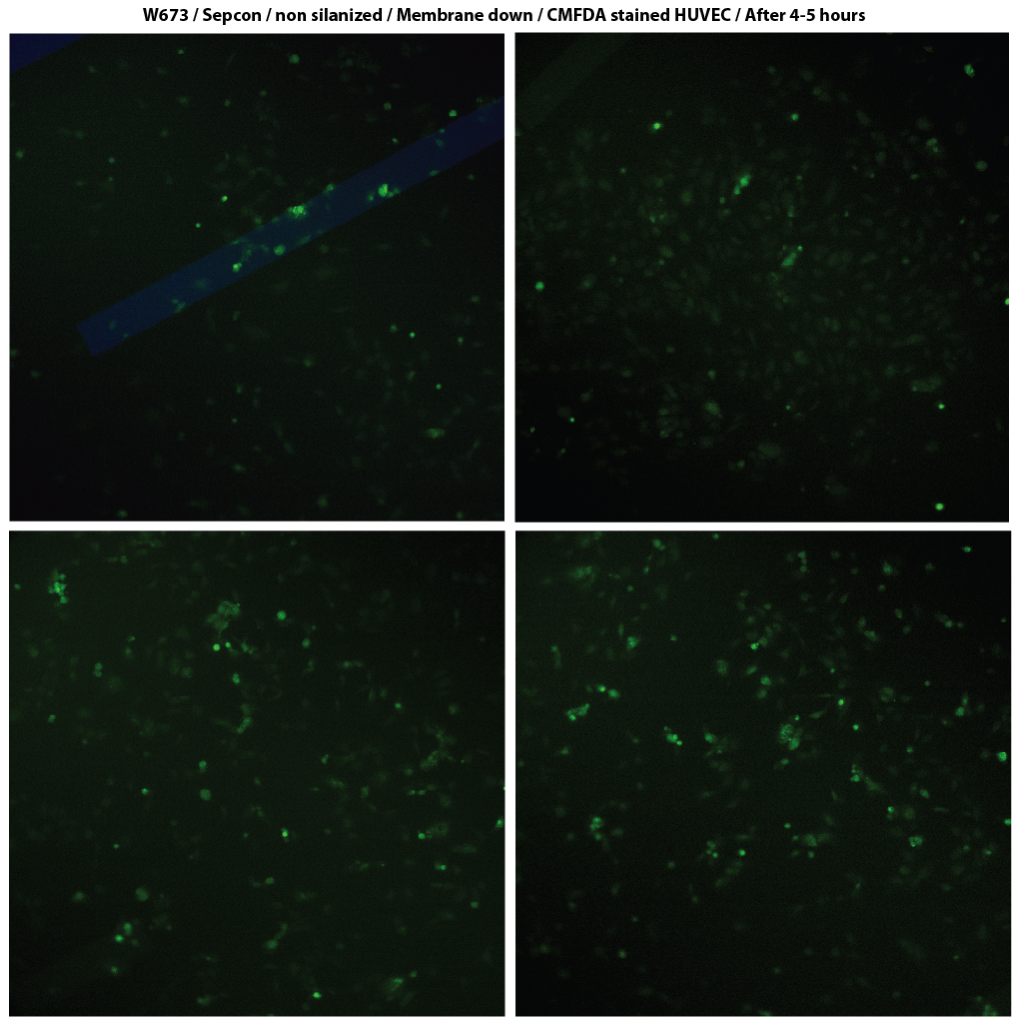
In the above figures, the membrane slits can be seen in dull blue color. These are one of the first set of pictures where stained cells can be seen on the free standing as well as supported membrane.
Here, the % Adhesion ~ 70%, which is on the higher side than what seen before (this again could be due to autoclaving instead of ethanol rinsing). I still have to get the adhesion percentage numbers for silanized samples. These samples are used for further growth study and I will post the Day2 results soon.
Cell morphology does look better, although it’s not perfect. We should look at RTP effects on short-term cell adhesion/morphology.