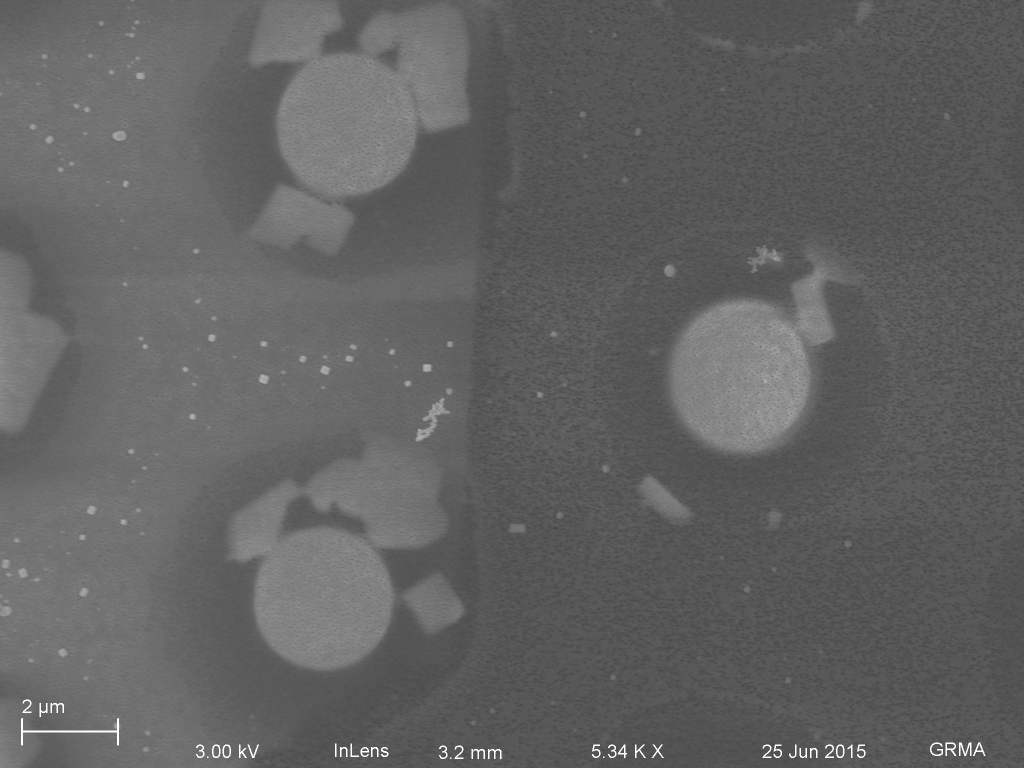
Continuing my work from last week, Tucker used the same tenting (NPN, vapor transfer) and incubation procedure (20 nm and 60 nm Au particles) on an oxide substrate with posts (200 nm high). The substrate was dessicated in the 70C oven overnight. No additional platinum or gold coatings were made. The sample was tilted slightly on the SEM stub, so I used a tilt compensation of 10 degrees to keep everything in focus.
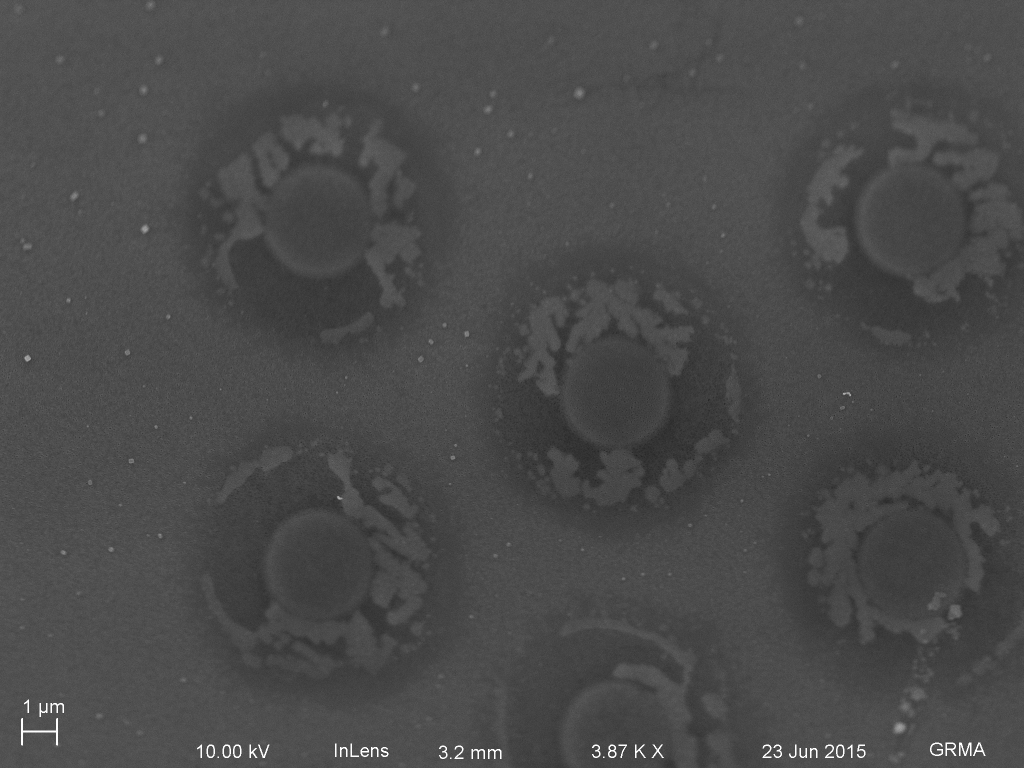
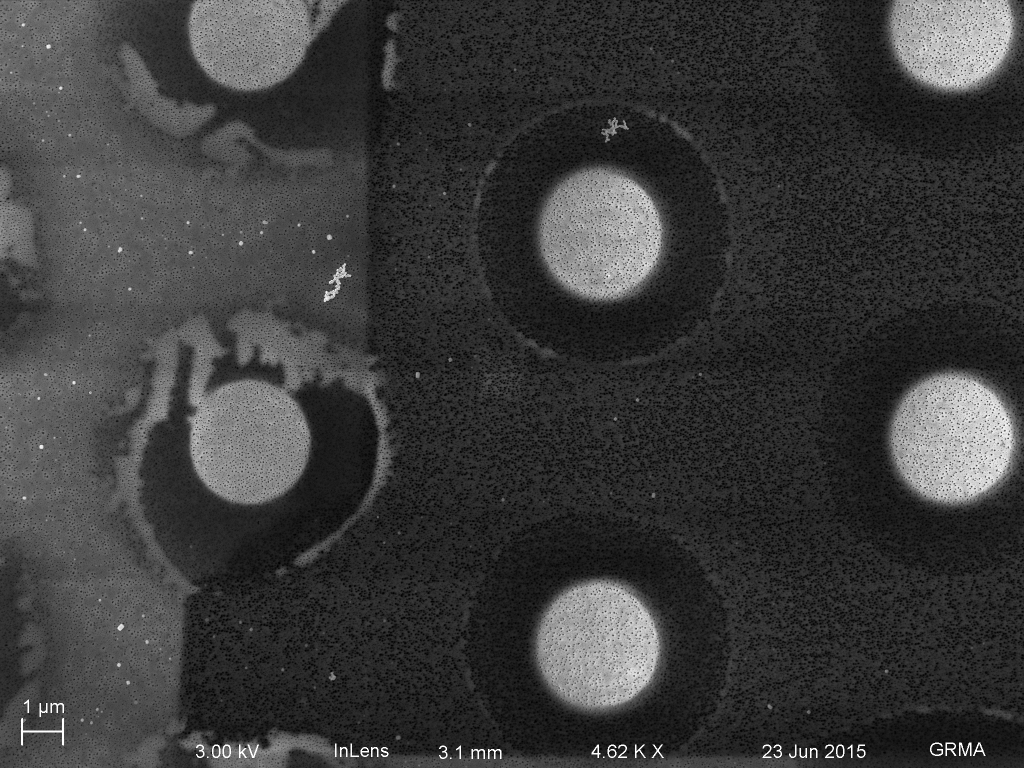
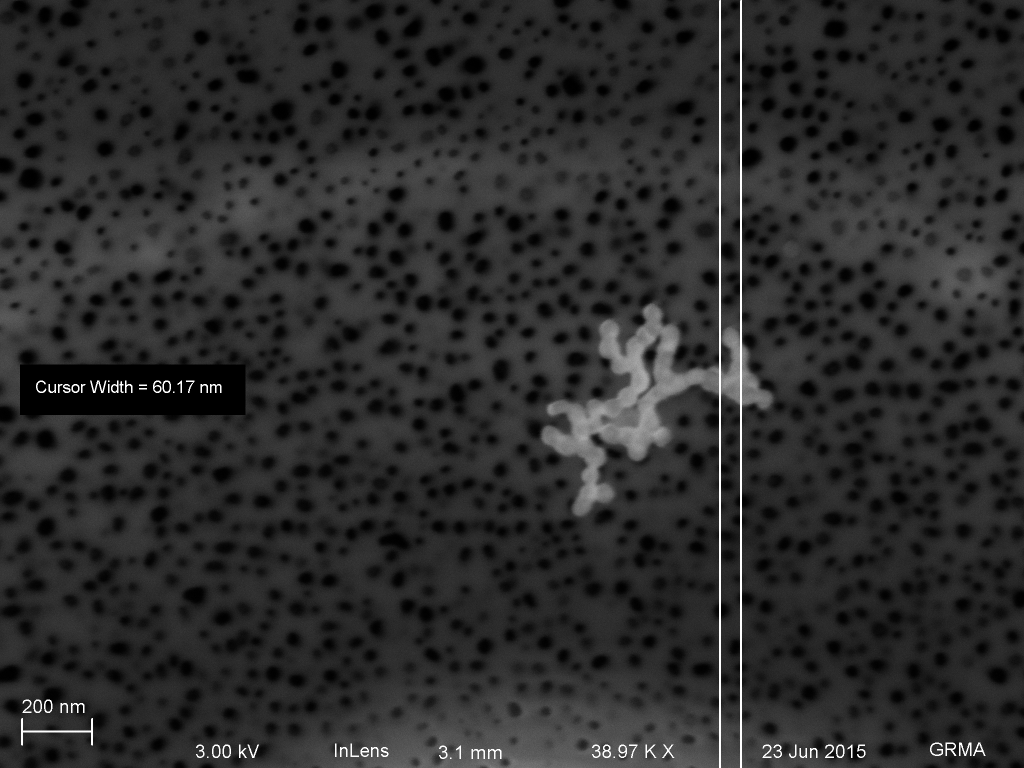
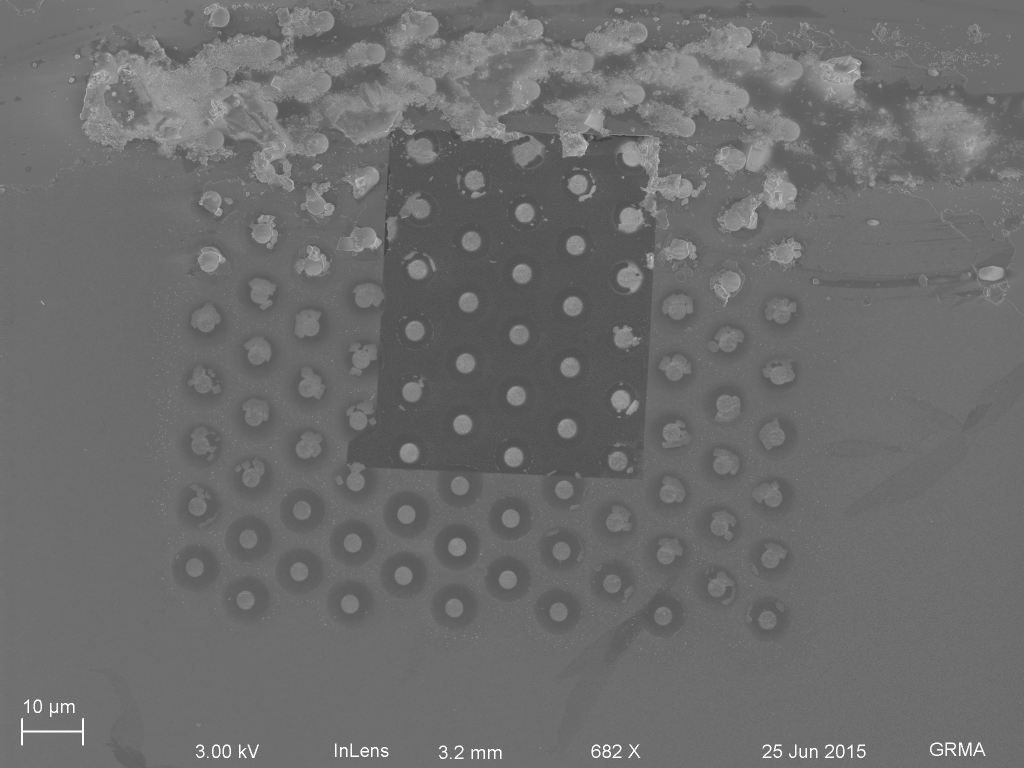
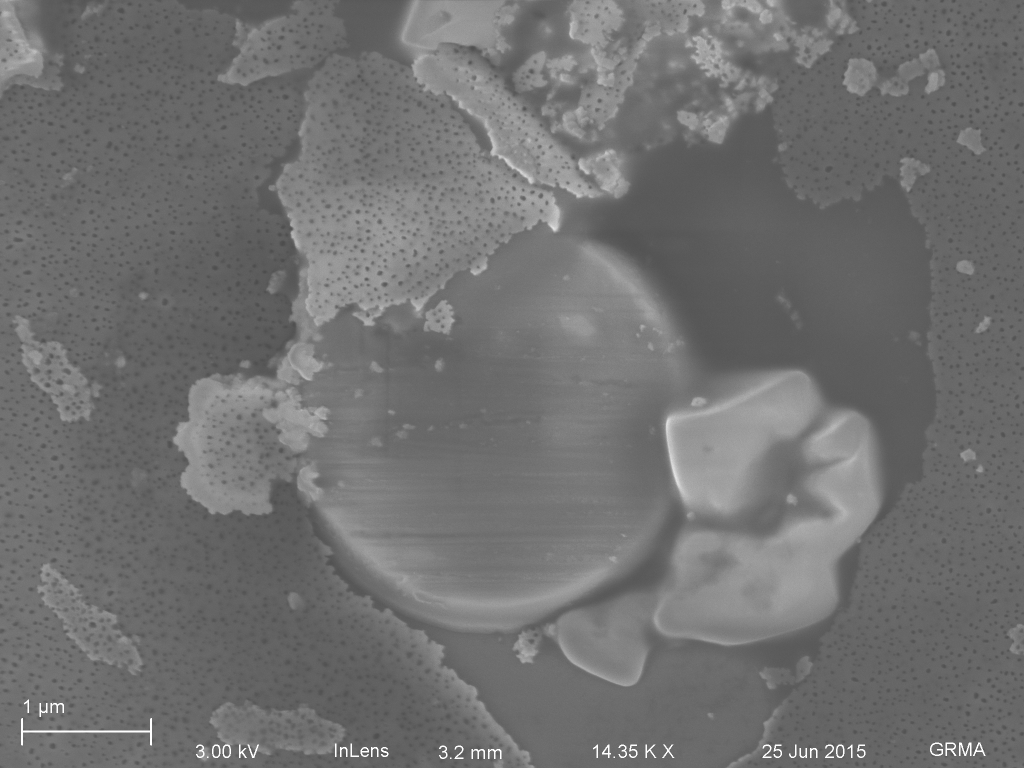
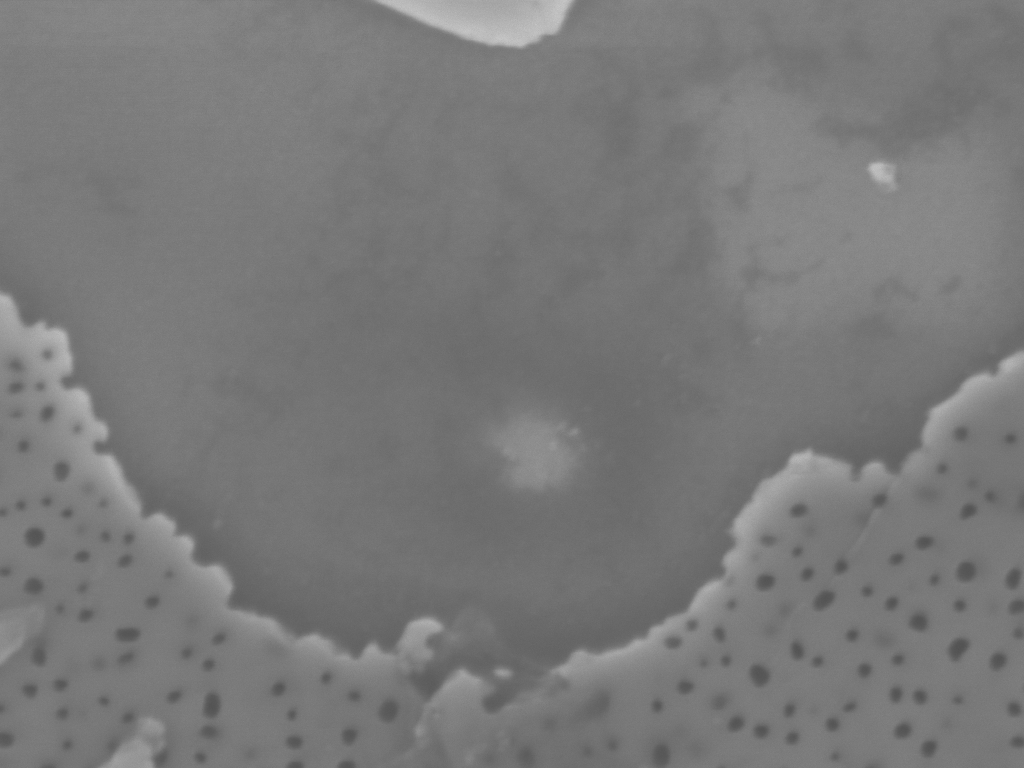
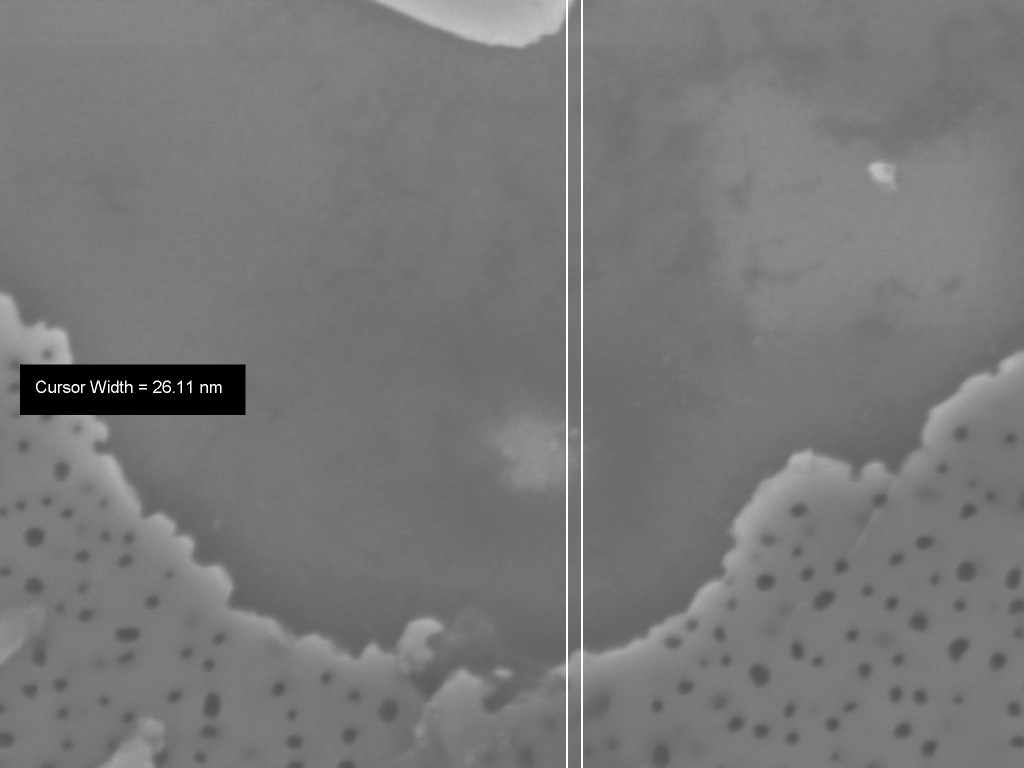
Image without tilt compensation. The items are blurry in the top portion of the image.Oxide patterned region with tented membrane over posts. The tented region consists of rings around each post. Some of the rings have an interesting high contrast pattern on them.Freestanding region tented pillars are on the right, and tented regions over the substrate are on the left. Some have high contrast, which is most likely a residue from drying or potentially particles stuck underneath. There are a few small salt crystals (cubes lower left) in the image.60 nm Au aggregates on top of a tented region.There are many holes, but no single 60 nm Au particle could fit through any of them.Small 25 nm particle near hole.Tented pillar region over substrate.
Magnified view of this pillar with large nanoparticles on top of the tent, and smaller ones occupying the holes.
Next, we will have to break the nanomembrane tent and see if we can observe particulate on the bottom surface.
Update 6/25/15 – We broke the tent
No metallization yet, just scratched the tweezers across the surface.
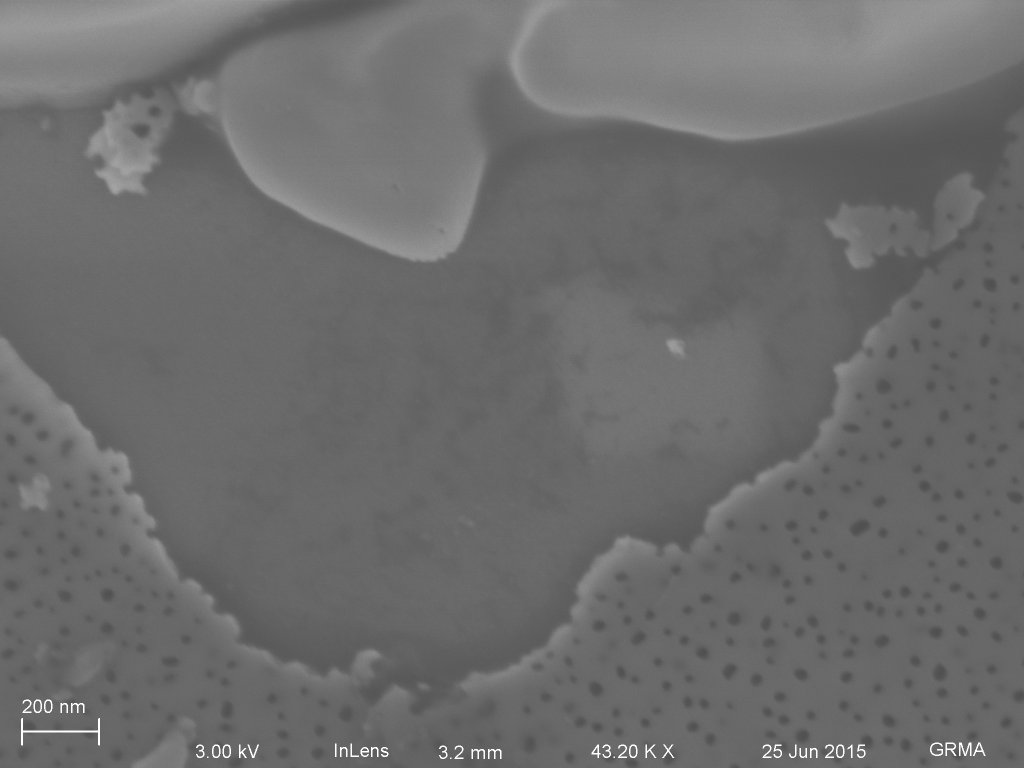
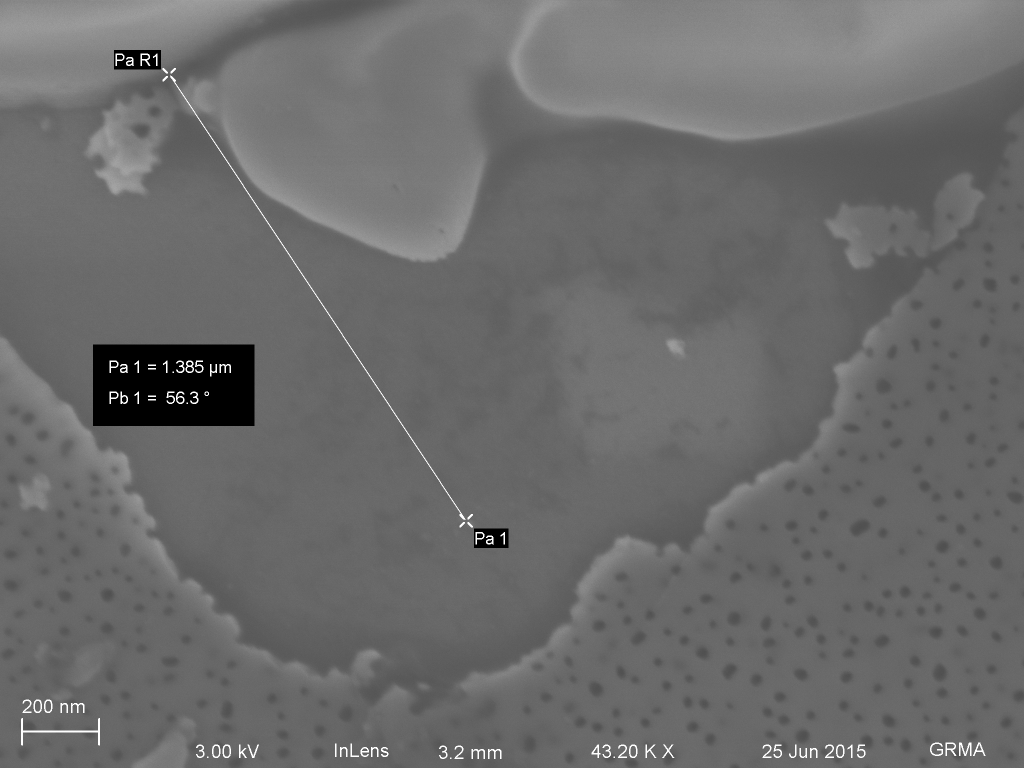
Large scale particulates (60 nm aggregate) are mostly in place)Broken post. The tented radius is about 1.5 microns.Broken area near post, which would have been under tent. Nanoparticles near bottom part of imageDistance to particles
Particles are about the right size.
I’m going to metallize with platinum to get clearer images.
Over the past few days Josh and I installed windows 7, windows office suite, Malvern’s Zetasizer software (available online), Tecan’s I-control software (available in the 3-ring binder in the glass cabinet above the machines), and chrome onto the new(er) laptop in the basement. I copied the files on the old computer that seemed relevant –…
I decided to find another supplier for HBSS and found one: CellGro. CellGro HBSS had the same components as Gibco HBSS, although a couple of the concentrations were different. I tested out this new HBSS vs. homemade HBSS. Here, the commercial versions of HBSS caused discoloration within a day, but my homemade HBSS didn’t. The…
Note: a postscript regarding an assay to determine the activity of our MMP-2/MMP-9 inhibitor was added to this post on June 14, 2021. Introduction The blood-brain barrier (BBB) plays an important role in maintaining brain chemistry by restricting the permeability of small molecules and cells. Inflammatory diseases may disrupt the BBB and promote the development…
I made a post yesterday showing that in 20mM HEPES, pH7.5, +10mM NaCl solution equivalent amounts of DDM were diffusing through the “treated” and “untreated” SC256 samples. Additionally it appeared that minimal amounts of BSA were diffusing across either sample. I set up another diffusion experiment and let it sit overnight. DDM analysis: As observed…