Ozone-treated PDMS: Contact Angles
As seen in prior NRG post, ozone treated samples recover over about 24 hours. However, recent experiments at Gaborski Lab show high variability when using the Corona wand to treat samples with ozone. The goal of this experiment was to determine the contact angles of PDMS samples when exposed to ozone treatment. PDMS samples were made using Sylgard 184 and were dimpled with 3-micron post. The ‘droplets’ were each 4 uL of deionized water and 5 droplets were measured for each condition to demonstrate variability.
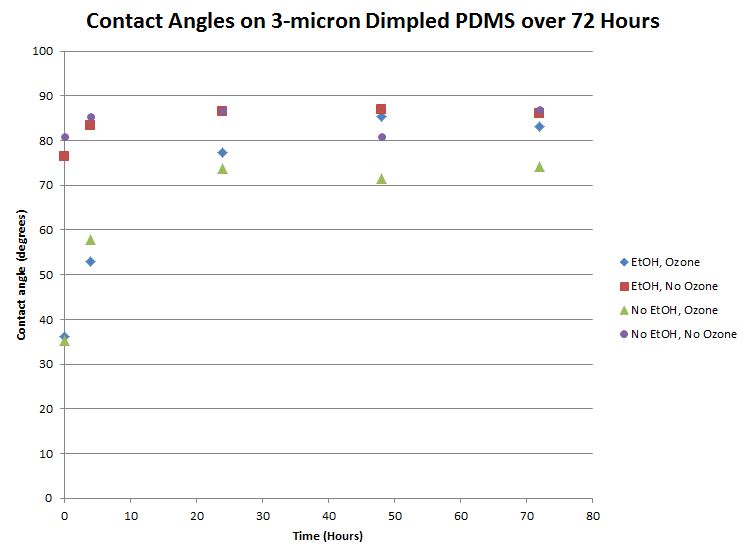
Prior research concludes that hydrophobic recovery of PDMS samples after ozone exposure subsequently increases contact angles. We hypothesized that over time contact angles would increase and reach an asymptote at about 24 hours. Time points were taken at 0 hours, 4 hours, 24 hours, 48 hours and 72 hours.
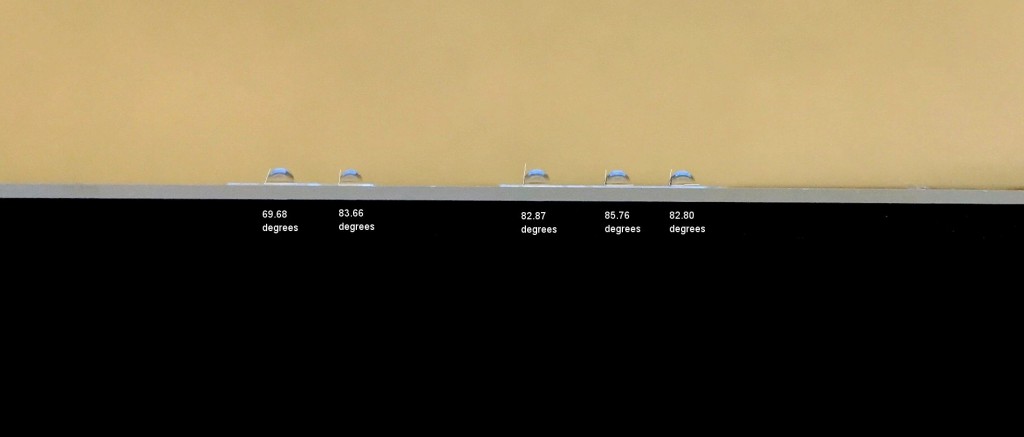
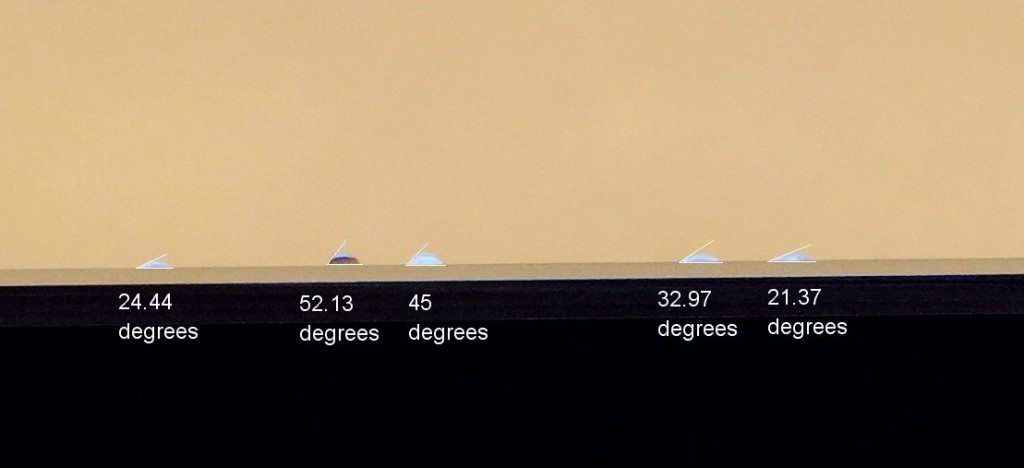
Below are images to demonstrate the variability of ozone treatment, angles drawn in ImageJ:
0 hours, PDMS, No Ozone treatment:
0 hours, PDMS, Ozone treatment:
Averages of Contact Angles over 72 hours:
Highly variable results remained consistent over time, as droplets were placed in same position at each time point. Variability of contact angle measurements shown over 72 hours, for ozone versus non-ozone treated PDMS:
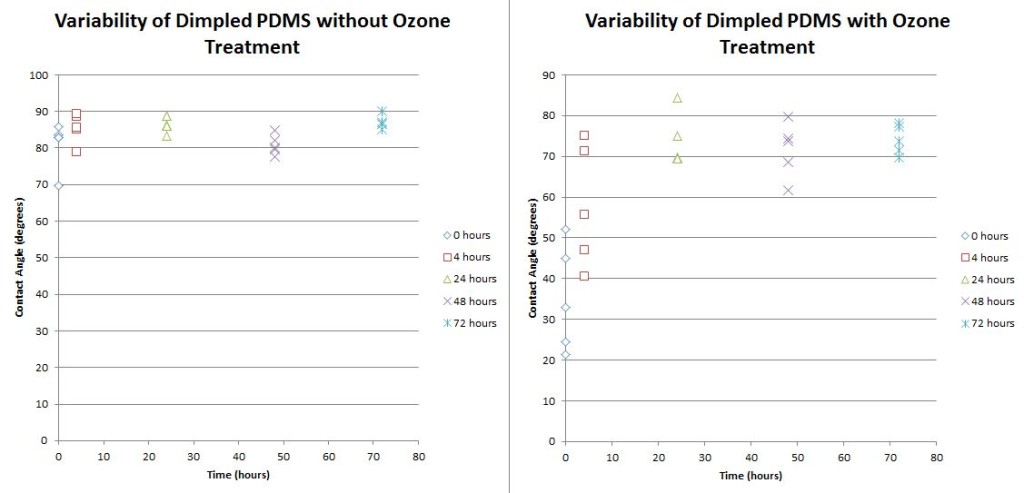
The graphs show that contact angles do increase and reach hydrophobic recovery over about 24 hours. However, there are still some concerns about inconsistent results when using the Corona wand for ozone treatment as seen with the highly variable results from contact angle measurements. From these results, we can see that we will need to wait anywhere from 24-48 hours before we seed cells onto devices for PDMS substrates to reach hydrophobic recovery.
(72 hour time points added 6/23/2015)