Continuing my work from last week, Tucker used the same tenting (NPN, vapor transfer) and incubation procedure (20 nm and 60 nm Au particles) on an oxide substrate with posts (200 nm high). The substrate was dessicated in the 70C oven overnight. No additional platinum or gold coatings were made. The sample was tilted slightly on the SEM stub, so I used a tilt compensation of 10 degrees to keep everything in focus.
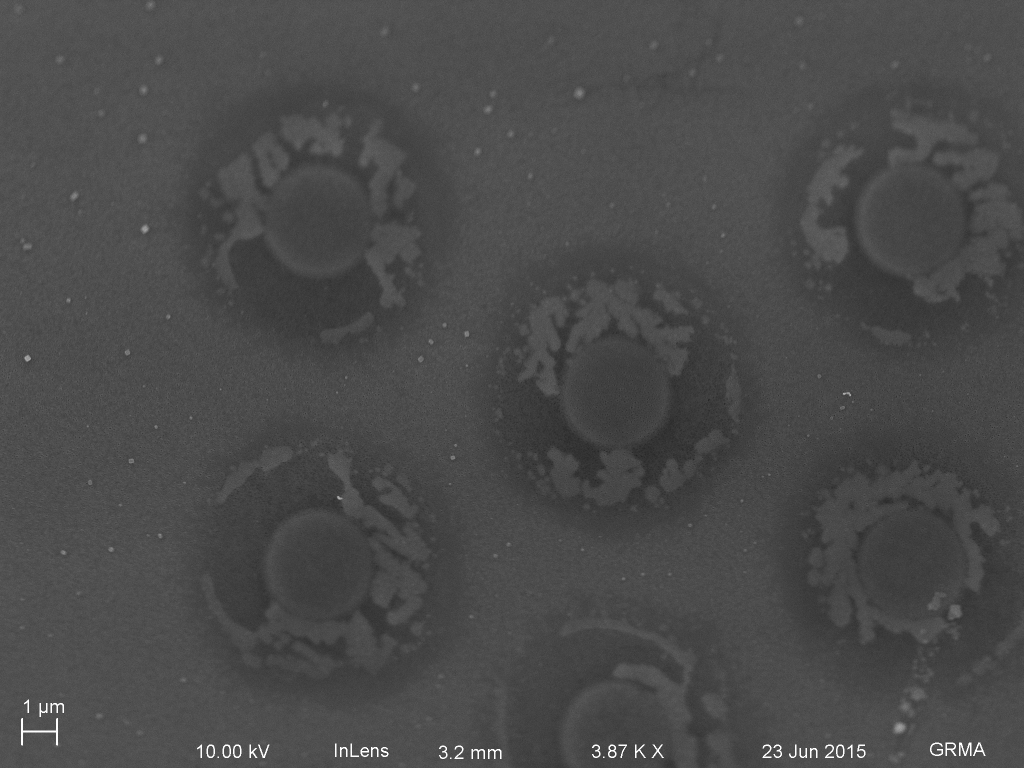
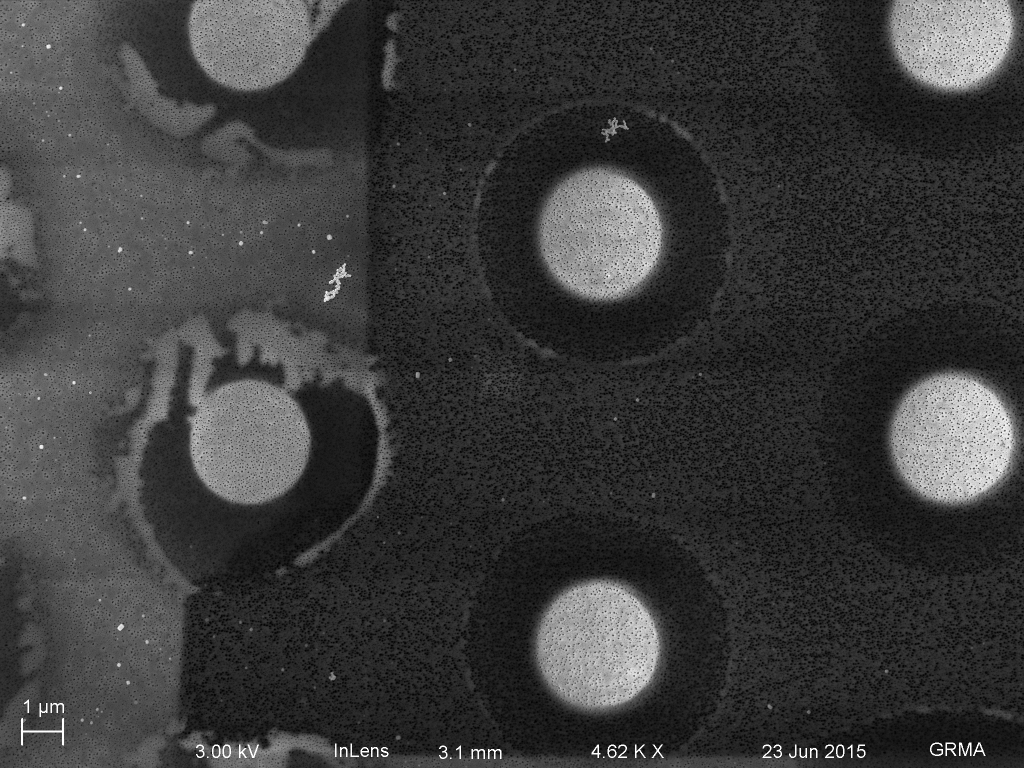
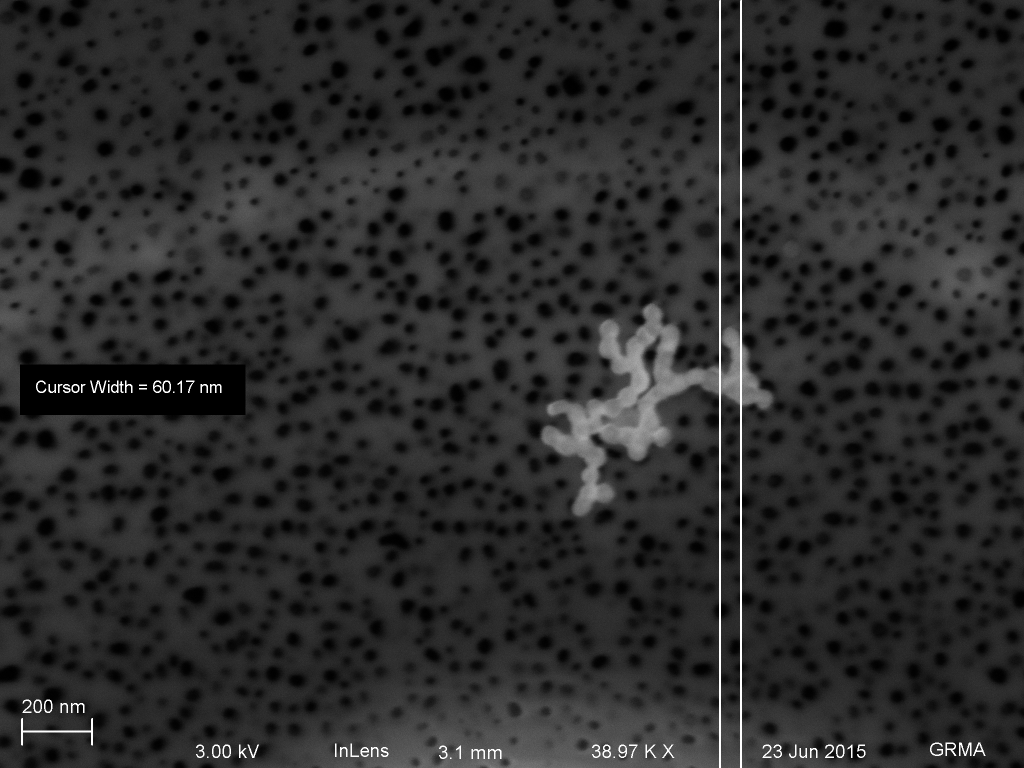
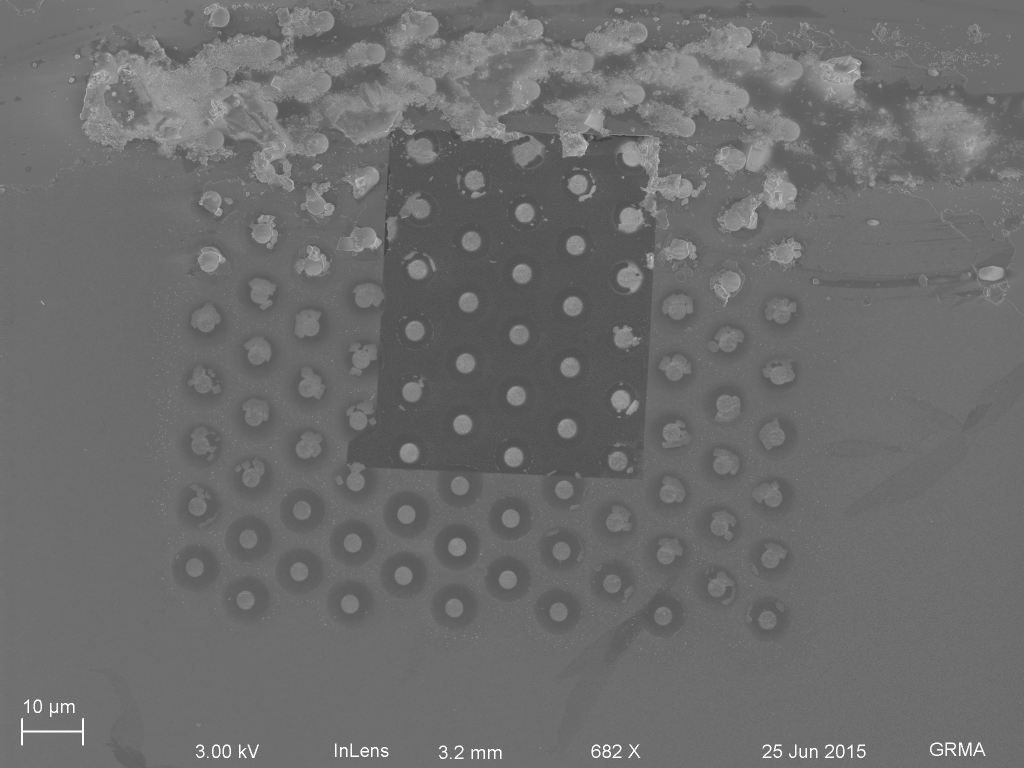
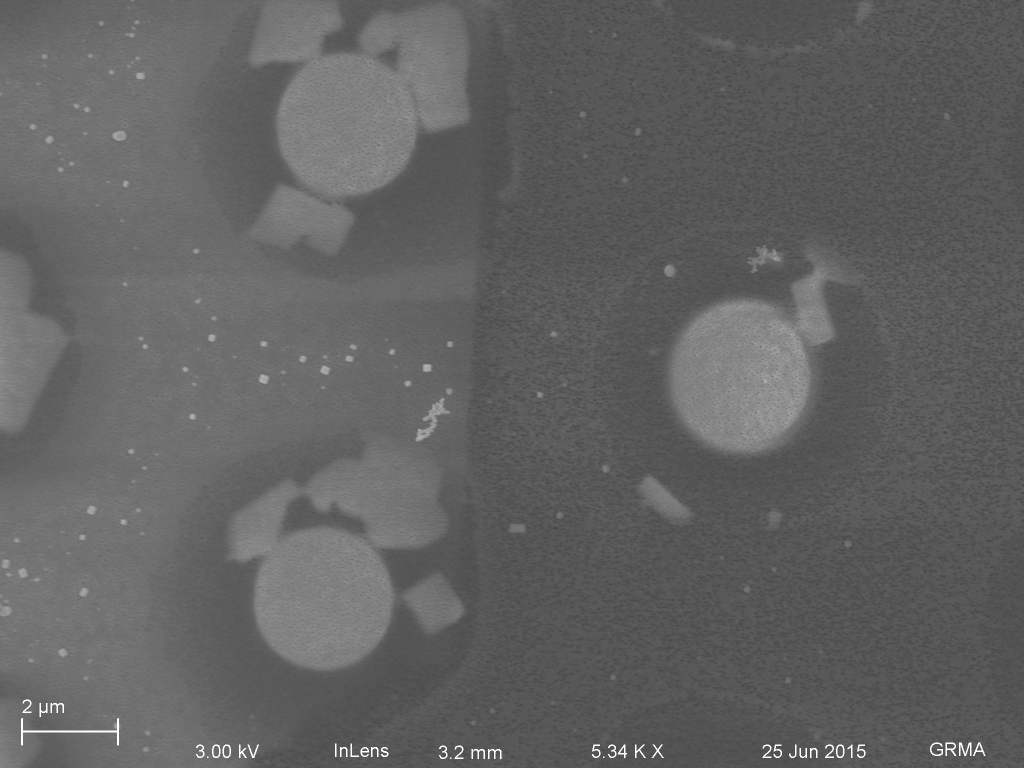
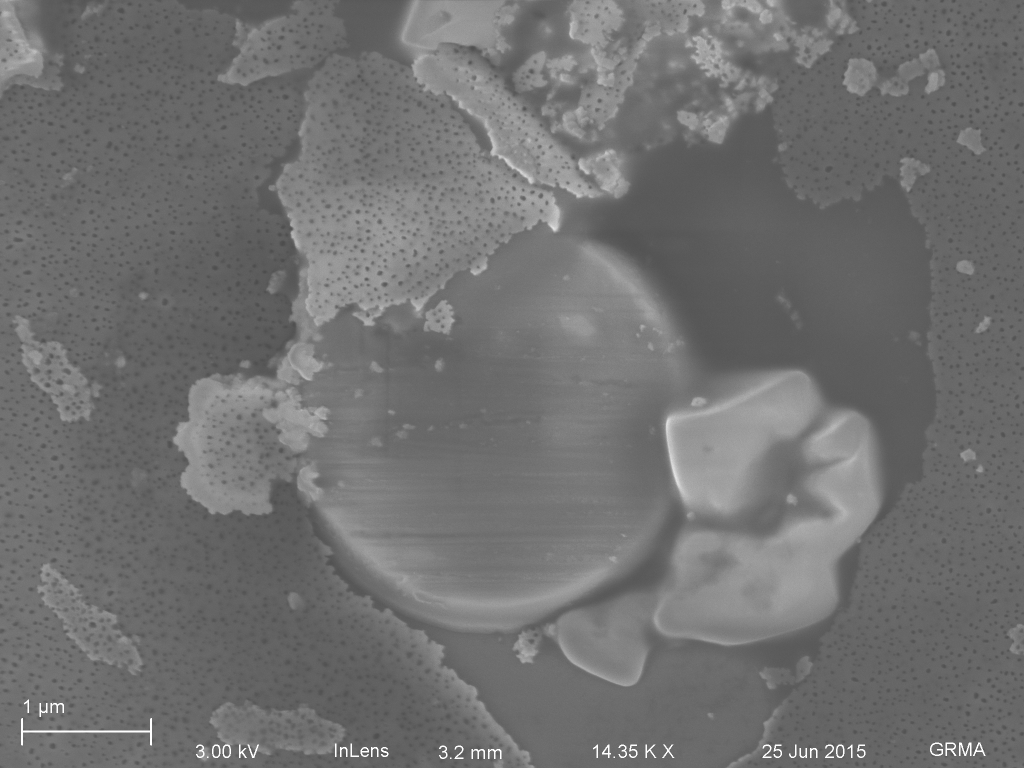
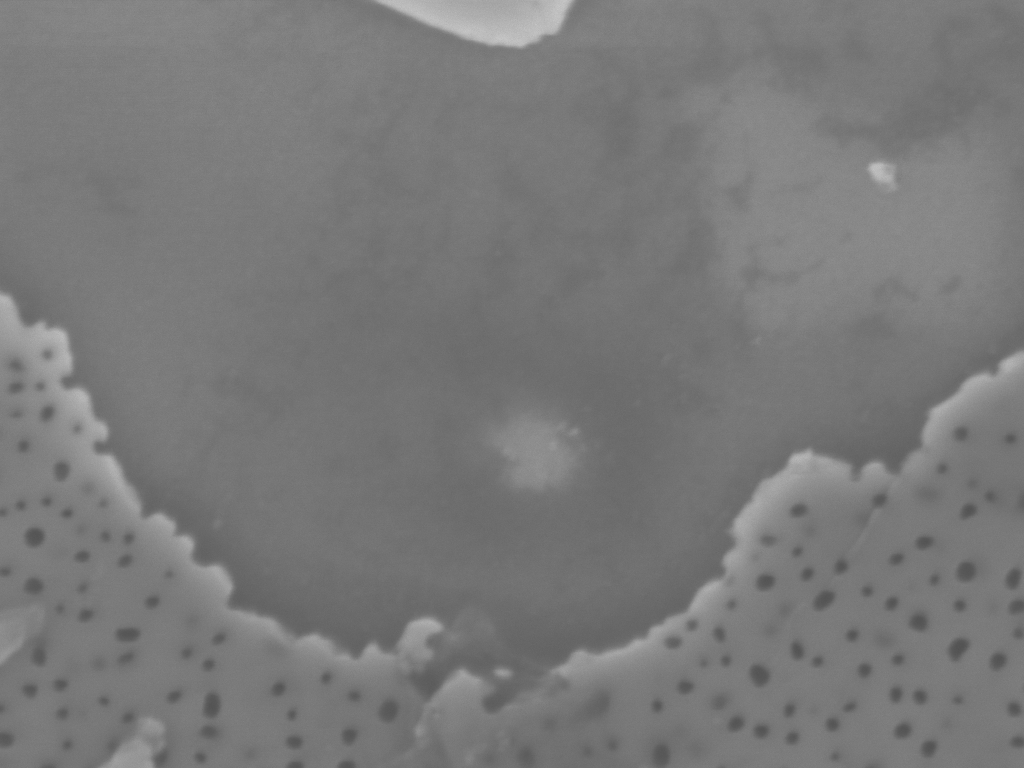
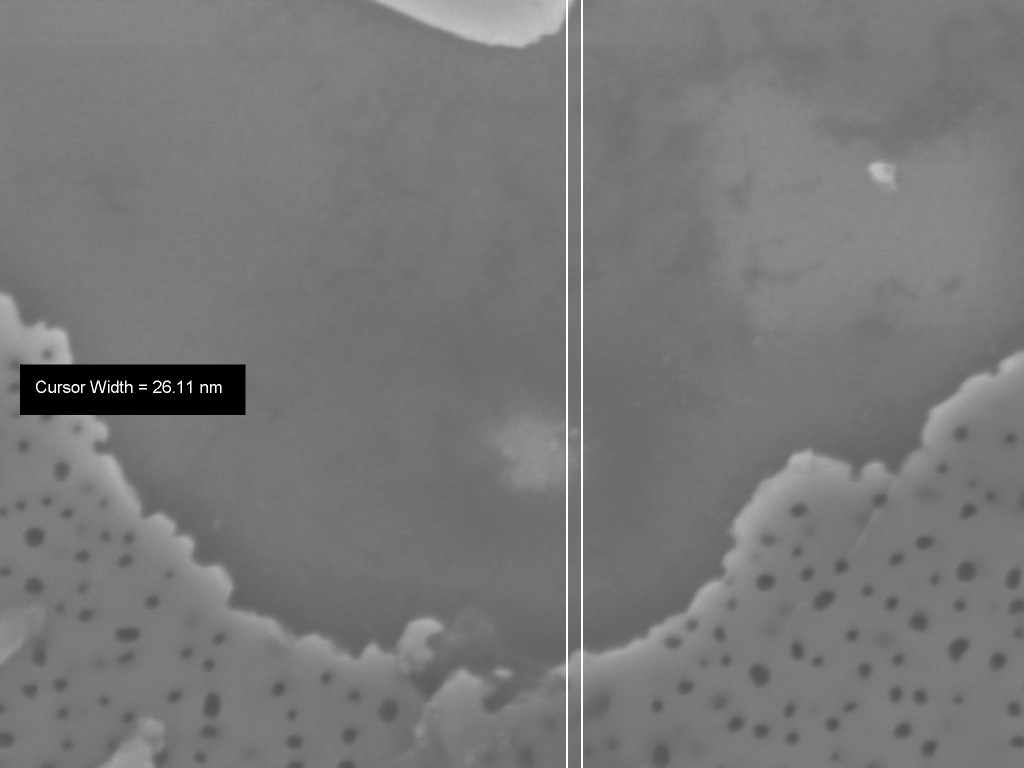
Image without tilt compensation. The items are blurry in the top portion of the image.Oxide patterned region with tented membrane over posts. The tented region consists of rings around each post. Some of the rings have an interesting high contrast pattern on them.Freestanding region tented pillars are on the right, and tented regions over the substrate are on the left. Some have high contrast, which is most likely a residue from drying or potentially particles stuck underneath. There are a few small salt crystals (cubes lower left) in the image.60 nm Au aggregates on top of a tented region.There are many holes, but no single 60 nm Au particle could fit through any of them.Small 25 nm particle near hole.Tented pillar region over substrate.
Magnified view of this pillar with large nanoparticles on top of the tent, and smaller ones occupying the holes.
Next, we will have to break the nanomembrane tent and see if we can observe particulate on the bottom surface.
Update 6/25/15 – We broke the tent
No metallization yet, just scratched the tweezers across the surface.
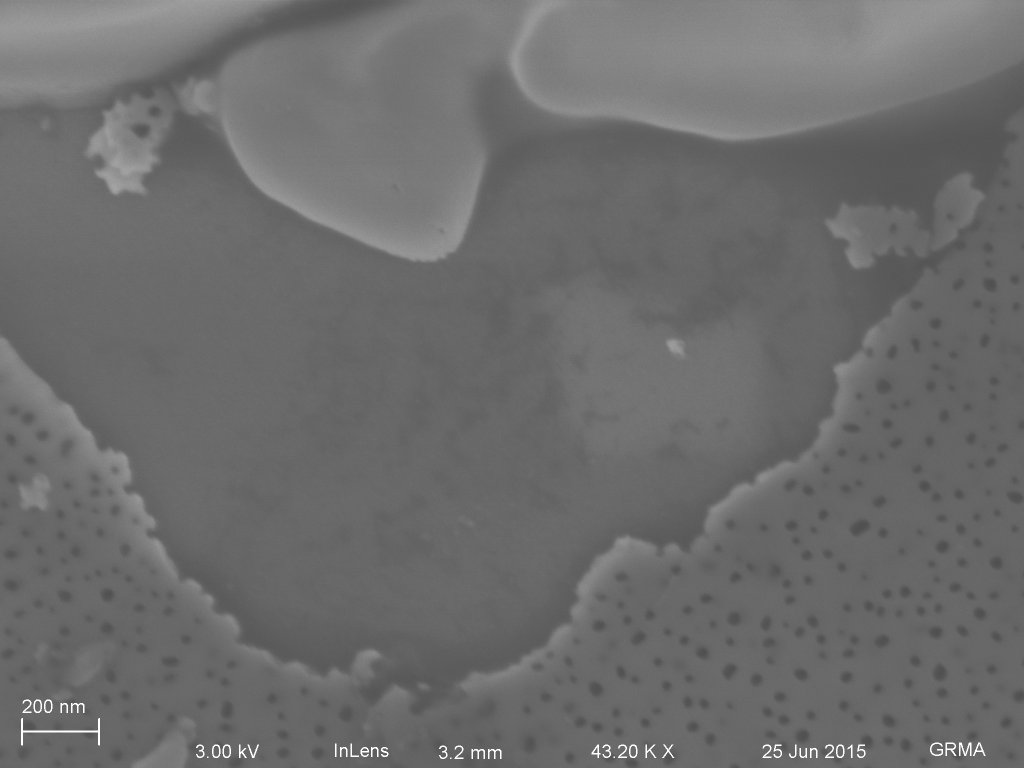
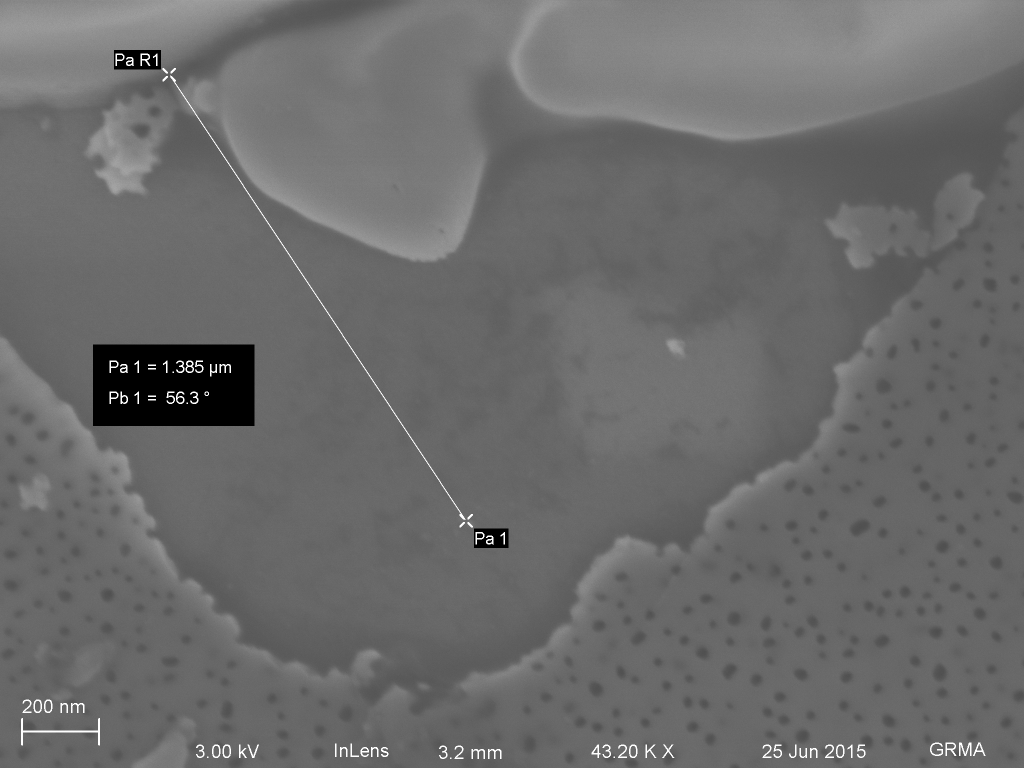
Large scale particulates (60 nm aggregate) are mostly in place)Broken post. The tented radius is about 1.5 microns.Broken area near post, which would have been under tent. Nanoparticles near bottom part of imageDistance to particles
Particles are about the right size.
I’m going to metallize with platinum to get clearer images.
Since we last discovered our polyurethane acrylate (PUA) has a shelf life (described here) and received a new solution of PUA, we have been trying to replicate the results that we had before. Unfortunately, we have realized that this is much easier said than done. What we have found is the specific dilution of PUA…
A while back, we discussed leaving the rotation stage off during the a-Si deposition to induce a thickness gradient over a single wafer. The purpose of this experiment was to explore the different morphologies vs. thickness at a given RTP treatment. We estimated that we could cover a 3x thickness range over a 8 cm…
Introduction The invasion of Staphlyococcus aureus into the cracks of cortical bone leads to osteomyelitis, a devastating disease often resolved by amputation [1]. The μSiM platform has been used to study the genetic mechanisms of S. aureus invasion. The membrane pores mimic the network of cracks in bone, referred to as the osteocyte lacuno-canalicular network…
While JK has been processing backside images from 50 nm, 75 nm, and 100 nm membrane SEM images for pore information, I thought I’d take a look at a 100 nm membrane from both the front and the back at the same spot. Here are the images referenced to a corner of the trench. The…
For many months, Emma and I are trying to achieve neutrophil migration through endothelial cells and through the underlying collagen gel. I need to explain the details of my device first. The schematic is shown as below. I am using a 3 um porous membrane to allow neutrophils to cross the HUVECs in the collagen…
We got a bunch of extremely nice EO wafers through the pipeline, and I’ve been trying to do some experiments with them. There’s very few pinholes on these wafers, and the pores are beautiful. My experiments so far have been w/ SC 166. Pore image: Contributed area distribution: We need the following figures for our…