BBB Device Update
BBB Device Update
We’ve identified a few areas in which we can improve upon the initial device seen in Booth et al (2012). Mainly:
- Endothelial TEER increases to an in vivo value, hopefully from increased astrocytic (pericytic?) support from the abluminal chamber due to better membrane characteristics.
- Real-time microscopy of endothelial cell tight-junctions under the influence of pharmacological agents via transparent electrodes (ITO or FTO, credit: Charles)
- Quantification of shear stresses and other fluid mechanics related to the design of the device
- Integrated microsystem “Lab on a slide”
Two fabrication methods I’ve been considering are the PDMS mold – 3-wall chamber bonding that we are familiar with and a silicone gasket method similar to the one outlined in Booth et al (2012). I wanted to test the PDMS method by embedding glass electrodes into the silicon mold to see if the glass could be processed using our normal methods and still form a shaped chamber, being incorporated into the roof of our electrode.
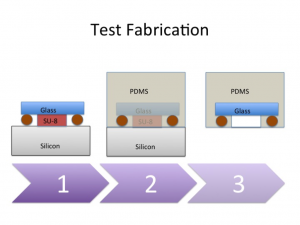
- Test fabrication for embedding a glass roof into a PDMS channel.
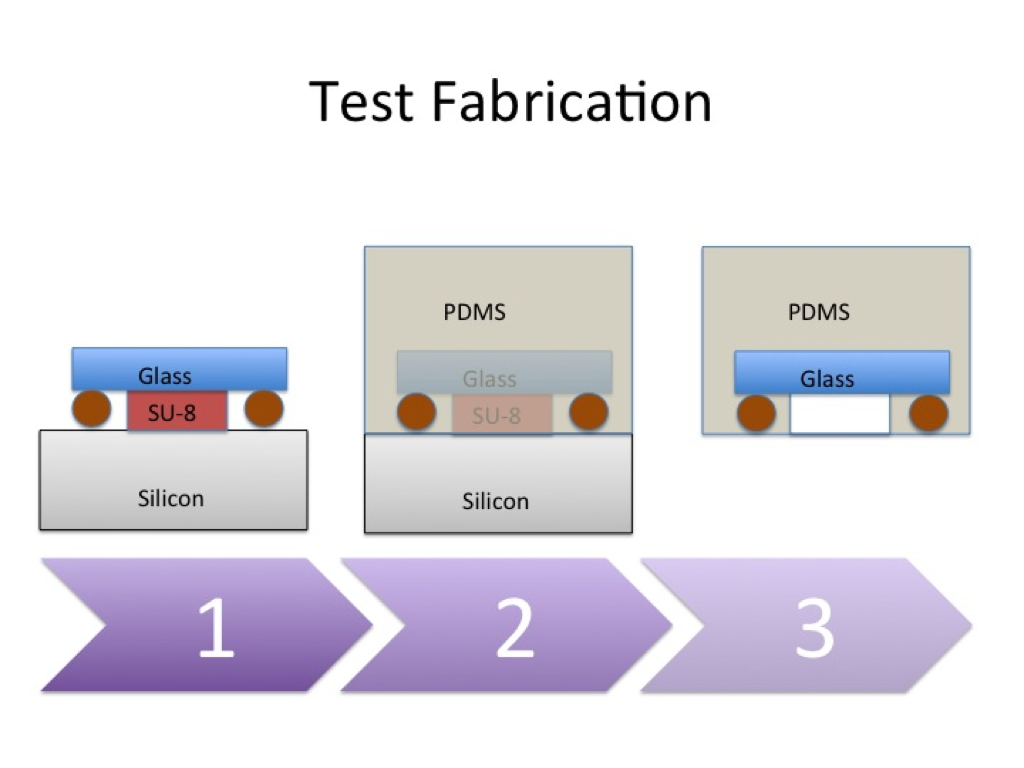
To this end, I took glass coverslides and placed them onto an old SU-8 mold Tejas had given me. I prepared the PDMS in a 10:1 ratio and did the usual outgassing steps, poured the mixture into the mold, and cured it for 2hrs. When I started to separate the mold from the cured PDMS, the failure rate for the coverslip glass was 50%. I repeated this procedure 3 times, and improved my failure rate to about 35%. In the beginning, the failures were due to separating the embedded glass from the mold too quickly, causing fractures. However, a significant number of samples did bond strongly to the SU-8 mold pattern, in which the mold pattern was removed from the wafer when the glass was pried off the wafer. This was persistent to the last iteration; it did not matter if I placed the coverslides prior to pouring the PDMS or sliding the coverslip in while the PDMS had filled the mold. The coverslips were cleaned with isopropyl alcohol before being placed in the mold, but no pirahnna clean was used. Adherence was not an issue with a non-patterned mold. Barring a lubricant, this method is probably not the best for mass production.

- Ruined Mold


- Embedded Glass into PDMS with working fluidic channels

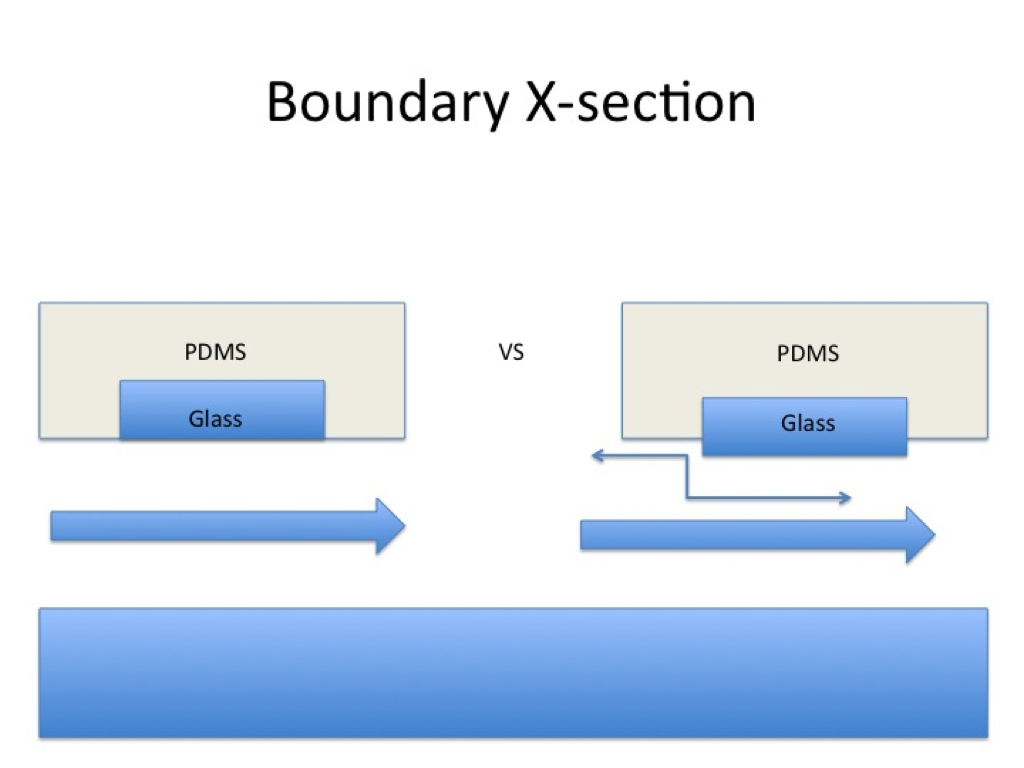
However, the fluidic integrity of the multi-material stack remained intact after ozone bonding. There wasn’t any issue maintaining a roof that switched to glass from pdms and back; no edge effects were observed when microbeads were flowed through the chamber.

- Will the flow be impeded?
Ultimately, I think the gasket method will be more appropriate for prototyping because of the mask wear and tear. If the gasket method is unsuccessful, there is at least the possibility that this method could supply the necessary integrated electrodes.