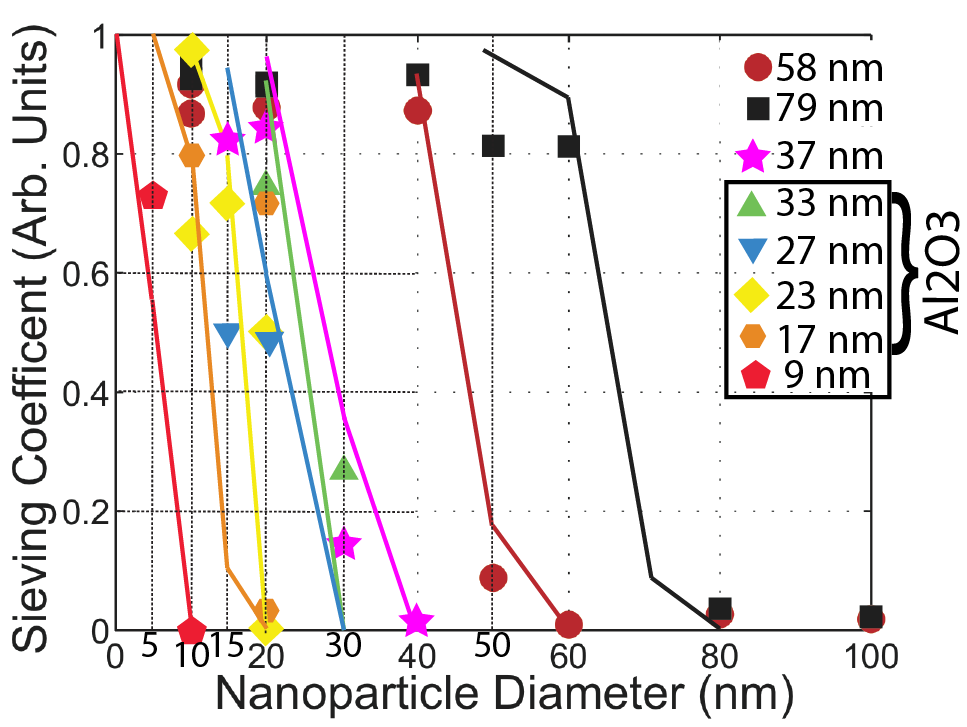
Gold sieving graph with all my data and model lines
Introduction Permeable membranes provide a physiologically relevant cell culture substrate for in vitro study of barrier cell types, such as endothelial cells, which assume a polarized morphology with distinct apical and basolateral surfaces. Cell morphology and subsequent monolayer formation and barrier function are largely dependent on initial interactions with the cell culture substrate via focal adhesions….
Here are the results for air permeability testing of W501. The sample closest to the origin had one very small (very difficult to see on Brian’s scope unless viewing at 100x) pinhole, the middle sample had 3 very small pinholes. The completely intact sample had a permeability of .773 cc/(cm^2*atm*s). It seems that the pinholes…
Dr. Webb is very interested in the thin nanomembranes that our group experiments with. To date, he has been trying to get cells to grow on SiN microporous material and image them with a few different types of microscopy (Phase, Confocal, Scanning Conductance Ion Microscopy). The cells have not grown well natively on the nitride…
In this post I will show that the analytical 1D model of diffusion is similar to our 3D COMSOL model, with the exception that the times do not seem to line up. This is reasonable though since the 1D model does not take into account the non-membrane silicon pieces and enlarged volumes that occur in…
Introduction As a continuation of my rotation project and a beginning to my PhD work in the McGrath lab, I wanted to finalize my shear stress calculations within our blood vessel microfluidic device. All previous shear stress calculations were purely analytical, with many assumptions. This work aimed to minimize those assumptions while providing some publishable…
As discussed in a previous post, we decided to test chips from wafer #1070 because they have smaller pores than those used in the most recent forward vs. reverse study. In the forward direction, 31 uL of filtrate was passed after 30 minutes at 3 krpm. (after 30 additional minutes at 5 krpm the total…