Updated Rhodamine Dilution
I fixed the graph for the serial dilution of Rhodamine that I did last week and removed all absorbency values that were greater than 1.08 AU. The graph looks much more linear now with an R^2 value of .9517
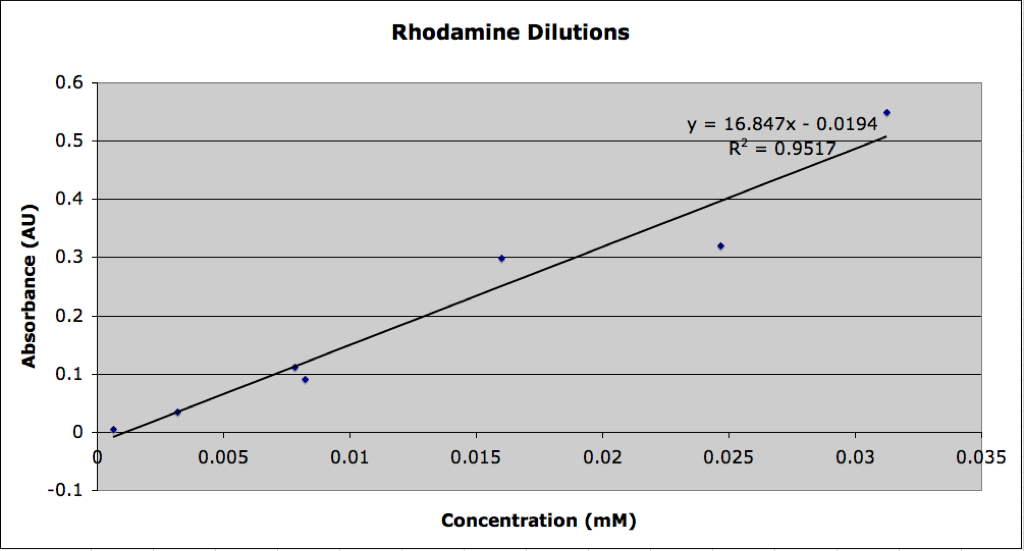
I fixed the graph for the serial dilution of Rhodamine that I did last week and removed all absorbency values that were greater than 1.08 AU. The graph looks much more linear now with an R^2 value of .9517
Our main purpose of this project is to reduce or eliminate the protein non-specific adsorption on the oxidized siliconnitride sample surface. By synthesis the PEG molecular on the surface, we believe we can reach the goal. There are different ways to synthesis the PEG on the surface. First is the silanes, after synthesis the silanes,…
Introduction In severe sepsis, a primary infection gives way to a maladaptive immune response leading to wide spread edema and multiple organ dysfunction. The initial infection can occur in many peripheral tissues throughout the body. The pathogen associated molecular patterns (e.g. LPS on gram-negative bacteria) interact with pattern recognizing receptors on resident macrophages and endothelial…
Type I collagen is a fibrous protein and the largest constituent of the ECM by mass. Collagen fibers are aligned across several millimeters to centimeters within load-bearing tissues, like the musculoskeletal tissue, cardiac tissue, and the cornea. Millimeter scale regions of fiber alignment are also observed in the tumor stroma and fibrotictissue. At the cell scale,…
PhD Dec. 15, 2010 Thanks for Everything!
There has been uncertainty with process of dissolution of pnc-Si in cell growth media. Whether the media enters the pores and ‘eats away’ the material leading to increase in pore sizes and eventually complete degradation was the question. Thinning of the material would have taken place too. To have a clear picture about this, I…
Continuing the studies on neutrophil transmigration in devices with embedded parylene membranes of different pore sizes and thicknesses, three pore sizes (1.0 um, 1.4 um and 1.7 um) and two thicknesses (0.7 um and 1.2 um) were used for these sets of experiments. Thickness ratio of 1.2 um to 0.7 um roughly correlated with…
Comments are closed.
What is the absorbance wavelength you are measuring?
The wavelength is measured at 530nm. I checked online and it said that the maximum absobtion of rhodamine is about 530nm.
This looks OK, but I’m still surprised that the data points are not tighter to the line (lower variance). This is close to an ideal system, so I would suggest trying to perfect your technique to get this rock-solid before advancing to more complicated experiments. If you try to measure the same sample multiple times, does the value jump up/down around the line? If so, maybe an averaging is needed?
If you think this is good enough for your purposes, that’s fine too, but you want to make sure that this measurement error is not a significant contributor to the overall experimental error. You should also consider the range of absorbance values that you will typically be using, and confirm accuracy in that regime.
I ran two measurements for each sample and then averaged the two measurements. I’ll run the experiment again on Monday and see if I can get a better fit.
How close were the two measurements for each sample? If each set of two is tight, then the variability is not in the measurement, but the prep. Once you isolate the source of variability, you will probably be able to get nice looking data with a few tweaks of procedure. Even if the variability is outside of your control, it’s still important to understand it for experimental design.