Updated Rhodamine Dilution
I fixed the graph for the serial dilution of Rhodamine that I did last week and removed all absorbency values that were greater than 1.08 AU. The graph looks much more linear now with an R^2 value of .9517
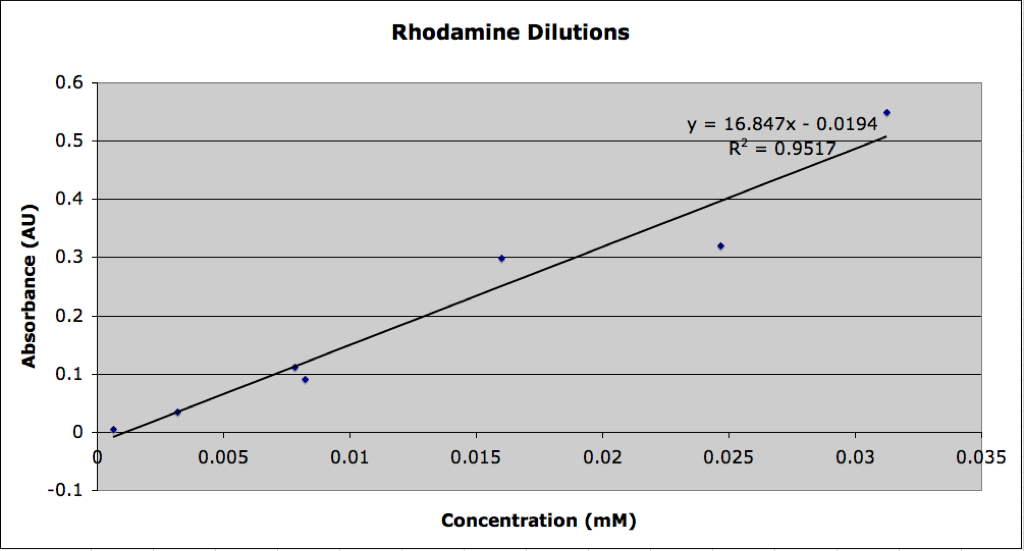
I fixed the graph for the serial dilution of Rhodamine that I did last week and removed all absorbency values that were greater than 1.08 AU. The graph looks much more linear now with an R^2 value of .9517
Purpose: The purpose of this investigation was to study the diffusion of Rhodamine, a florescent dye, in crosslinked Poly ethylene glycol (peg) using a Leica DMI 6000. Knowing the permeability of crosslinked peg is valuable as peg is a potential material for the hemodialysis project particularly the lift off component, and knowing about Rhodamine’s (MW…
This post is a continuation of the work in Partial Etch RIE Blows out NPN Pores and MgF2 Nanomembrane Fabrication on partially etched NPN substrates. We believe the underlying NPN template influences the shape of our SERS active nanostructures and therefore the SERS properties. In this post, we’ll take a look at some of the structures resulting…
The 300K nanosep membranes that Jess ordered came in so I ran a single set of three membranes at 21.63psi to compare their hydraulic permeability values to those of the 100K microcon membranes. As expected the 300K nanosep membranes have a much larger hydraulic permeability then that of the 100K microcons; approximately a factor of…
Creating an array to hold a pnc-Si wafer to proving to be difficult. The PDMS spreads too rapidly though the NC to form a consistent array for the pnc-Si membrane (and eventually wafer) to rest on. I’m still running different trials of the PDMS on NC to see if I can get the array to…
The Barcikowski lab sent us generous amounts of three different samples – gold, platinum, and bioconjugated gold. Each of the samples was created via laser ablation, resulting in fairly polydisperse (4-50nm diameter) nanoparticles for the pure metal and significantly less polydisperse (2-20nm, not including bound ligand) nanoparticles in the case of bioconjugated gold. As before,…
I tested four samples (-1,1); (-1,2); (-1,3); and (-2,4) for air permeability and burst pressure. The first three samples showed no measurable air permeability for three attempts each. The sample from position (-2,4) did have a very small air permeability of 11.2 cc/(cm2*atm). Based on the results of rhodamine diffusion it seems odd that I…
Comments are closed.
What is the absorbance wavelength you are measuring?
The wavelength is measured at 530nm. I checked online and it said that the maximum absobtion of rhodamine is about 530nm.
This looks OK, but I’m still surprised that the data points are not tighter to the line (lower variance). This is close to an ideal system, so I would suggest trying to perfect your technique to get this rock-solid before advancing to more complicated experiments. If you try to measure the same sample multiple times, does the value jump up/down around the line? If so, maybe an averaging is needed?
If you think this is good enough for your purposes, that’s fine too, but you want to make sure that this measurement error is not a significant contributor to the overall experimental error. You should also consider the range of absorbance values that you will typically be using, and confirm accuracy in that regime.
I ran two measurements for each sample and then averaged the two measurements. I’ll run the experiment again on Monday and see if I can get a better fit.
How close were the two measurements for each sample? If each set of two is tight, then the variability is not in the measurement, but the prep. Once you isolate the source of variability, you will probably be able to get nice looking data with a few tweaks of procedure. Even if the variability is outside of your control, it’s still important to understand it for experimental design.