NPN Lift-Off Update – hybrid micro-/nano-porous approach
Josh Miller and Elizabeth Hirschman (RIT co-op student working on STTR lift-off project) obtained preliminary successful results lifting off ~1 in2 sections of NPN membrane where the nanopores were only transferred into the nitride layer in a microporous pattern (ø3 µm pores, hex-close-packed on 6 µm pitch). Details of process are given below.
Bruce Furnace Thermal oxidation: 100nm
LPCVD (RIT) Poly Si deposition: ~1000nm (this is the sacrificial layer that get etched away by XeF2 during the lift-off etch)
RV SiN deposition: 50nm
AJA a-Si deposition: 32nm
AJA SiO2 deposition: 20nm
SSI RTP: 1050C / 100c/s / 60s soak *
10:1 BOE oxide etch: 60s
Create microporous pattern through which nanopores will be transferred into the nitirde layer
S1813 resist application: std recipe
GCA stepper lithography: std 3um pores mask and parameters **
CD-26 Develop: std 3um develop
SRD and extended rinse, 150C hard bake to drive off moisture
Trion RIE Transfer: std recipe, 75s (Nanopore transfer)
Piranha Etch: 10min 130C
P5000 TEOS deposition: 50nm target std low stress recipe
SU8 application: std conditions 10um target
SU8 support lithography: 45s BB exposure 100um space/ 10um line
SU8 develop: std conditions
10:1 BOE oxide etch: 60s (or until fully wetted) removes adhesion and native oxides
Xactix XeF2 etcher: various pulse counts, 60s, 3T XeF2, 0T N2
As a recap from the last attempt: the nano-porous film was sticking to the etch stop oxide and tearing upon separation, but the micro-porous films did not suffer from this. We then hypothesized that by combining the two methods, we might have at least a stop-gap between full blown nano-porous membranes and our countless broken attempts.
This method has show effective in allowing us to lift-off the membranes with little or no tearing as seen in pure nano-porous films, see images. Membranes lift-off at 5-7 pulses though some areas of the wafer have poorly exposed SU8 grids which may lead to inaccurately small counts for achieving lift-off
A couple of notes:
You will notice that the nano-porous areas are highly porous, I plan to back down the temperature from 1050C to 1000C for the next wafer, and/or adjust the RIE transfer (the resist may be altering the chemistry during the transfer or something to that effect).
Now that we have confirmed that the 3um pattern (that was originally used for my senior design) works well with nano-pores, the next wafer I would like to try one of the hexagon masks made for the pnc-Si, these have a much higher active area and may still be sufficient for lift-off purposes.
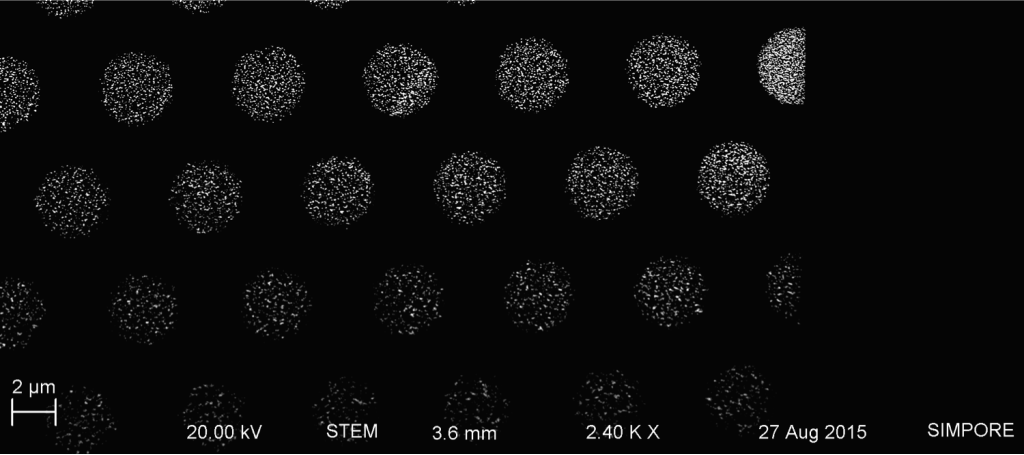
Micrograph 1: Lower magnification image of membrane field showing micro-nano pore pattern
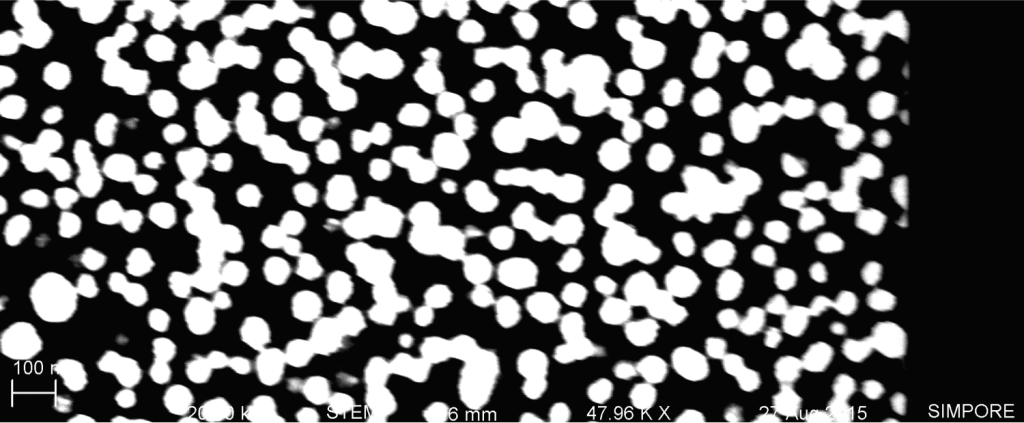
Microgrpah 2: High magnification image of nanopores. Note the nano-pores are a bit larger than desired due to RTP cycle used.
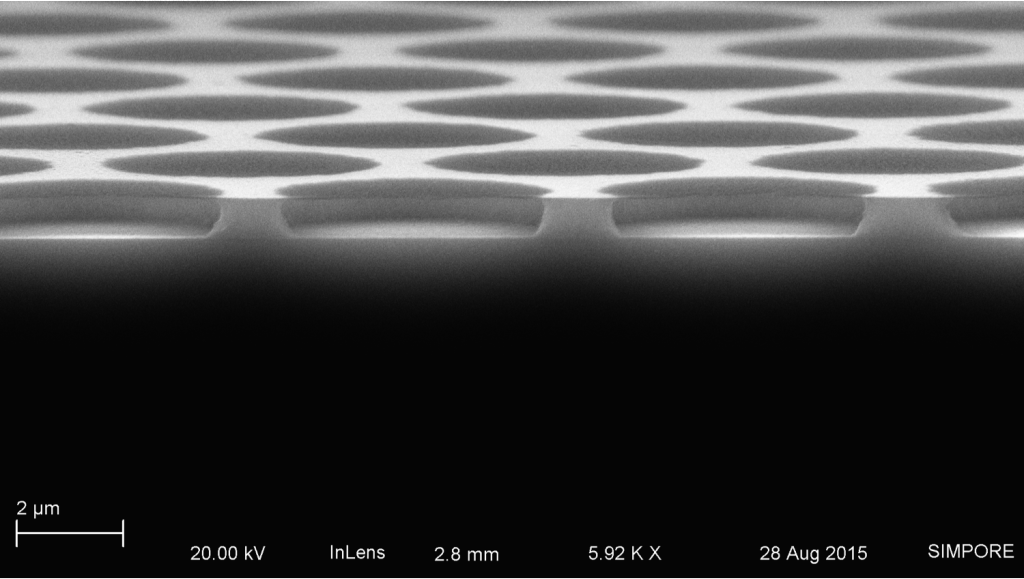
Micrograph 3: Tilted image of sample showing etch progress after just one XeF2 pulse. The ~1 µm sacrificial poly-Si layer is etched away in the micropore regions.
Nice imaging! I cannot recall the tradeoff with the lower temperature for pore formation; does it impact porosity while keeping lower pore sizes? The RIE certainly blows out the pores, but I think keeping the NPN layer free of the pnc-Si template is more important. Lower porosity template material means that it’s easier to enlarge the transferred pores without merging adjacent pores together (as seen in Micrograph 2).
Has anyone tried ozone bonding silicone to this material yet?
Greg, you are correct. The caption under Micrograph 2 is mis-leading. Back when Josh W. and I were working on the RTP we ended up switching 6″ wafers to 1050C (vs 1000C) because we were not getting sufficient porosity. Now, I believe its over compensating, and we can handle the lower porosity of 1000C, pore size should be relatively unaffected. Further, if we adjust the pressure on the RIE, we may be able to reduce the swelling of the pores, but I think both approaches will be necessary.