Surface-Charge-Dependent EO Pumping Behavior Persists (weakly) at Low Applied Voltages
In a previous post (link) I presented a video that showed that the voltage applied to a silver film changed the pumping behavior of a membrane. The key data is summarized by the following powerpoint slide:
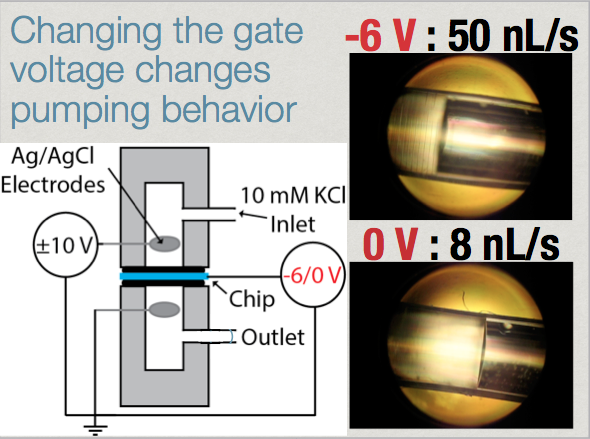
My most recent post (link – electrical characteristics…) showed, however, that the breakdown voltage of these silver and alumina NFTs is 5.8 V +/- 1.0 V. If -6 V is applied to the gate and +10 V to one of the electrodes, that’s a voltage difference of 16 V. I almost certainly popped these chips. The change in pumping behavior is probably due to the fact that the membrane is acting as an electrode. The fact the pumping was directional is also explained by that – the silver film is only on one side of the membrane, meaning that it can only pump in one direction. Further supporting the idea that the dielectric had broken down is the fact that I saw virtually no difference between an applied gate voltage of 0 V or +6 V. In my previous post (electrical characteristics…) charge only leaked out of the membranes when a negative voltage was applied.
I realized that my electrical characterization negated the key slide from my BMES talk on the walk to the airport on my way to Texas. Since further experimentation was out of the question and I needed to show variable EO rates, I dug up an earlier video (described in this blog post – link) that saw a similar effect at applied voltages less than the breakdown voltages of the chips. I really liked the high voltage data because you could easily see the effect just by watching the video, whereas the low voltage case needed some elaborate image processing to reveal the voltage-dependent pumping rates. But after several hours in illustrator with the measure tool, I generated the following data:
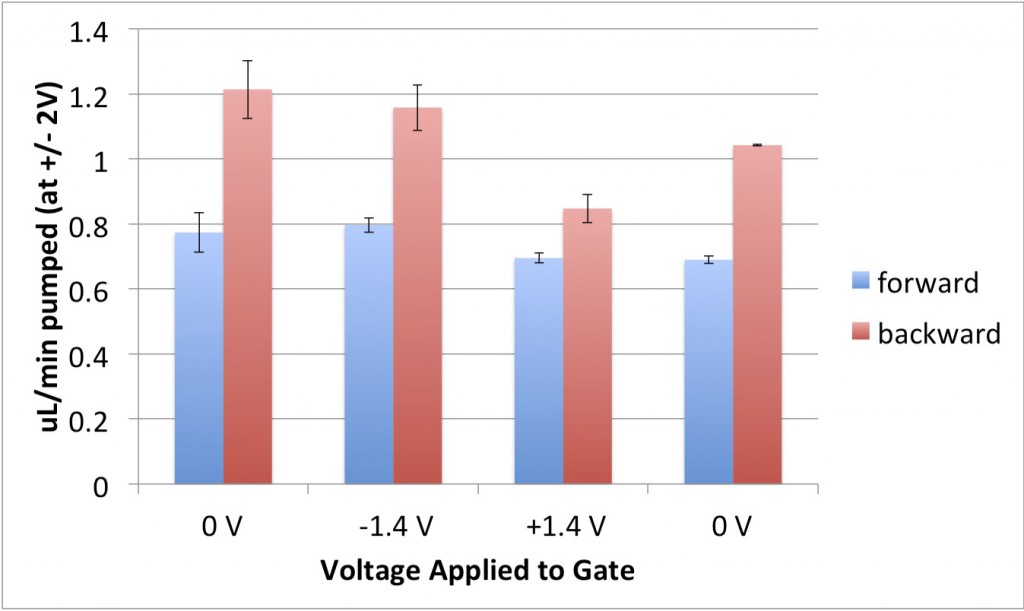
The spreadsheet makes more sense if you take a look at the video it was generated from:
The excel spreadsheet used to generate this data is linked here: (EO NFT pumping rates)