Peclet Number Analysis Update
With changing my channel height to attempt to lower the Peclet number, one important factor that is affected is the transmembrane pressure. Decreasing the channel height will significantly increase the transmembrane pressure, which may stress the membrane and cause it to break. However, in addition to changing the channel height, I will also be changing the flow rate and decreasing it by an order of magnitude. This will cause the transmembrane pressure to decrease, but the question still is whether or not it will be enough to not stress the membrane.
As I had stated on Thursday, I have a Matlab model of the device and the pressures and resistances that we expect to be found in the device. This is basically a circuit model which models the pressure drop as a function of flow rate and resistance, which is a fluid analog to Ohm’s Law. Figure 1 shows the system on the left and the circuit diagram on the right.
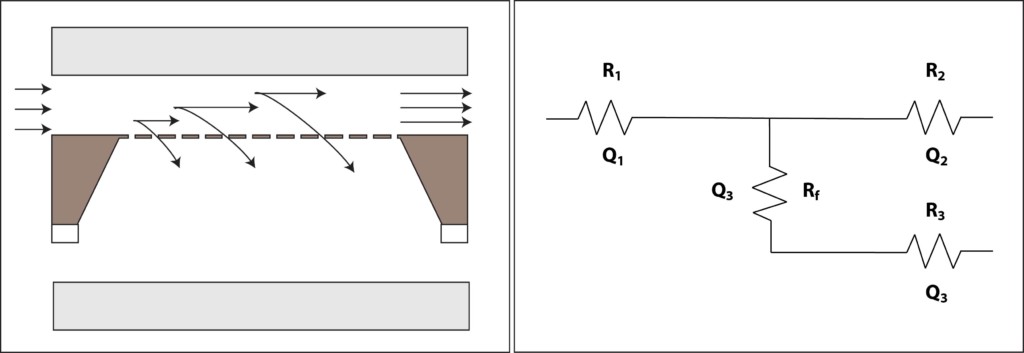
Figure 1: Left) Simple schematic of the tangential flow system. Right) Circuit diagram of fluid system, analogous to Ohm’s Law.
We can therefore take this system and solve for the flow rate across the membrane, and thus the transmembrane pressure. The flow rate across the membrane is given by:

where the given pressure difference is the pressures at the outlets. In the case of this system, that pressure is atmospheric at both ends, and therefore cancels out. However, to increase the transmembrane pressure we can add a reservoir at each end to drive the pressure in the direction that is desired. To then calculate the transmembrane pressure, this flow rate can be inserted into our fluid analog of Ohm’s Law and we get:

where the resistance of the filter (membrane) is calculated from the permeability data in DesOrmeaux et al. (2014). The other resistances are the channel resistance and the tubing resistance combined in series and can be calculated by the combining these two resistances. Plugging all the known information in gives the following plot of transmembrane pressure as a function of flow rate:
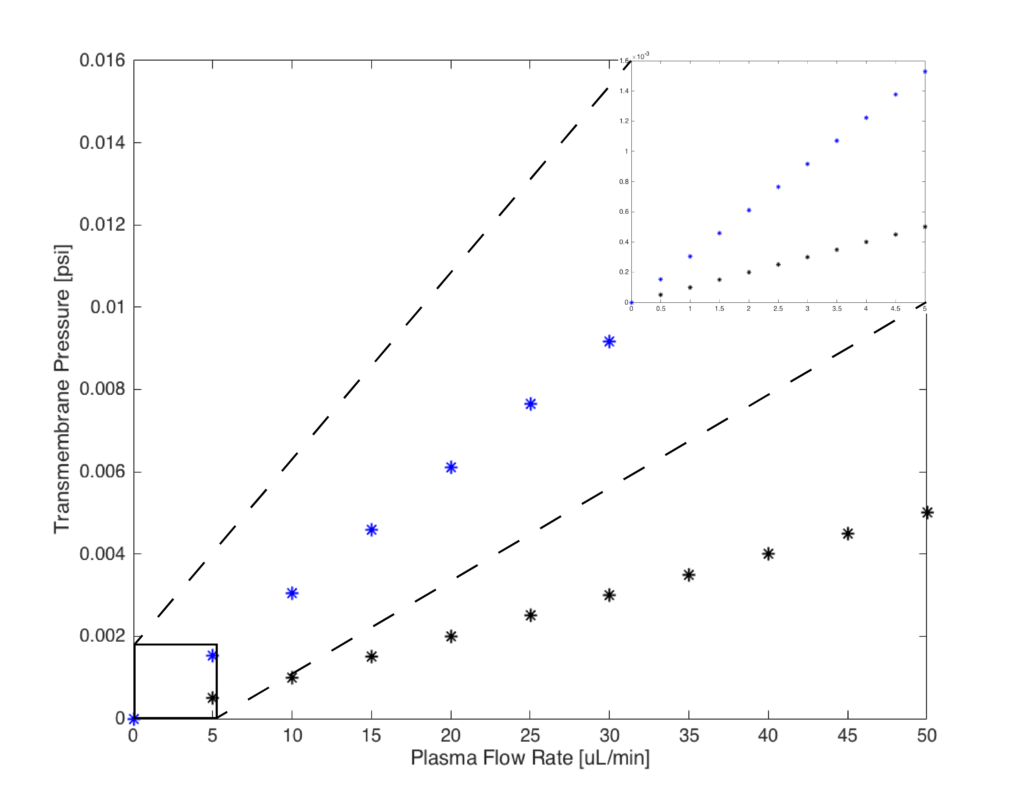
Figure 2: Transmembrane pressure as a function of inlet flow rate. The normal operating flow rate that I have been using is 10 microliters/minute, I am now proposing to reduce that to 1 microliter/minute. The blue stars are the 50 micron top channel and the black stars are the 100 micron top channel.
Decreasing the flow rate will decrease the transmembrane pressure by almost one order of magnitude, which is a very large reduction. Whether or not this will significantly affect the capture remains to be seen. I am currently working on a force balance to analyze what will cause the exosomes to remain captured in the pore at a given flow rate and this will provide more insight as to whether the transmembrane pressure generated at these conditions is enough to sufficiently retain the exosomes.