Compatibility of Aquamarijn Membranes in the SepCon Devices
The SepCon filtration devices represent an innovative housing solution for Silicon Nitride membranes utilized in the filtration of microparticles and nanoparticles. In assessing compatibility, I conducted a test to evaluate the suitability of Aquamarijn’s microsieve membranes with our existing SepCon devices used in microplastic research.
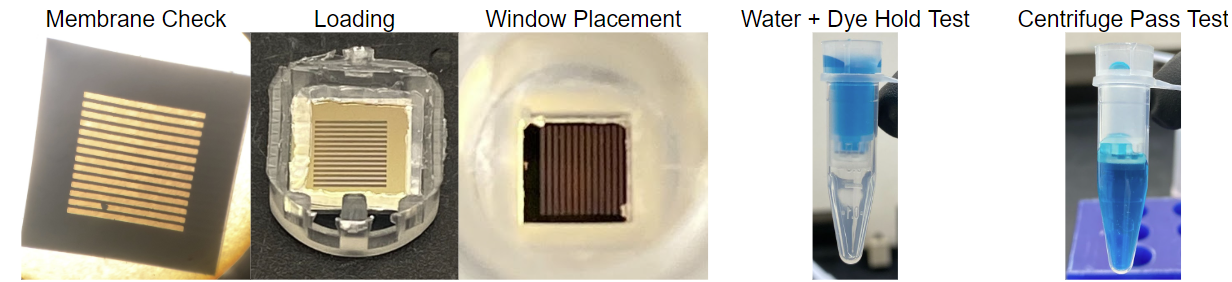
In the initial experiment, a standard SepCon assembly and filtration process were executed, outlined in Figure 1 below. Prior to loading, a thorough inspection of the Aquamarijn membranes was conducted to ensure the absence of any damage. Subsequently, the membrane was carefully inserted into the bottom component of the SepCon device, followed by securing the top component into place. Verification of window placement and quality ensued. The assembled SepCon device was then immersed into a conical tube. To verify membrane integrity and the absence of leaks, a mixture of water and blue dye was introduced onto the top of the SepCon device. Upon confirming leak-free performance, the SepCon underwent centrifugation using the “Quick” setting for 4 seconds. Centrifugation resulted in the complete passage of water through the filter, indicating comparable functionality between the Aquamarijn and SiMPore membranes.

Figure 1: Open window test to check for normal filtration
To determine whether water was really being filtered through the membrane windows rather than leaking from their edges, another closed-window test was conducted. Utilizing the same membrane from the previous experiment, a layer of 3M 300LSE PSA was applied over the membrane windows to seal them off, as depicted in the loading image in Figure 2 below. Subsequently, the membrane was reinserted into a new SepCon device as previously described. Upon confirming that water was retained atop the membrane prior to centrifugation, the SepCon underwent centrifugation once more.
As anticipated, this time the water did not permeate through to the bottom of the SepCon. This observation conclusively demonstrated that the passage of water previously observed in Figure 1 was indeed by the membrane windows themselves, rather than water leaking from the sides of the device.

Figure 2: Closed window to check for side leakage
For the second experiment, the PSA did not touch or cover the gaskets, right? I want to make sure you left those exposed so that we were testing the integrity of the seal against the chips.