Silanization and Membrane Chemical Stability
Due to our desire to improve membrane stability in cell culture, different methods of treatment have been mentioned to try, including carbonization and silanization. W606 was treated with UV/ozone at 150C for 20 minutes, followed by silanization performed by some of Chris’ colleagues. I then ran a basic discoloration test in DMEM +10% FBS (the harshest media we have tested) against untreated controls. The results are shown below.
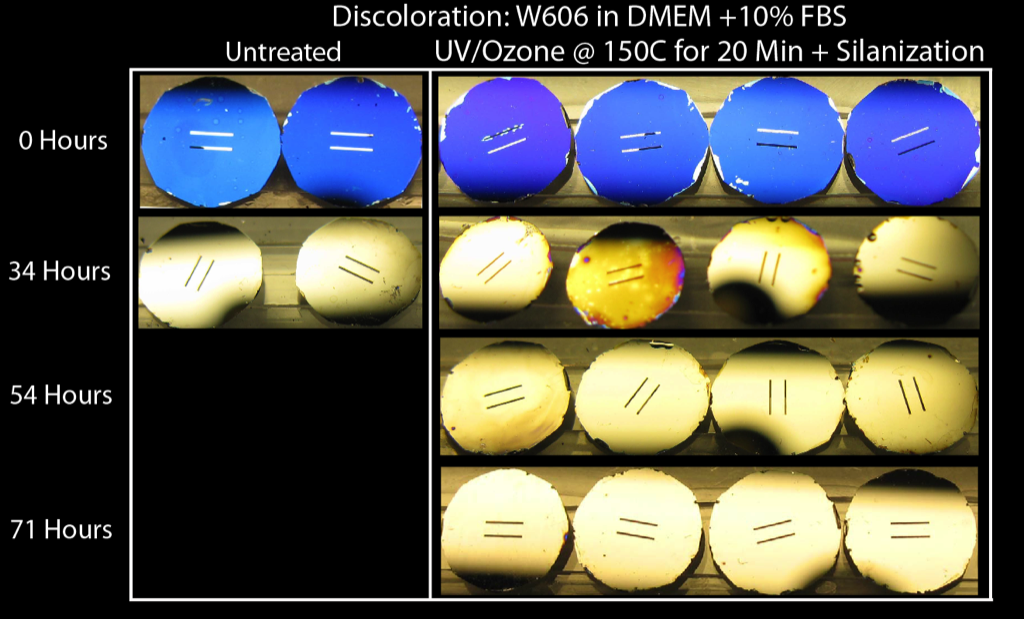
Disappointingly all samples discolored within 34 hours regardless of treatment. I thought we hypothesized that silanized membranes should last… maybe some problems arose during silanization or other factors led to the poor performance. I think it is a good idea to try silanization again to make sure this experiment was not just a source of procedural error.
As a procedural note: samples were UV/ozone treated and silanized on the same day. The test was then started about 36 hours after silanization, with the samples stored in a gel box on the bench. I also did not clean the samples with ethanol or methanol, as I was unsure what that would do to the silanization. The membranes were only exposed to DMEM prior to 34 hours. Prior to imaging samples were gently rinsed in deionized water and 70% ethanol, then dried with air (this is our usual procedure for imaging). Barrett helped with the 34 and 54 hour time point images over the weekend.
What about the UV/Ozone but not silanized samples? Should these have lasted longer?
I forgot to have a UV/ozone control for this experiment, but as shown here UV/ozone performed similar to untreated samples.
This is not completely unexpected. Solution-phase silanization is known to be unstable, and this is why we are looking at buying the new YES vapor-phase system. I see no need to repeat this with amino-silane, but if someone wants to try another silane, perhaps with a negatively surface charge, that may be worth a try…