Comparing TEER values from microfluidic device with transwell
I spent some more time in understanding the numbers I am getting for our device simulations. In my simulations, I am assigning a conductivity value for my cell layer. Technically, from this information and by knowing the thickness and area of the cell layer, I can analytically calculate the value of resistance that the cell layer will offer.
This value will be, however, valid only in the case of uniform electric field, which is satisfied only when I have 100% active area. The back-calculated values are always higher than what I assign them to be. Thus this process allows me to calculate the “overestimation” I am doing. This overestimation is also an indicator of the error involved if we assume the length and area of the cell layer ideal, and prohibits us from multiplying with the total area cells occupy.
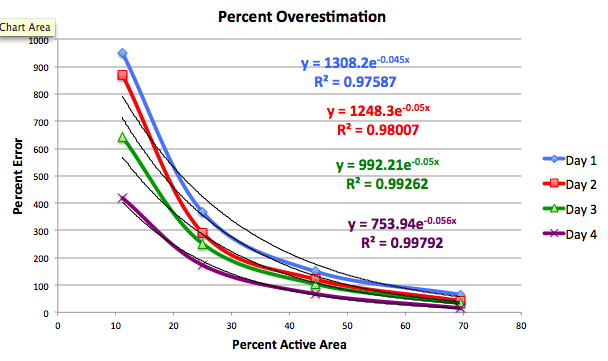
I found this perspective useful. We can notice that error gets lesser as the days increase; as the cellular resistance gets dominant, geometrical asymmetries get masked down. Also as the active area increases, the error reduces significantly. For my device, I can realistically achieve ~50 % active area by designing gasket sizes appropriately.
Not shown above, is the error for 100% active area configuration; the error is actually zero, since the system then completely reduces to ideal Ohmic configuration, and superposition helps to predict the exact value of the cells that I assign them in the first place. I took the values for 100% active area and compared with the ones I obtained from a transwell simulation.
(All the values shown here are after background subtraction, i.e. for cell layer only.)
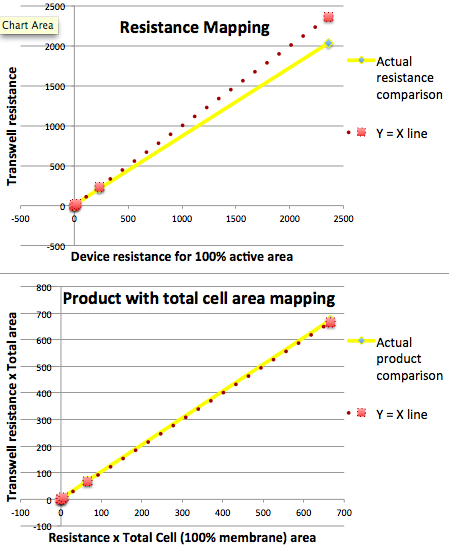
The resistance for my device is slightly higher than what I get from transwell. Upon multiplication with their respective cell areas, I get almost similar values (look at the overlap in the ‘product’ graph). It was bit surprising, since although my device is now Ohmic, the transwell isn’t; but maybe the background subtraction takes care of that (the overestimation error was negligible for transwell setup somehow!)
So this is the proposed experimentation: I am going to make my device with planar ITO electrodes and prove that the resistance of the system plateaus asymptotically to a lower value as I increase the active area. I will be repeating the same for transwells and comparing if we can get similar comparative trends, if not the actual numbers. This way we can confidently claim that our simulations make sense, and also prove the point that multiplication with active area doesn’t give a constant value.