SiO2-deposited discoloration
Last week, Lingyun and I deposited 30nm SiO2 onto both sides of wafers 335, 341 and 345. Unfortunately, these wafers weren’t in too good shape, so there are only a few intact slits without pinholes. I then took a few chips from each wafer and did RTP (800C, 5 min, Ar). I’m doing discoloration studies on these chips now in DMEM+10% FBS in the incubator. The control is an untreated ship from w334. Here’s what I have so far (there is a duplicate experiment underway).
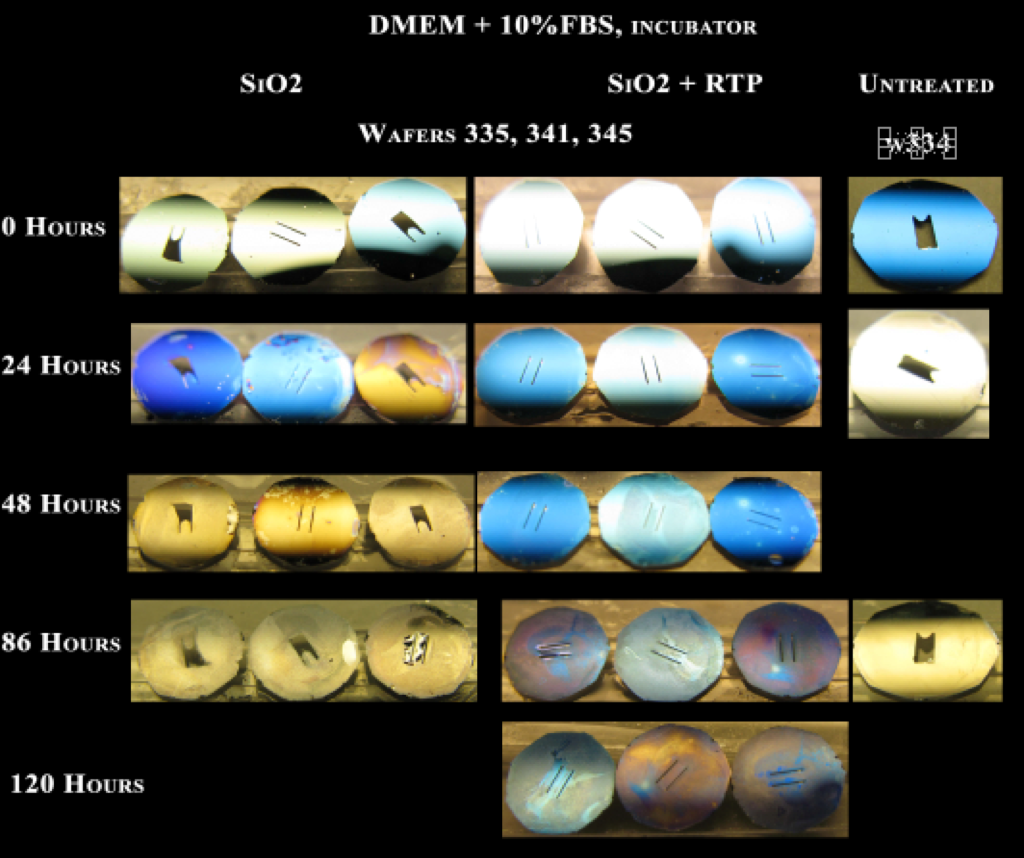
A few things are noteworthy – the 30nm SiO2 layer alone helped slow the discoloration but only by ~ 1 day. Disappointing. RTP’ing the SiO2 layer improved the stability quite a bit. After 5 days, discoloration is just starting. However, the surfaces of the SiO2 and SiO2-RTP chips look bumpy – the SiO2 layer is undergoing some strange transformation. Any ideas? Also, the SiO2-deposited chips don’t start out as brilliantly blue as untreated chips – see the 2 chips at 0 hours under SiO2 treatment. The third chip in that picture is blue and it discolored after 1 day. I would guess that the SiO2 did not deposit well on this chip for some reason.
Here’s a couple of larger pictures of the discolored membranes:


UPDATE (Aug 13 08)
Karl and I decided that this bumpy stuff is actually bacteria that is semi-fixed to the chips. The bumps looked like bacteria in the reflection scope and I was able to wipe off this stuff with kimwipes. They are “semi-fixed” due to the ethanol rinses that we do in order to ensure fast sample drying and to try to maintain sterility. I stopped this experiment due to the bacteria. The layer of bacteria on the samples didn’t protect the SiO2 chips from discoloring, so SiO2 deposition+RTP creates one of the most discoloration-resistant chips we’ve seen.
What is the weirdness in the center of the 3rd brown sample in the 2nd image? Is that a membrane or something pealing off the surface?
Also, the samples look very dirty when they start to discolor – I assume this is the bubbling that you mentioned?
Were these RCA cleaned or cleaned in any way prior to deposition? Wafers that have been sitting out for a while are rarely deposited on without a clean, for the reasons that we discuss all the time – water and organics just build up over time.
Didn’t we try this before and it worked fine? Does anyone remember an experiment like this in the winter or something? Am I confused?
The weirdness is some water or ethanol that I didn’t dry completely.
The dirtiness is the bumps that I mentioned – likely bacteria.
I’ll have to defer to Lingyun to see if any cleaning was done before deposition.
This was done and posted on March 17th, although only a 5-day timepoint was measured and it was done at room temperature.