Water transport in Electrophoretic Cell
I’ve tried to get some more data for the phenomenum that may be electro-osmosis in our electrophoretic cell. In the last post I looked at the rate of passage of 1x PBS in pinhole membranes from w621. After that I first tried to see if DI H20 would also work (also pin. At 15V (which was what I was running all of the previous experiments), the power supply wasn’t reading any current. I raised the voltage all the way to the maximum 99V, and it still wasn’t reading any current. I took the positive electrode out of its well, and moved it over to the same well as the negative, and there was a little bit of electrolysis happening at the wires at 15V, and just barely 1mA of current.
In the diagram below, basically in the case of DI H20 it looked as though A. didn’t work but B. did. So this may be due either to membrane resistance or distance between the electrodes.
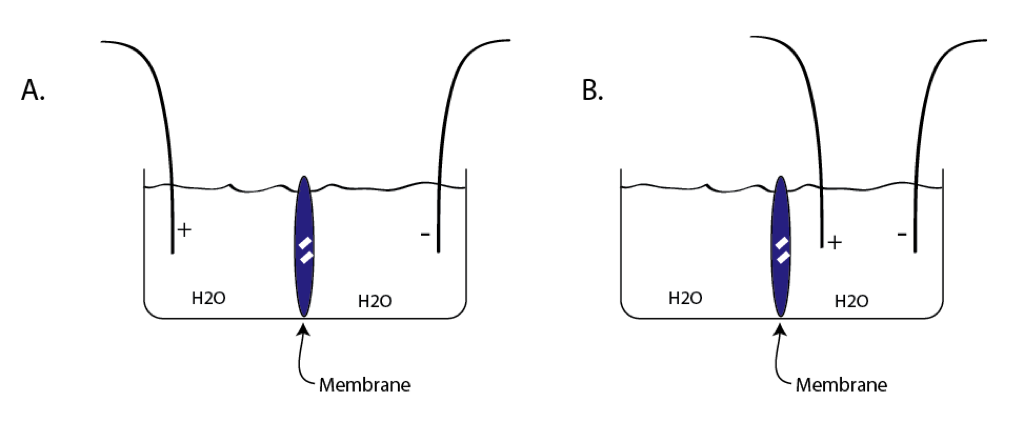
So I removed 50uL from each of the wells and replaced it with 1x PBS, resulting in about 1/8x PBS in the system. This showed 1mA for 15V and electrolysis was visible. I checked the passage of fluid in this setup. I then raised the concentration to 1/2x PBS in the same setup and checked the passage. In all I looked at 1/8x PBS, 1/2x PBS, 1/8x PBS, 1/2x PBS in the same system. Results are posted in chart at the end of this post.
I then tested an intact membrane from w639 with 1x PBS and at 15V and 5mA. I did see water passage, albeit a little slower, but this shows that pinholes are not creating the phenomenon. The intact membranes appear as dotted lines on the following chart.
Finally, I went back and decided to give water another whirl. I turned it on to 15V and let it run while I stepped away to do something else even though there wasn’t any current being read by the source. I looked back at 15 min, and noticed little bubbles on the wires and a height change of 20uL. So DI H20 actually works, but it’s much slower.
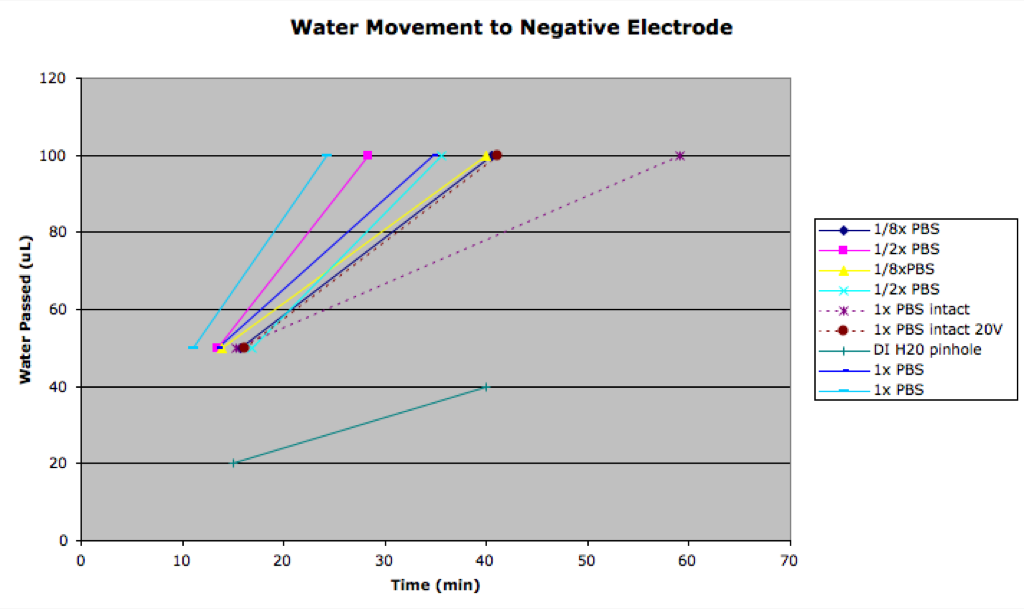
Note: I tried this with a broken membrane and there’s no change in height.
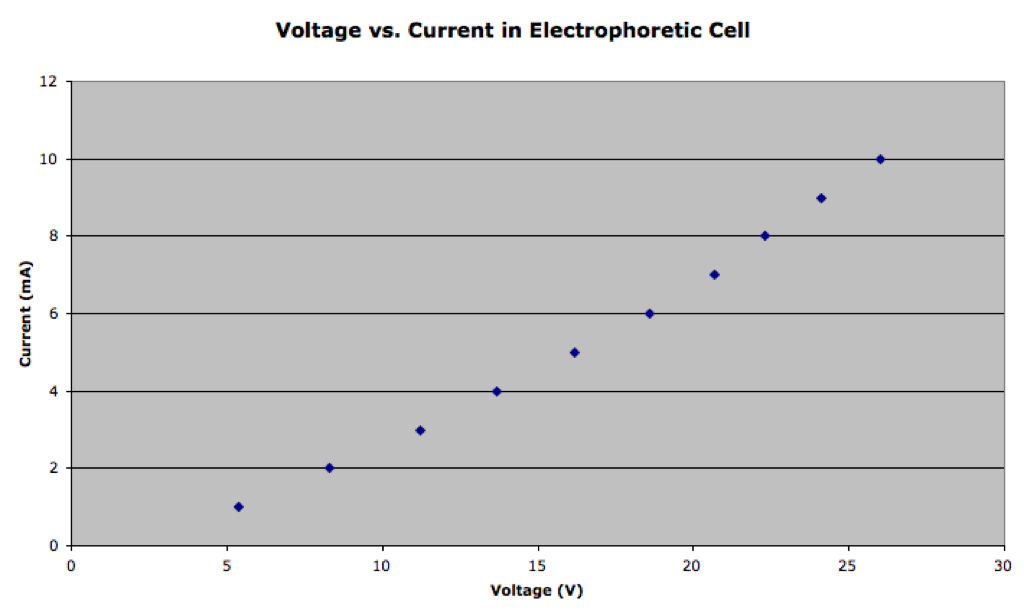
I’d like to also add a little chart I made up showing the relationship between voltage and current for a pinhole membrane with 1x PBS. I’ll try to do this with the other membranes and solutions as well.
I needed the no membrane control to appreciate the role of the membrane in the phenomenon we are seeing. These results amaze me. I don’t know if they would be surprising to the world or not. At the very least they provide evidence that we have charged pores, not just charges near pore entrances. But the impact of these findings might be much bigger. Please find the proper theory for electro-osmosis to discover if increased channel length slows the flow (it must couple in either through the fluid mechanics or the V-I relationship). If so, our flow rates might be off the charts compared to anything folks have seen before in electro-osmosis. If we can create these flows without denaturing proteins, this could become the preferred way to do filtering through pnc-Si. Wow.
I went back a skimmed the references from the NER application. Electroosmosis in long nanoscale pores (PCTE) was observed and studied by Sweedler and Bohn. However, work in thinner alumina-filled microsieves by the Dutch did not exhibit any EO. This is something we touched on briefly in the grant.
These papers are difficult to quantify, so I suspect our flow is much faster, and there are likely other advantages that we can speculate on. So EO in nanoscale pores is not new, but it is likely unexpected in a material as thin as ours, and flow is likely much higher. The obvious advantages of an ultrathin material carry over as well. There may be clever ways to enhance this transport given our geometry as well.