High resolution TEM images from Hitachi
Jamie asked me to post these images of our membranes taken by Dr. Xiao Zhang from Hitachi. They used a 300 kV tool to acquire these micrographs.
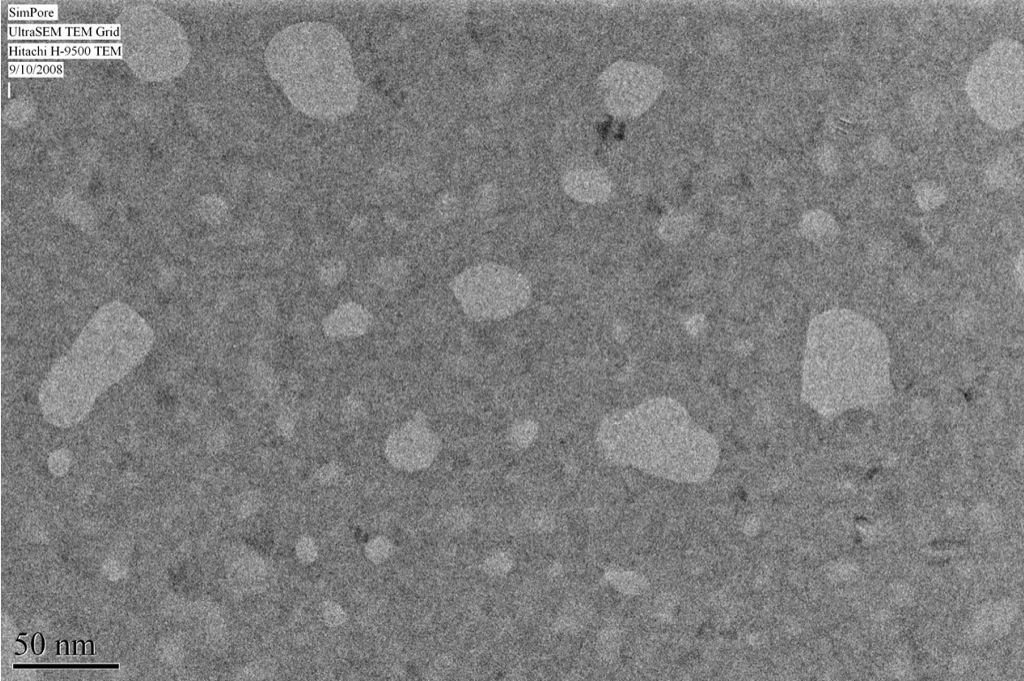


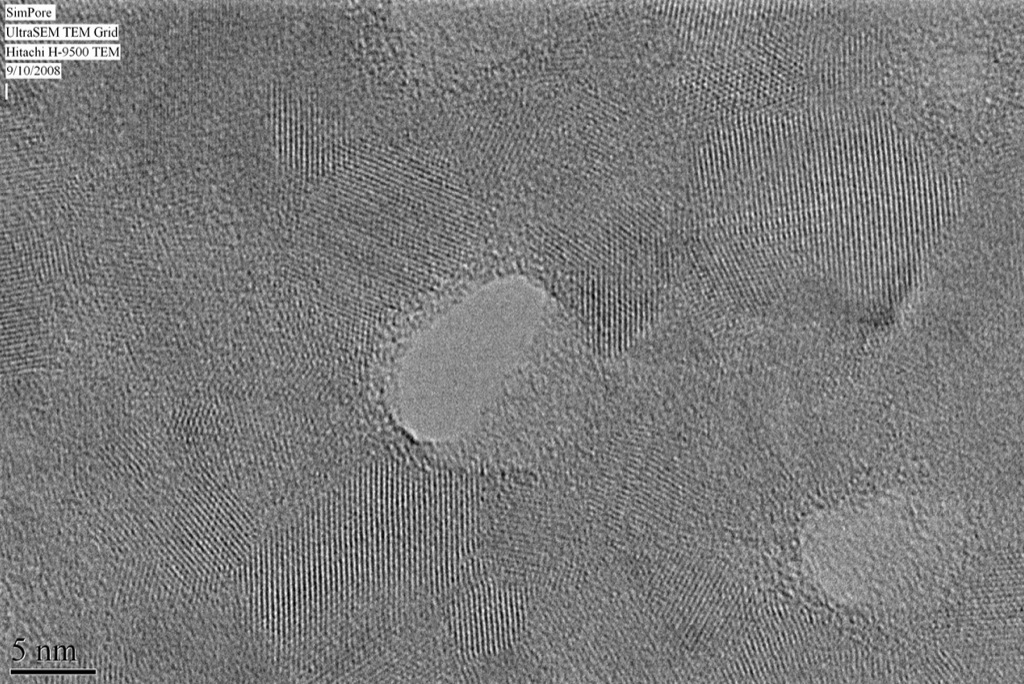
The spacing between the atoms (striations) tells us the crystallographic orientation; most of the nanocrystals we see are in a (111) orientation. It’s interesting that the perimeter of the pore looks amorphous. We also have confirmation that it’s possible to have a partially occluded pore. A lot more can be learned from such high resolution imaging such as growth mechanics. Exciting!
NOTE: Please do not distribute these images without permission from Xiao Zhang and Hitachi.
When you say partially occluded pore, are you referring to a non-through pore or some sort of overlapping crystal?
Maybe both.
The second image from the top shows a “circular” pore with an amorphous ring around the entire perimeter. This is what I would call an open pore.
If you look at the third image from the top, you can see that a crystal has grown “into” the top portion of the pore. The bottom part of the pore has amorphous material at the boundary and a larger crystal next to it.
The last image shows the pore surrounded by amorphous material but the ring is thicker in the SE region.
All these things may be clues into understanding the different “phases” of our pore formation process.