New wafers – discoloration
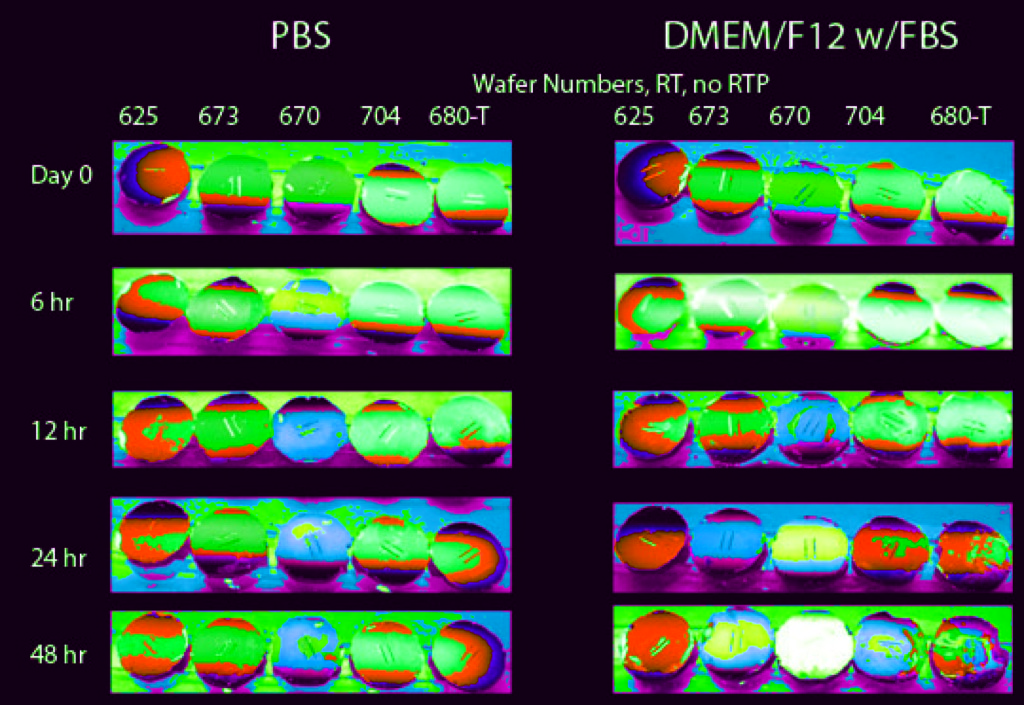
Since Jess saw discoloration last week within a day in PBS with the new material, I did a couple of discoloration studies this week. I looked at wafers 670 and 673 and compared them to 625, 704 and 680-T. These were not RTP’ed, I did the tests at RT since that’s the temp diffusion studies are done at, and I looked at PBS and DMEM/F12 with 10%FBS cell media.
Notice that 670 and 673 start out more purple than what we’ve been used to seeing (also, they are slightly different shades of purple from each other). In PBS, only 670 discolored. This happened within 6 hours, but then it stopped discoloring, even out to 2 days. In cell media (which is harsher than PBS), 670 and 673 discolored quicker than the other wafers, with 670 discoloring the fastest. For some reason, 670 didn’t discolor until 12-24 hours compared to 6 hours in PBS. So it seems like 670 is much different than “recently normal” wafers and 673 is intermediate between old and 670 material. The PBS result (670 started then stopped discoloring) could be explained by a contaminant leaching out of the silicon and causing discoloration until it has completely diffused out of the silicon.
Just to be sure, I repeated the PBS experiment with 670, 673 and 661, again at room temperature without RTP. w670 discolored sometime between 12 and 24 hours, but 673 and 661 did not.

Which # are post-rebuild and which are pre-rebuild?
And what is so magical about w625 that it does not discolor in DMEM?
To answer my own first question: 670 and 673 are post re-build and all the others here are pre-rebuild. So this isn’t a sufficient test of the sputterer re-build on PBS stability – we need more new material tested side-by-side with old. This is a repeat of Jess’ uncontrolled study with some old controls – and that is good – but we should be looking all the new stuff that is coming out. This is a top priority for this coming week. We should also get the old AJA material thrown into this test – even if its just part of the frame. The question being tested is if the ‘pure’ material we are starting to make is inherently less stable than the ‘impure’ material we’ve been making all along.
So I am still not going to accept that we are making useless material unless we surface treat. 670 is very chemically unstable, but it might be an anomaly.
Remember Dave said wafers ‘dated’ past 9/17 are post-rebuild. Use the wafer summaries to get the dates. Some of the recent stuff was deposited long ago and etched recently so it appears ‘new’ to the lab but isn’t post-rebuild. Then there is the problem that newly deposited stuff sometimes really does has older wafer numbers and older depositions have newer numbers. I don’t understand why this happens. For trouble shooting, it would be best if we could keep the numbering chronological.
670 is not the first wafer to discolor in PBS. I spoke with Jess and she saw this same type of discoloration in PBS on wafer 265 (from the Nature paper). Also, I am positive that Joe saw discoloration with PBS in wafers 264 and 265, from the Nature paper, as he consumed all the remaining wafer frames of this material during his first summer here. Unfortunately, this data seems long gone. If anyone wants to, I could probably find some of the original Nature material, but there is very little of it left, if any.
670 is a recent anomaly, but not a historical anomaly. I think we have just come full-circle.
Still, we have never produced any membrane that I would call chemically stable. We’ve just been walking a tight rope, with a day or two of stability here, a few days there. For any experiments that take a few days, we really need a material that shows no discoloration at all for well over a week. Otherwise, the material is under constant attack and is therefore changing during the experiment. Keep in mind that the chemical attack starts long before we can observe a color change, it’s just a matter of how much variation an experiment can deal with. I think all our material is fine for SepCon experiments, some is OK for diffusion, but I can’t see any of this being stable enough for consistent multi-day cell culture on membranes….yet.
Please do find some of the original Nature material. We don’t need much. This would help us test the hypothesis that pure material is unstable for < 1 day in PBS. We should be able to see the ‘full circle’ in this study.
I’ll look for Joe’s old notebook. I don’t recall Joe doing anything but cell culture media his first summer with us, but I can’t be so sure. In the second summer we tried all kinds of buffers – but only one wafer.
Not sure what the story is with w625, but it does seem to be discoloring a bit at the last time point.
I’ve been having a hard time keeping straight which wafers are pre-build or post-build. I vote for a chronological system, as well.
If you look at my discoloration wiki, or Joe’s summary, there is no evidence of dramatic discoloration in PBS. There is some variation of course, but more often than not, discoloration in PBS doesn’t occur for several days.