HUVEC in Sepcons
I’ve been doing some preliminary studies with HUVEC in commercial transwells and on pnc-Si in the Sepcon/transwell hybrid format. The thinness of pnc-Si will enable better microscopic examination of cells than other membrane systems (if pnc-Si is flat). I thought it would be interesting to compare commercial transwells to the pnc-Si “hybrid transwell” format in 24-well plates via phase-contrast and fluorescence microscopy.
I imaged HUVECs (10x) one day after seeding on commercial polyester (PE) transwells, commercial polycarbonate (PC) transwells (the most common type) or pnc-Si transwells. For fluorescence, I stained cells with 10uM CMFDA. Keep in mind that these are live cells on membrane surfaces that I’m imaging through the bottom of polystyrene multiwell plates, so this is far from ideal imaging conditions.
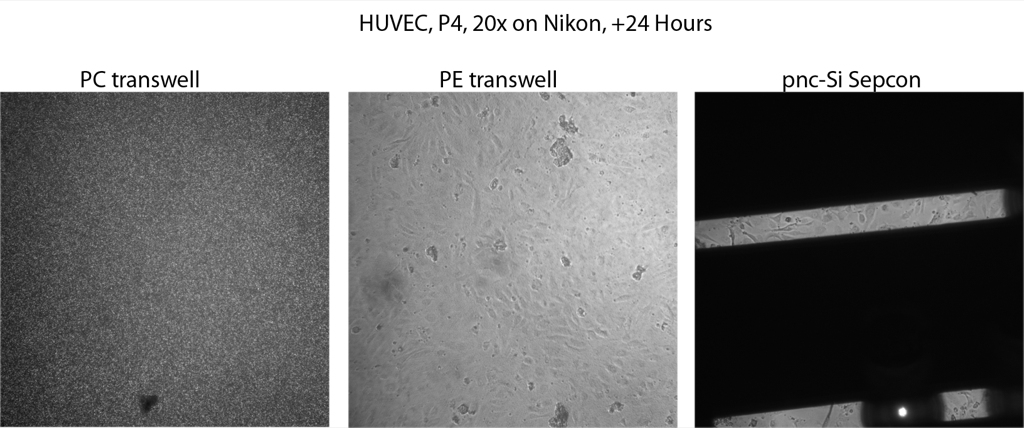
The polycarbonate membranes are so opaque that you can’t even see cells growing on them. HUVECs are faintly resolvable on the PE transwells. Subcellular features of HUVEC are clear only in the pnc-Si Sepcon format, so I would argue that pnc-Si Sepcon transwells afford the best resolution for routine examination of cells grown on transwell membranes in multiwell plates.
CMFDA:
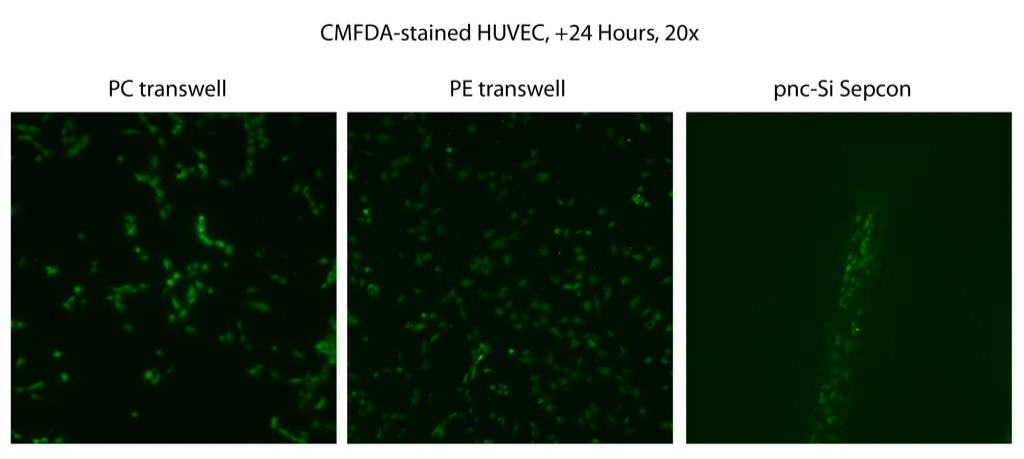
I could not focus on HUVECS which were on the PC membrane. This is probably due to a combination of the membrane thickness and its opaqueness. It looks like the resolution in PE transwells and pnc-Si transwells is comparable.
The transwell format is not suited for high resolution microscopy because there is a millimeters-wide gap from the membrane to the bottom of the multi-well plate (plus, multiwell plates are plastic). Our Sepcon-transwell hybrid will not overcome this shortcoming. However, it’s certainly advantageous to be able to visually track cell growth, etc. in transwells during routine culture.
I thought autofluorescence was a problem with the polymer membranes? Doesn’t seem to be the case here.
I thought so, too. It might be more significant with different fluorophores.
We know that both PES and cellulose fluoresce very strongly in rhodamine and FITC channels.