Cell viability – XTT
XTT is a colorimetric assay for measuring cell viability. Supposedly, it gets taken up by cells and is reduced by mitochondrial activity intracellularly into water-soluble orange formazan crystals. The readout is the absorbance of these orange crystals.
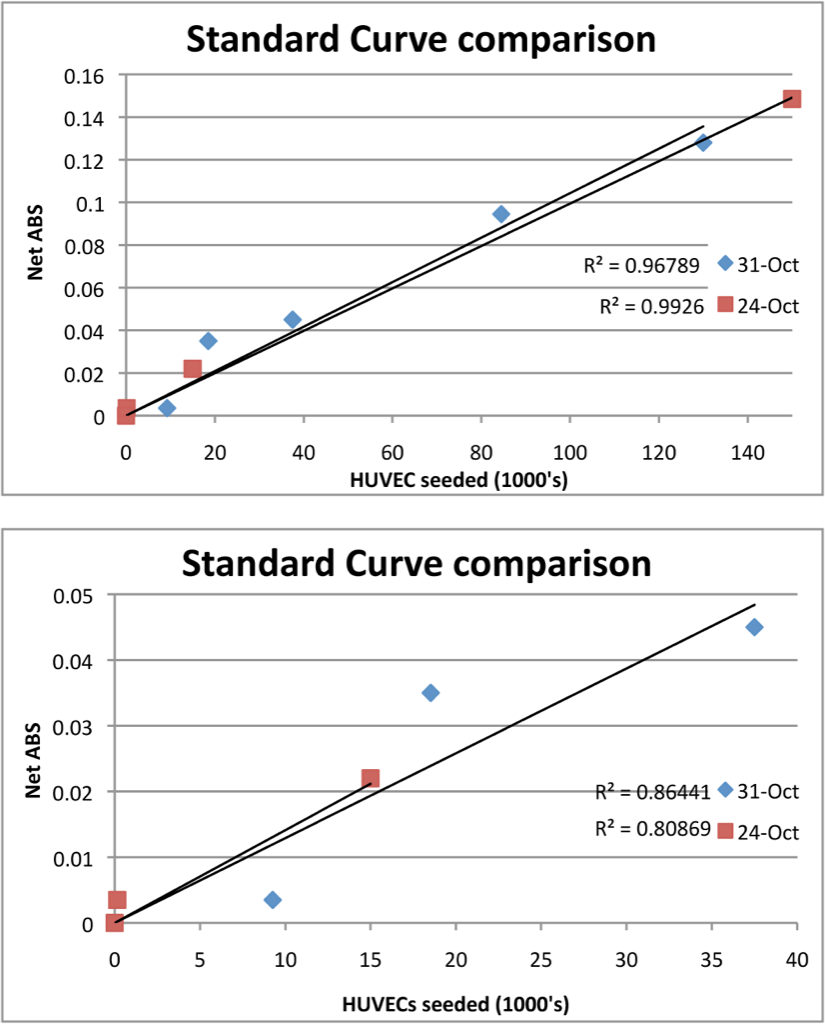
I used XTT to get standard curves of HUVECs in 24-well plates first. Here’s the data from 2 different experiments. The first graph is the entire experimental range, and the standard curves are fairly linear. Net ABS means that I’ve subtracted out the background ABS from wells without HUVEC (accounts for any absorbance from XTT itself, media components, etc). For the surface areas of pnc-Si and 24-well transwells, people tend to plate between 10k and 50k cells. So, I zoomed in on the standard curve to this range. Unfortunately, the linearity of the assay isn’t too good in this range.
I also did XTT assays with HUVECs on commercial transwells and pnc-Si transwells. The solid blue line is one of the standard curves from above and the transwell samples are columnar data.

The blank transwell and pnc-Si transwell have less than background ABS. I didn’t detect the cells (either 18000 or 38000) that were plated on either device. As reported by other groups (Anant presented one of the papers the other week), pnc-Si alone did cause XTT reduction. Based on the standard curve, this is equivalent to ~ 15000 HUVECs. This doesn’t make sense considering that pnc-Si in the Sepcon format had less than background ABS. Basically, I don’t have much confidence in this assay to measure cell viability in pnc-Si Sepcons. I think the cell numbers just might be too small to be in the robustly linear range of the assay.