Porosity vs Discoloration I
We have known, W683: no visible pores; W684: very few pores; W685: usual porosity.
After Vlassak’s view on discoloration, I took samples from above wafers to check if any difference in discoloration can be seen as they have different porosities. We could expect the more porous material to degrade faster than the less porous and thus discolor quicker.
Conditions: Oven @ 37C in DMEM(-FBS), no RTP.
After 3 hours in 3D: Both slits of #683 were intact; there were small cracks in #684; both slits disrupted in #685.
[PS: Once the samples are out to take discoloration pictures, its difficult to keep the membranes intact (if any). So after the 3 hour time point, the membranes are anyway broken.]
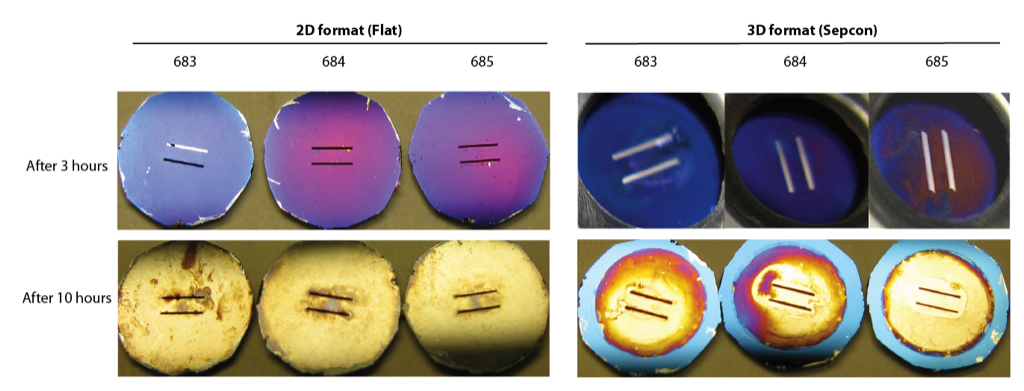
As expected, the more porous sample discolored faster than the sample with less/no pores.
Intriguing.
Please explain the environmental conditions. We see 9 days w/o discoloration in some posts and 3 hours in others. I think its because we intentionally accelerate discoloration by doing some of our studies in the oven, but don’t leave us guessing!
I have updated the post Jim.
These are the same results the Bernhard Group found a couple of weeks ago (here’s the post). I gave them samples from 683 and 685, and discoloration happened much quicker on 685. However when we discussed these results in the meeting, we decided that 685 only had background pores – so it’s not really more porous than 683. Importantly, it also seemed that 683 was more amophous in character than 685, and this may be related to the difference in discoloration more than porosity.
To increase the throughput of data acquisition, we’ve switched to the oven mainly.
I don’t know if it’s really an effect of amorphous vs. crystalline because Nakul’s post showed that amorphous wasn’t that much different from the other samples he tested.
Also the Bernhard group tested them in flat format, whereas I did these in Sepcon as well.