Electroosmotic Theory
This is something that’s been living on my knowledge page, but I think it’s a good idea to put it up here to get some discussion on it.
Probstein gives the following equation for electroosmotic velocity in his book Physicochemical Hydrodynamics:
U=-εζE/μ
where U is the velocity, ε the permittivity, E the electric field, ζ the zeta potential, and μ the viscosity. Probstein then goes on to write that if you are given a typical zeta potential of about .1 V, a field of 103 V/m, viscosity of water, and permittivity of water, you’ll get a velocity of about 10-4 m/s.
I went on to see if the flow rate we viewed compares well to what Probstein suggests. Lets say our volume flow rate is 7 uL/min (this was the raw volume flow rate for our fastest oxidized chips). To get a velocity, I divided that number by .4 mm2 (the active area), .02 (assuming a 2% porosity in this active area), and 60 (min to sec conversion). That means the velocity I was seeing was 1.5×10⁻² m/s, which is 2 orders of magnitude higher than what Probstein suggests.
If the velocities don’t match up, maybe one of the assumptions in the initial equation is incorrect given our material. So I went back though the initial equation using my own set of assumptions (which really aren’t that much different after all), and tried to find the zeta potential of our material:
ζ =Uμ/εE
For velocity I used 1.5×10⁻² m/s, viscosity 8.9×10⁻⁴ Pa s, and electric field 103 V/m (that’s 10 V over 1 cm). I’m not totally sure on the permittivity, but I used 80 (dielectric constant of water) x 8.85×10⁻¹² F/m. I’m actually not completely sure how these units will cancel out (which is bugging me to death… I just haven’t gone back to figure it out yet), but this value is of the same order as the one Probstein would have used as I found by back calculation.
Anyhow, if you go through all that, you’ll find that zeta comes out to be 18.9 V. Probstein says a typical zeta should be 100 mV, so this is again two orders of magnitude higher. I then went through some of the literature and found these two graphs:
This one is from the Burns(Zydney) paper on streaming potential –

This one is from Binner(Zhang). J. Materials Science Letters. 2001. (20) p123. It’s a paper on the zeta potentials of silicon powder and silicon carbide powder –
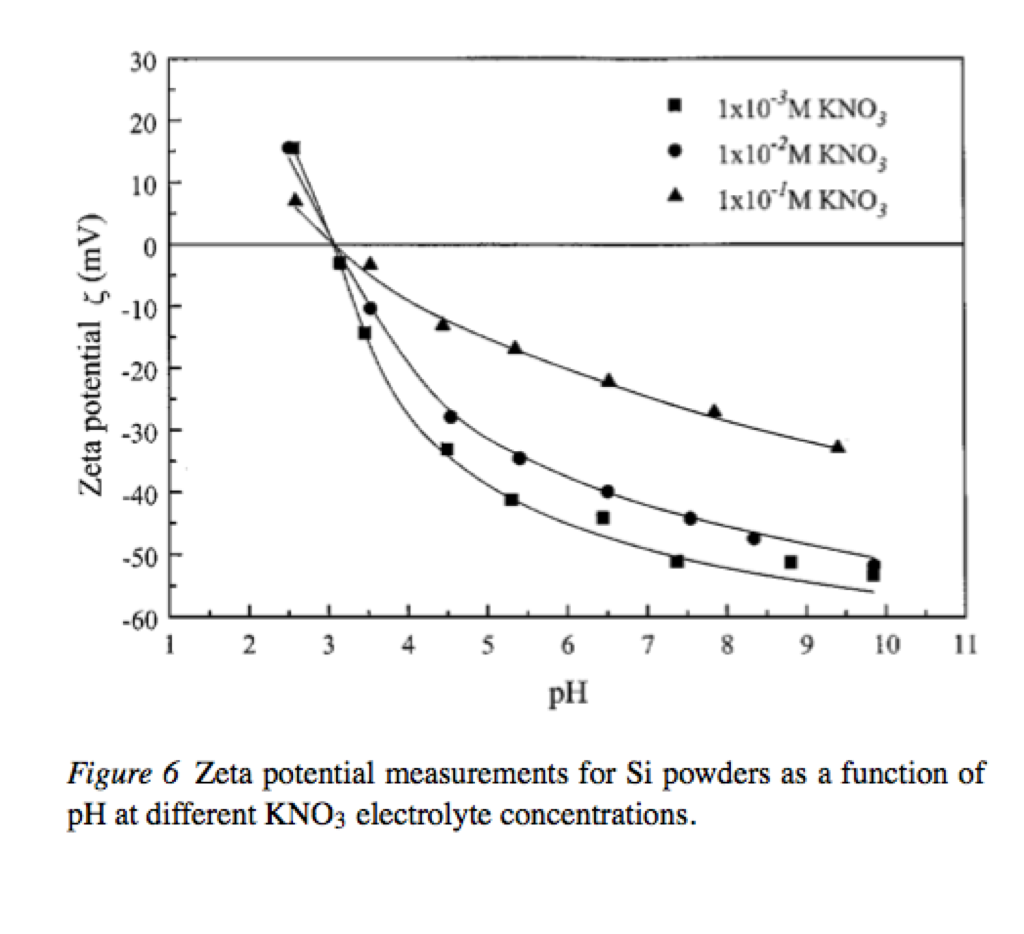
As you can see, all the potentials are in the 10s of millivolts in both cases. Even the Malvern Zetasizer manual mentions that zeta potentials around 30 mV are stable. Something is either off with the assumptions I’ve used or the equation.
I should probably mention that if I didn’t use the porosity normalization back in the beginning, things would have come out pretty close. The book mentions though to scale by porosity if you have a porous material since all these equations are just done for single capillaries.
I think we need to know more about how this equation is applied to capillaries – is it just for the flow of fluid at the wall where there are charged species or is there some normalization across the entire diameter? In our case, charged species extend over a greater % of the pore area, since the pores are so small. I really don’t understand these simple equations, since the situation is somewhat complex, given how the charge density drops off exponentially as you move away from the wall.
The other issue is that the E-field is enhanced within the pore. I’m not sure if this enhancement is 2 orders of magnitude, but one order of magnitude would not surprise me…
The fluid mechanics in the equations may assume a fully-developed velocity profile which we will obviously never see with 15 nm long pipes. If the flow doesn’t fully develop, it should move faster for the same driving force. In the permeability manuscript we are using a modification of Poiseulle’s theory to account for the fact that the flow will not develop much at all after entering a pore. We might want to look at that theory more closely to decide if 2-orders improvement is a reasonable expectation compared to classic, fully-developed flow theory for electroosmosis.
I also wonder if we can convince ourselves that there is a theoretical upper limit to the zeta potential based on the membrane’s atomic structure or something. How high could the charge density really go? Two orders beyond what people see elsewhere is probably impossible, but I don’t know. If we can convince ourselve that the zeta potential must be lower, then we know we are dealing with some special physics here and that would be exciting.
As mentioned at today’s meeting, this deviation may hold true for other membrane types. Going back through my data on track etched membranes shows that the expected zeta potential doesn’t match that found in the literature.
I’m currently looking into a different treatment of the actual data using Darcy’s Law and the Kozeny-Carman equation for permeability relationship. More on this if I get somewhere with it.
For pressurized flow through thin membranes, Dagen actually says that the entrance length is 1/4 the pore diameter (also see Figure 3). I think the difference between this theory and the standard calculation of entrance length is that Dagen considers the influence of the outer flow that is approaching (or exiting) the pores. Normally such flow is negligible compared to the development that occurs within the pipe.
Essentially, the entrance length for ultrathin membranes is the distance required for the bending flow entering the pore to straighten out, while for long pipes it is the distance required for the no-slip condition at the wall to be felt at the center-line.