Thickness series revisited
Last week, we ran a series of wafers with three different Si thicknesses (15 nm, 30 nm, 50 nm). We wanted to explore how morphology shifted with film thickness. Below are three membranes that were annealed at 800 C with no susceptor and a ramp rate of 100 C/s.
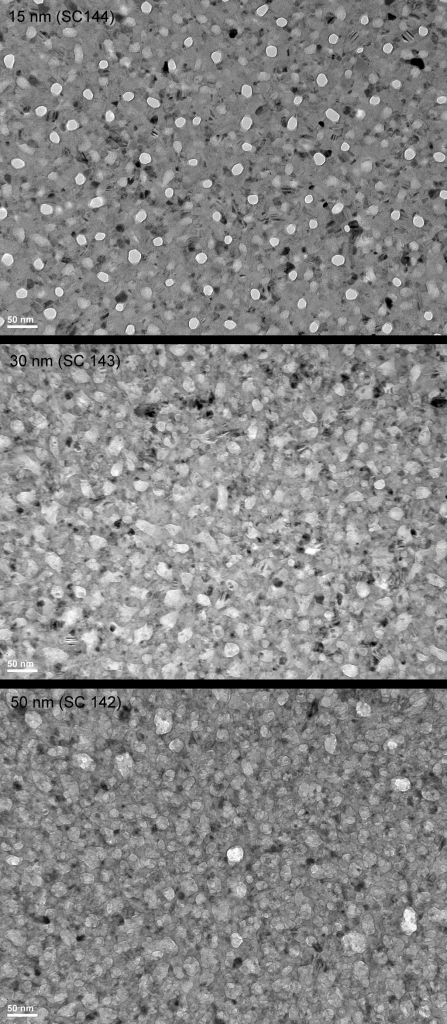
As expected, as film thickness increases pore density decreases. At 30 nm and beyond, we are in a regime where nanocrystals are no longer confined in the vertical direction. What this means is that these nanocrystals can grow on top of each other thus occlude any would-be pores. In the 50 nm film, there are a few areas where it looks like the pore is nearly through. I believe these are places where the grain boundaries between nanocrystals are aligned thus creating an almost through pore.
Looking at a 30 nm at two RTP temperatures (800 C and 1000 C), we observe that the higher anneal does indeed open pores. The pores look conical (lighter ring around pore) which suggests they “grow” top-to-bottom (?).
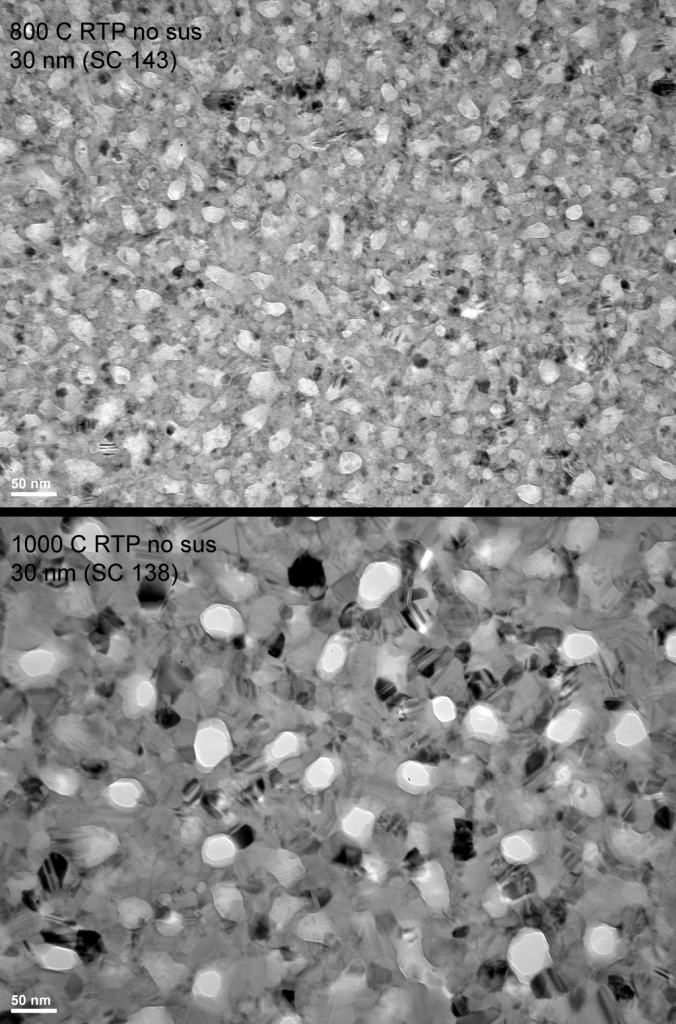
If the burst pressure tests come back favorably, these may be useful in forced flow applications.
Also of note is that 30 nm and 50 nm 800 C RTP films were still wrinkled after the protective oxide strip where the 30 nm 1000 C RTP was almost completely flat. Although 800 C is beyond the crystallization temperature, a high ramp rate was used (100 C/s) and it is possible that some amorphous material may still exist in the lower temperature annealed films.