AFM – PVP on pnc-Si
Tom gave me a few samples to scan on the AFM. PVP was added to the well side of the samples. I scanned the pnc-Si side of the chips to see if/how the PVP came through the pores. Samples were from SC114.
Two different areas of supported pnc-Si membrane on control (no PVP) chip:

The red squares on the images are masks that I created in order to calculate a more accurate roughness (without pores). Roughness data is in the text table (RMS roughness 0.18-0.19nm). The height profile was captured to try to measure two pore diameters and get an idea of the roughness around those pores. I couldn’t get an image of the free-standing membrane on the control chip.
Two different areas of supported pnc-Si membrane on PVP-treated chip:
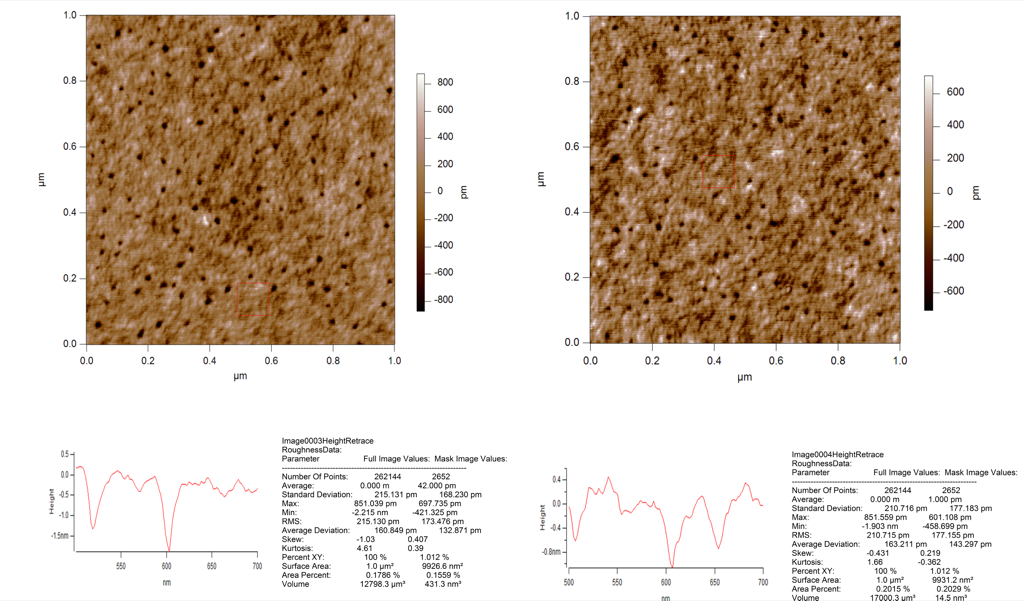
These were Sepcons with 9 square membrane areas, and these scans were acquired in between those squares. I thought these surfaces looked rougher than control scans (and the the height profiles seemed to support that observation), but the surface RMS roughness was about the same as control pnc-Si (~0.17-0.18nm).
Free-standing pnc-Si membrane on PVP-treated chip (PVP was added to the opposite (well) side):
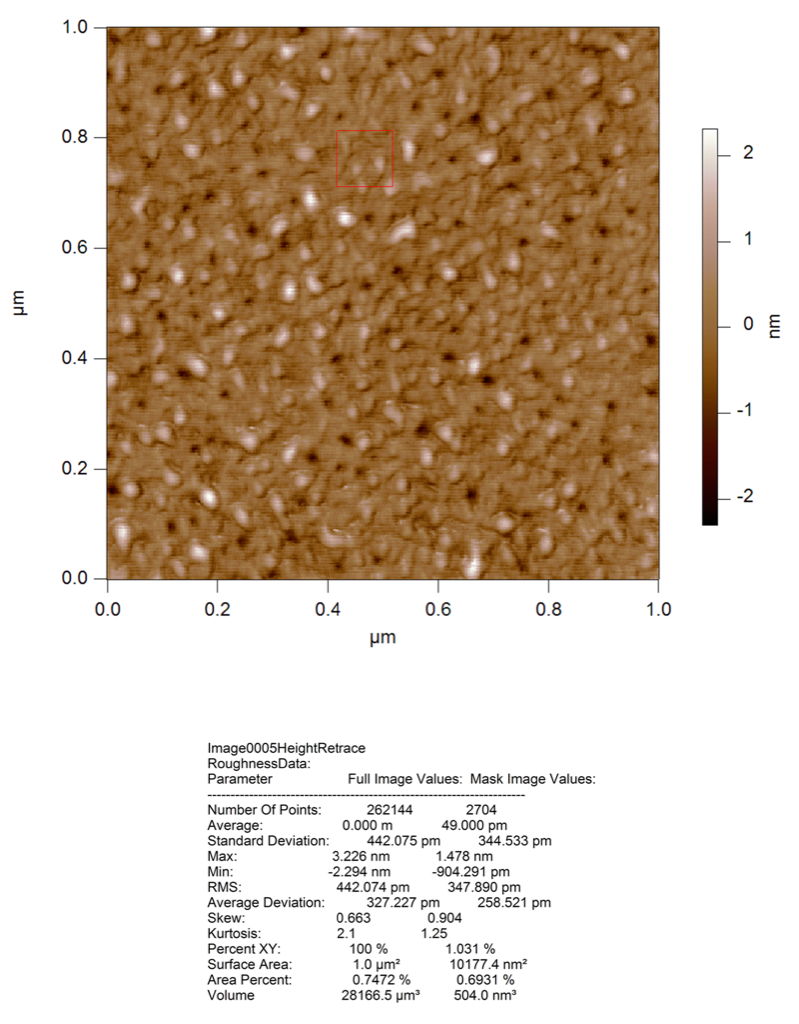
A dramatic difference! The RMS roughness of the masked area is about twice the other scans (~0.35nm) and there are clearly “tall” 1-2nm deposits of material on the membrane. Interestingly, open pores are obvious, which is in contrast with what Maryna’s vapor-deposited parylene membrane looked like here. Maryna’s samples also had polymer deposits far from the membrane area as well as occluded pores (here again). These PVP samples clearly showed polymer on the membrane but not definitively on the supported pnc-Si away from the membrane. Of course, we know that fluid flows through PVP-treated membranes, so open pores are reassuring. I’m not sure how to explain how the pores stay open as the PVP is removed from the membranes.
Once again, I had trouble acquiring an image of free-standing membranes on the control chip. I was able to get images of free-standing membrane on the PVP-treated chip, though. This was the same experience I had with Maryna’s parylene samples. I think the polymer coatings on the free-standing membranes stiffen the membrane enough for me to measure it. By contrast, clean free-standing membranes move around too much to get images with these AC160 tips (membranes could be moving due to drafts in the room, tip tapping force?).