Carbon 'nanorings' inside our pores?
I had some old carbonized samples kicking around and decided to do some high res TEM yesterday to see what a completely occluded pore looked like. Below is an image showing a blocked pore and adjacent Si nanocrystal.

Inside the pore, you can see concentric “rings” of carbon atoms i.e. graphene sheets? Here is a closer view with the atomic spacings:

3.12 A corresponds to a (111) oriented Si nanocrystal. The 3.56 A corresponds to adjacent C-C atoms in graphene. You will notice that the rings appear broken in places; something a second high temperature anneal may repair…
If we can pass fluid through these structures, I would imagine that our numbers would blow the carbon nanotube membrane people out fo the water! Here is an almost occluded pore:
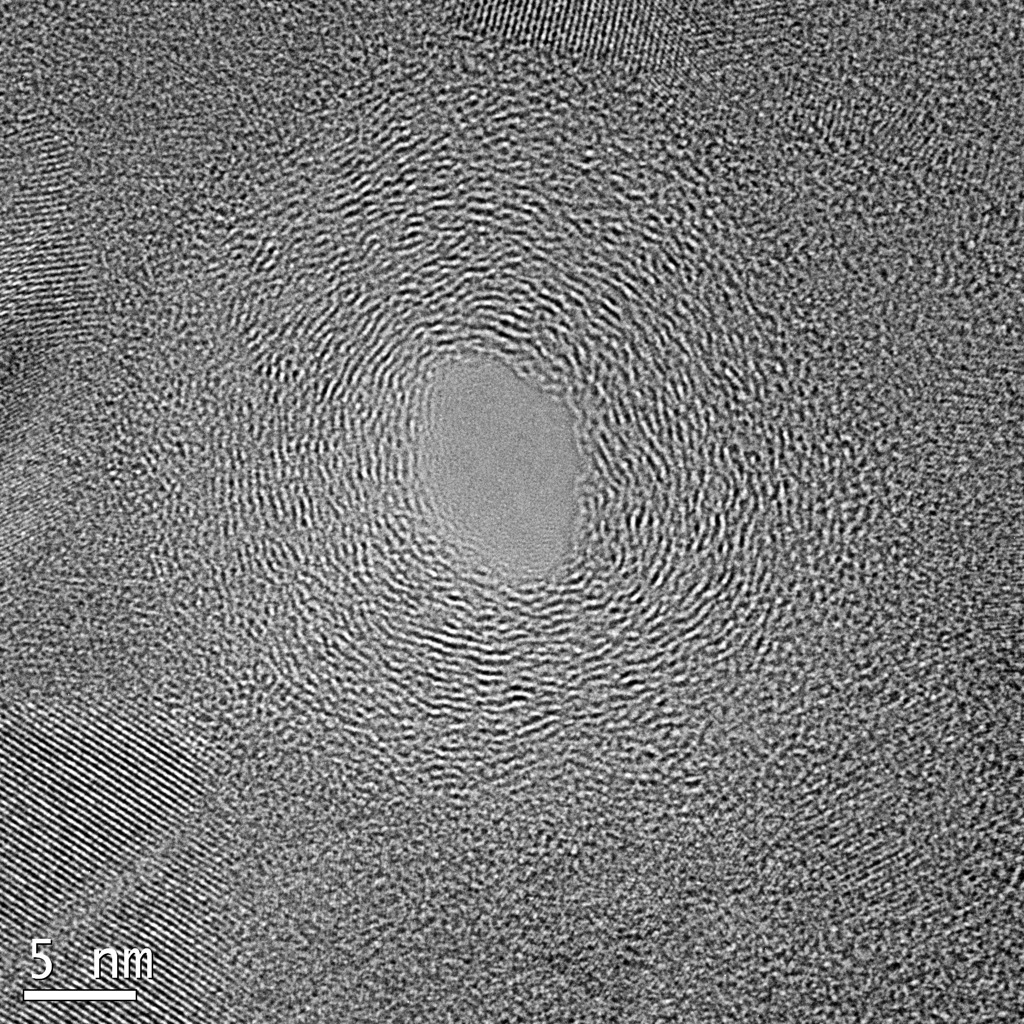
How would water pass through a ‘completely occluded pore?” Do you think there are gaps between the rings?
Sorry, I meant to say we could try pushing water through the partially occluded pores.
These graphene-like rings appear to be a common feature in our carbonized pores, so I think it’s worth further investigation. However, Dave is stuck until more samples can be produced, but there’s yet to be any solid response to our calls for a decision on whether to procede with this process in the RTP. There are really just 3 options:
1) We continue this work, but with a mandatory inspection of the chamber before and after each run. If a problem is observed, we stop the process and figure out a way to clean the chamber.
2) We invest $2000 in another flow controller for O2 and require that an oxygen cleaning process is run after carbonization to remove any excess carbon before it builds up.
3) We forget about this process.
Any thoughts?