BSA and DDM diffusion with SC269
Yesterday I posted results of a diffusion experiment using rhodamine and fluoroscein that showed the pores in SC269 are open both before and after treatment in the UV-Ozone system. I set up another diffusion experiment to test “treated” and “untreated” SC269 samples with diffusion of BSA and DDM. As a reminder the focus of my project is to try and seperate BSA from detergent micelles (DDM) by retaining BSA and allowing DDM to pass through the membrane.
When I ran the analysis this morning I found that in the “untreated” case no BSA was allowed past the membrane while at the same time DDM was allowed to pass. On the other hand the “treated” samples gave interesting results in that they appeared to allow both BSA and DDM to pass across the membrane in larger concentrations than in the “untreated” case. I think the problem was touched upon by Jim in a comment he made to my original post about BSA diffusion with SC269 earlier this week. It seems that SC269 is naturally more hydrophillic in comparison to SC267. Therefore when “treated” SC269 sample become so hydrophillic that the 6uL drop placed on the top-side of the sample chips span the entire surface and often leaks over the edges. To try and verify this I set up another diffusion matrix in which I am testing “treated” and “untreated” SC269 with diffusion of BSA and DDM; in this setup I am using a smaller topside volume on the “treated” samples to hopefully prevent overflow.
DDM Analysis:
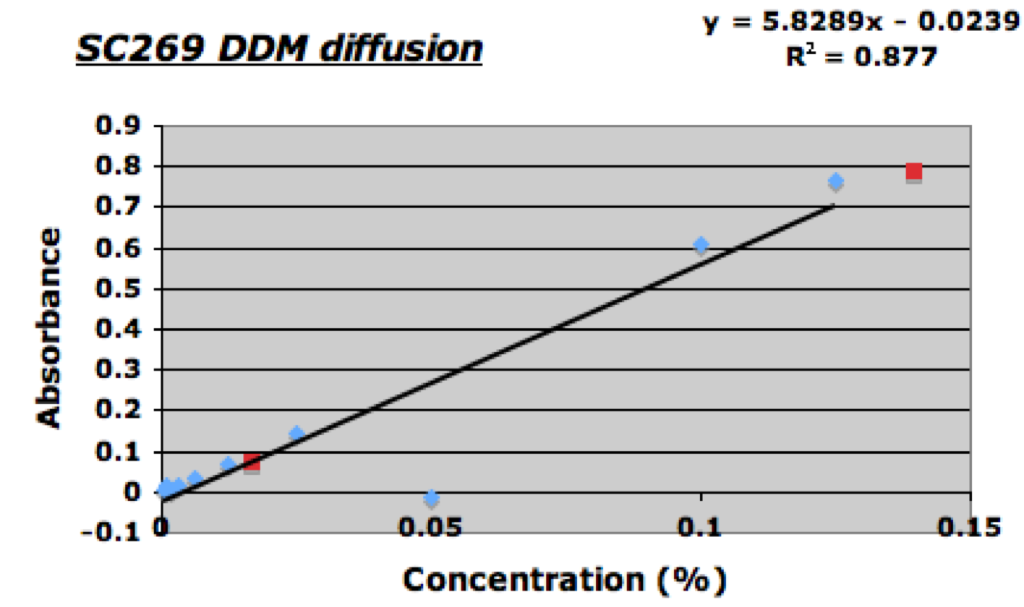
Again, in the case of the DDM analysis the “untreated” sample allowed DDM to pass across the membrane; the final filtrate concentration being ~0.016%. On the other hand the “treated” sample allowed for a larger amount of DDM to pass across the membrane; the final filtrate concentration being ~0.13%.

BSA Analysis:
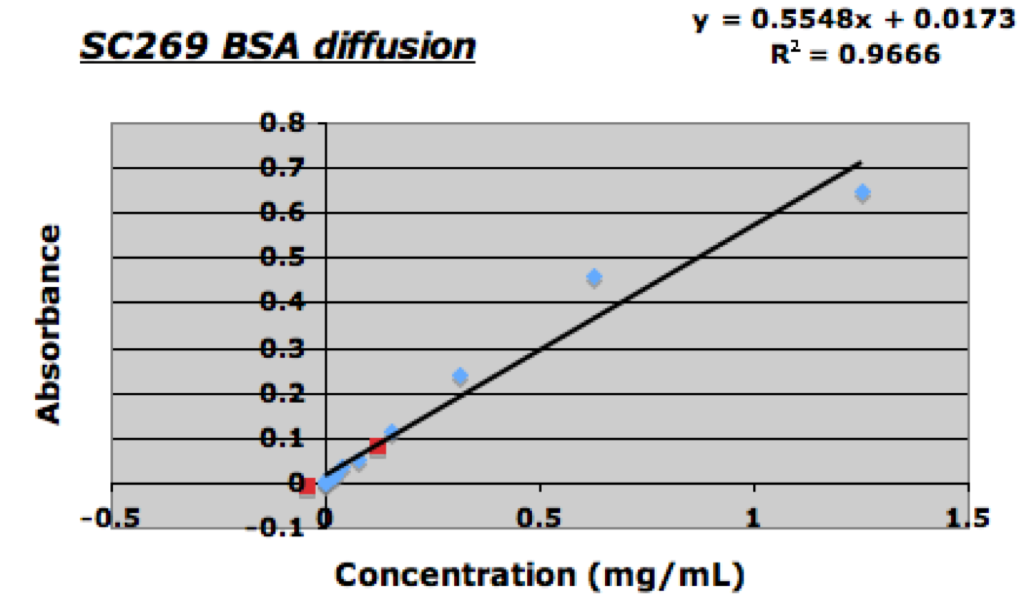
Similar to the case of the DDM sample in the BSA analysis the “untreated” sample allowed for no BSA to pass across the membrane; the final filtrate being ~0mg/mL (~-0.044mg/mL). On the other hand the “treated” sample allowed for a large amount of BSA to pass across the membrane; the final filtrate concentration being ~0.12mg/mL.