Young's modulus of pnc-Si determined by the bulge test
Initial studies into the mechanical properties of pnc-Si were carried out using the “bulge test”. With JP’s help, we’ve collected a large amount of pressure-displacement measurements. This technique has been used to investigate thin film membranes suspended over windows of different geometries e.g. Vlassak. In this study, we measure the deflection of a pressurized membrane by white-light interferometry and fit the data with the generalized bulge equation:
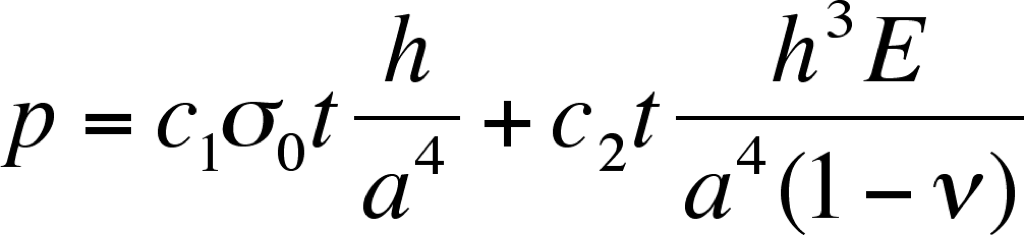
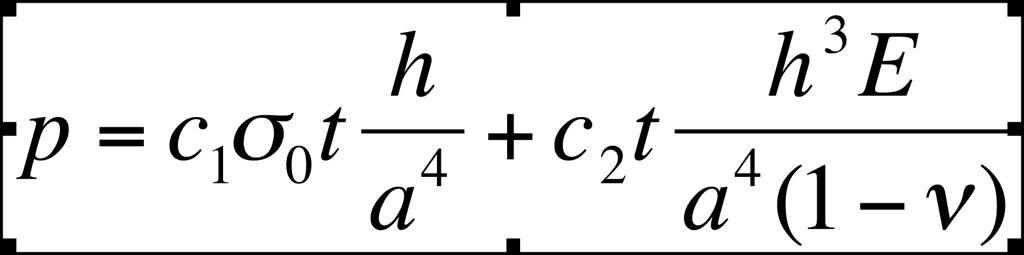
The c1 and c2 coefficients are dependent on the membrane geometry and the film’s Poisson ratio, E, P is the pressure applied to the membrane, σ0 is the film’s residual stress, t is the thickness of the film, d is the vertical displacement at the center of the membrane, 2a is the length of the square window, and M is the biaxial modulus, E/(1-n), for an isotropic film. For a square membrane, Vlassak calculated c1 = 3.393 and c2 = (0.792 + 0.085 ν)-3 using energy minimization techniques to match the free energy of the membrane with the membrane displacement field.
In order to determine the Young’s modulus of pnc-Si, a value for Poisson’s ratio, ν = 0.22, was assumed based on previous studies with polysilicon. The bulge equation was fit to an experimental pressure-displacement curve using a least-squares method. Three different membrane geometries were investigated. Here is a graph showing the experimental data and fit.

As expected, deflection magnitudes increase with window size.
Below is a table summarizing the Young’s modulus, E, and estimated residual stress, σ0, of pnc-Si and other forms of silicon structures.
Table 1. Table of Young’s Modulus and Residual Stress
|
Geometry |
Young’s Modulus (E) | Residual Stress (σ0) |
| Pnc-Si (200 mm) | 100 GPa | 80 MPa |
| Pnc-Si (300 mm) | 97 GPa | 60 MPa |
| Pnc-Si (400 mm) | 92 GPa | 130 MPa |
| LPCVD Polysilicon | 151 ± 6 GPa | – 350 ± 12 MPa |
| Single Crystal Silicon | 169 ± 2.5 GPa |
– |
The residual stress of pnc-Si was also determined by fitting against the experimental data. We see that pnc-Si is about 50% less stiff than polysilicon and single crystal silicon. This makes sense if we think of pnc-Si as a single layer of nanocrystals held together by amorphous atoms in the interstitials. Polysilicon consists of multiple layers of crystallized sites and single crystal silicon is completely ordered. The second conclusion we can draw from these numbers is that the residual stress of pnc-Si appears to be very low.
This is great work and quite interesting, since the question of Young’s modulus and residual stress have been a real question mark, and this data at least gets us in the ballpark. The primary question I see is why these values vary for different membrane sizes? I assume they are from the same wafer, so the modulus and residual stress should be the same, correct? For each membrane size, are the results consistent across the wafer? What are the sources of error? What is the porosity of these films?
These membranes were all from the same wafer, annealed at 1000 C 100 C/s no sus. The only explanation I can offer at this moment for the discrepancy in values are non-uniformity in the film thickness (or some other factor that affects stress) and measurement error.
The non-uniformity across a wafer is sometimes observed (some membranes wrinkled, others not, some half-wrinkled). This particular wafer showed no signs of wrinkling, but that does not rule out the possibility that the films are under different tensile stresses.
Our measurement error can be determined by running several more tests on identical membrane geometries.
I hope that Barrett’s work with the AFM force curves will confirm our observations with the bulge test.