Effect of NHS- PEG8 modified surfaces on the adsorption of proteins (BSA)
The AIM of this experiment was to see the effect of surfaces modified with PEGs (Polyethylene glycol) to protein adsorption. The PEG that I used for the current study is MS-PEG8 (Methyl-PEG8-NHS) which is Amine reactive.
Method:
For the current experiment I used planar silicon chips which have ~ 142 nm of thermally grown oxide. The chips are modified with APTES via chemical vapor deposition procedure using the YES system. Following APTES treatment, the thickness of the silane layer was measured using spectroscopic ellipsometery. Couple of chips from this batch was then subjected to 6 mM of MS-PEG8 (solvent used was dry Dimethylformamide (DMF)) for 1 hr @ RT. (Note: each chip was exposed to 50 ul of the PEG solution for 60 mins and at the end of incubation time they were rinsed extensively with 70% ethanol and then with copious amounts of ddH2O)). Again following this step the thickness of the chips was measured via spectroscopic ellipsometry. Now all the chips (2 each of plasma treated chips, 2 chips modified with APTES and 2 others modified with MS-PEG8) were incubated with 1 mg/ml of BSA (Bovine Serum Albumin) in a humidity chamber @ 4oC overnight. Next day they were rinsed thoroughly with ddH2O and dried under nitrogen. All the chips were once again measured using spectroscopic ellipsometry.
Results:
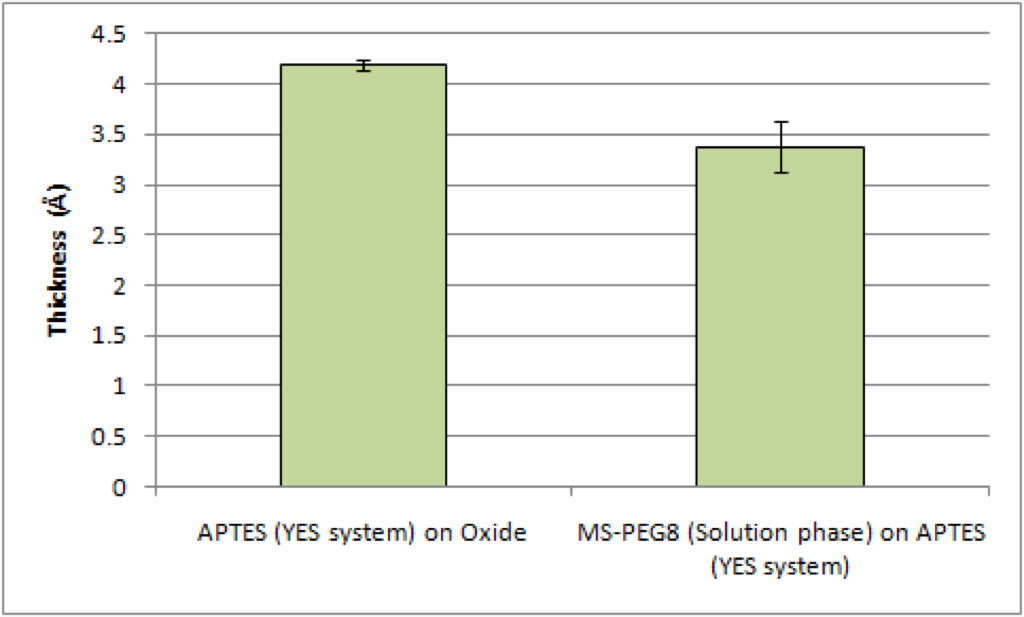
The Plot above shows the thickness of the APTES layer deposited using the YES system and also the thickness of just the MS-PEG8 layer deposited on APTES treated chips.(Note: error bars correspond to the standard deviation of the measurements from the average of two measurements).

This plot above shows the thickness of the 1 mg/ml of BSA on plasma treated silicon dioxide chips, on APTES modified chips and finally on the MS-PEG8 modified chips. (Note: error bars correspond to the standard deviation of the measurement from the average of two measurements).
Discussion:
- From the plots above we observe that the thickness of the APTES layer on silicon dioxide is ~ 4.2 Å and that of MS-PEG 8 on APTES treated surface is ~ 3.5 Å (theoretical length is ~ 30 Å). This means to say that we are either getting a very sparse monolayer of the PEGs on the surface or the PEG chains are not fully extended from the surface.
- From the second plot we observe that the thickness of the BSA (protein) layer on the plasma cleaned and on the APTES modified chips is ~ 20 Å. In contrast, the thickness of the same BSA layer on PEG modified surface is negligible.
Conclusion:
Looks like the MS-PEG8 modified surfaces are able to prevent the adsorption of BSA. This conclusion again is merely based on the ellipsometric measurements. We will have to use fluorescent techniques to confirm the same. Again in this experiment BSA was used as the model system for proteins and as such will be good to check if the PEGylated surfaces are non-fouling even to other proteins in general.
Well its unclear why its working so well, but its working! We should compare to solution based APTES/PEG to (hopefully) justify the purchase of the YES Beast. Then we should really try this on pnc-Si and try some functional tests (flow, separations) with help from Nakul.
Great! We should make up some FITC-BSA and test that next.
Wow, a first experiment that works almost perfectly. Did you try a dilution series of the PEG solution to confirm that you have saturated the surface (reached a stable thickness). If you dilute the solution to 1/2 or 1/10 in concentration and see the same thickness, I’d be convinced. Long molecules like this will sterically hinder the binding of other PEGs within it’s reach, much the same way it keeps BSA off the surface. Therefore, a thin layer is expected. What was the contact angle? Hopefully it wets nicely.
Any updates yet?