Larger pores in 30 nm pnc-Si w/ post-Si dep. Ar sputter
Today I deposited two 30 nm thick Si films and annealed one at 1000 C for 1 min and the other at 1000 C for 5 min. My running hypothesis is that performing an Ar sputter after the silicon deposition creates “broken” bonds that seed crystallization. Therefore, the crystallization should nucleate at the interface and grow “into” the film. If pore formation follows the crystallization front, this should mean that pores have more room to grow i.e. Si atoms have more volume in which to vacate before they hit another nanocrystal. Here are the results:

Without the Ar sputter, the pore sizes at 1 min and 5 min were small and at a low density. I believe this is due to the random nucleation of crystals inside the amorphous volume without the Ar sputter. As pores form, they encounter a neighboring nanocrystal and stop growing. This explains why the 1 min vs 5 min anneal in a non-Ar sputtered film were less porous. In fact, the 5 min film was even less porous than the 1 min film, which supports my random nucleation argument. I found that the 1 min anneal in the Ar sputter films increased the pore size significantly. What’s more interesting is that a 5 minute anneal opened up some really large pores. These are most likely multiple pores merging judging from areas like this:
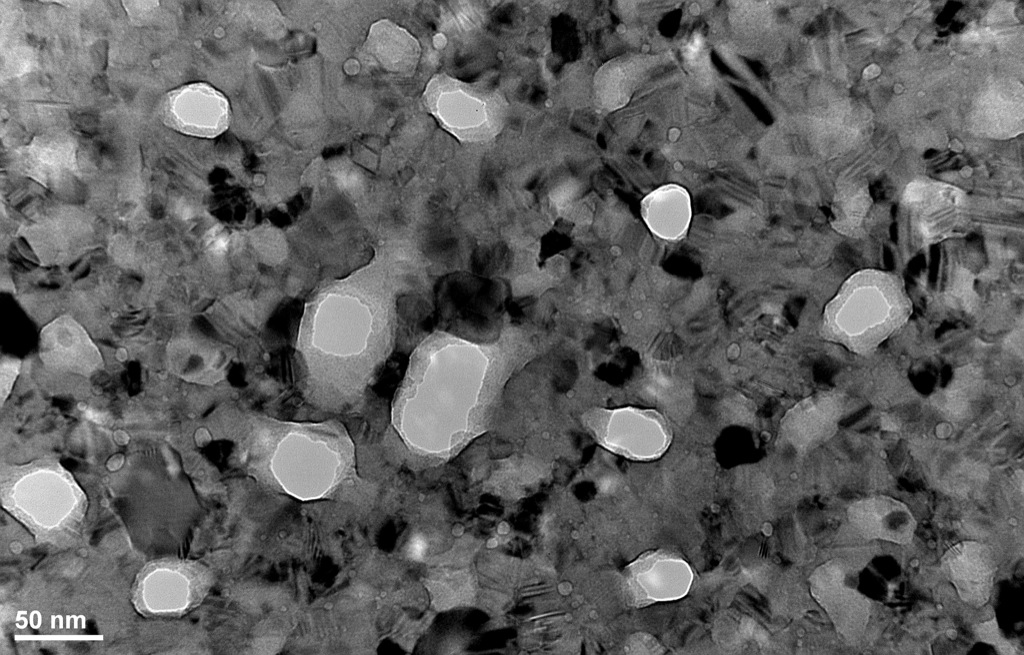
Here is a low mag image of the large pores:
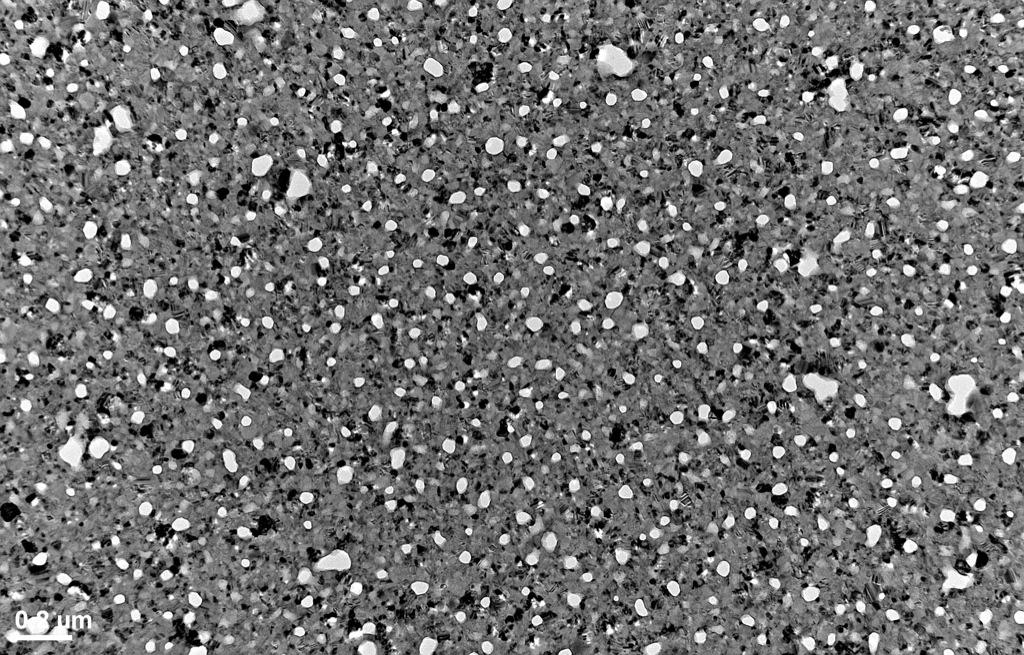
The next step I’m thinking about involves how to make the large pores rounder and the distribution narrower. I think ramp rate is a good place to start.
Wow. This is really dramatic.
What would the expectation be for a 5 min anneal compared to the 1 minute without Ar sputter.
Can you add more to the pinhole story?
Just added a panel in the figure with a 5 min no Ar sputter film.
W.r.t the pinholes, we recently installed new oxide targets which I did not characterize a deposition rate for, thus the oxide in these two films were closer to 15 nm. As a result, almost every membrane had at least one pinhole. My recommendation would be to start increasing the thickness of protective oxide as it seems we’re on some critical thickness.
What? The 5 min control has smaller pores than the 1 min control?
This is why we are seeing an increase in pore size when we seed growth at the interface. With random nucleation, it shouldn’t matter how long you anneal because once you’ve hit a film interface or another crystal you’re done growing. This is evidenced by the smaller crystals in the non-Ar sputtered films.
Sorry I screwed up my comment. Now fixed. I’m trying to ask why the purple line is to the left of the blue line in the histogram data. Random pore growth for more time gives smaller pores?!? This contradicts your last post.