Comparing growth rate of carbon on bare and alumina coated pnc-Si
This week, I did a systematic study on the growth rate of carbon on bare and aluminum oxide coated pnc-Si membranes. The bare samples were not treated prior to carbonization, while the alumina coated samples underwent a 5 nm treatment in the ALD tool. A bare and alumina coated sample were placed together inside the RTP for each time point. The acetylene flow was fixed at 1 lpm and the process temperature was 750C. Each sample was carbonized for 1, 2, 5, 10 and 15 minutes. I then looked at the carbon growth under HRTEM and measured the amount of carbon that had developed.
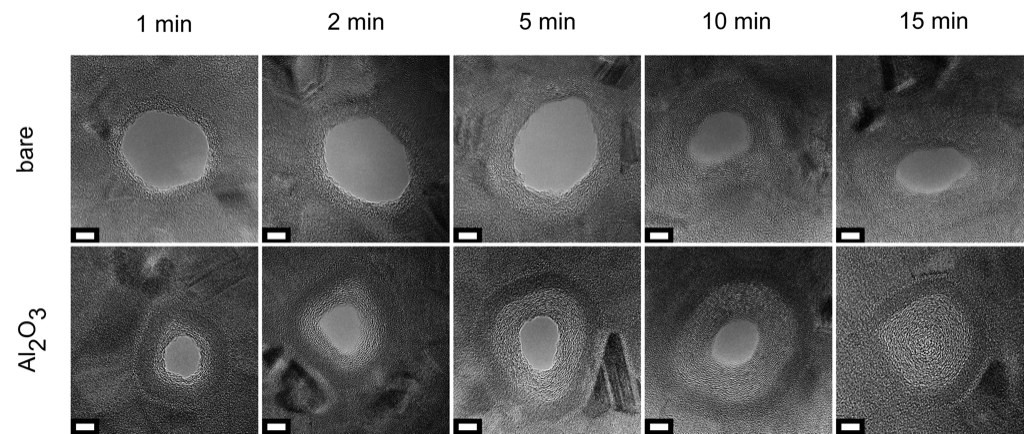
scalebar is 5 nm
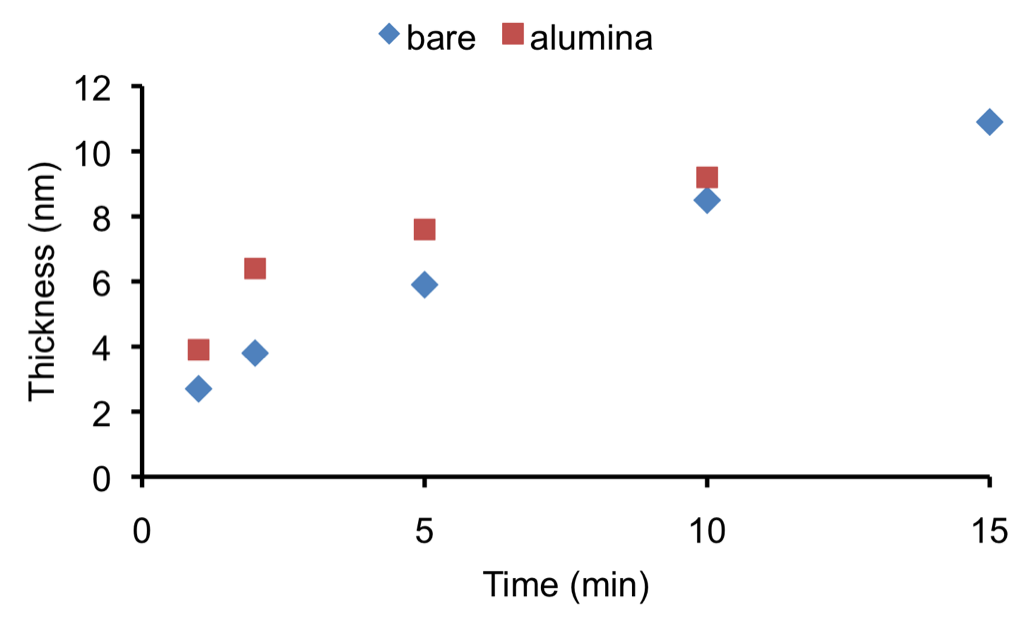
Consistent with my initial report on carbonization of alumina coated pores, the carbon growth rate appears to be higher on the treated surface. Growth on bare pnc-Si is linear, except in the first minute. In contrast, growth on alumina coated pnc-Si is logarithmic. This data indicates the growth mechanism of carbon on these two materials is fundamentally different. I believe this difference stems from the growth mode of an ordered vs. amorphous material. Notice that the ordering is much greater on alumina than the bare pnc-Si. As the radius of curvature increases (more carbonization), it becomes increasingly difficult to form ordered rings. On the other hand, proliferation of an amorphous material should not have as high of an energy barrier.
If the hypothesis that the growth rate on alumina is size dependent is correct, then we should expect to see a change in the shape of the pore size distribution with increasing carbonization. Below is a cartoon showing the pore size distribution before and after a coating process on a material that is growth limited and non-limited.
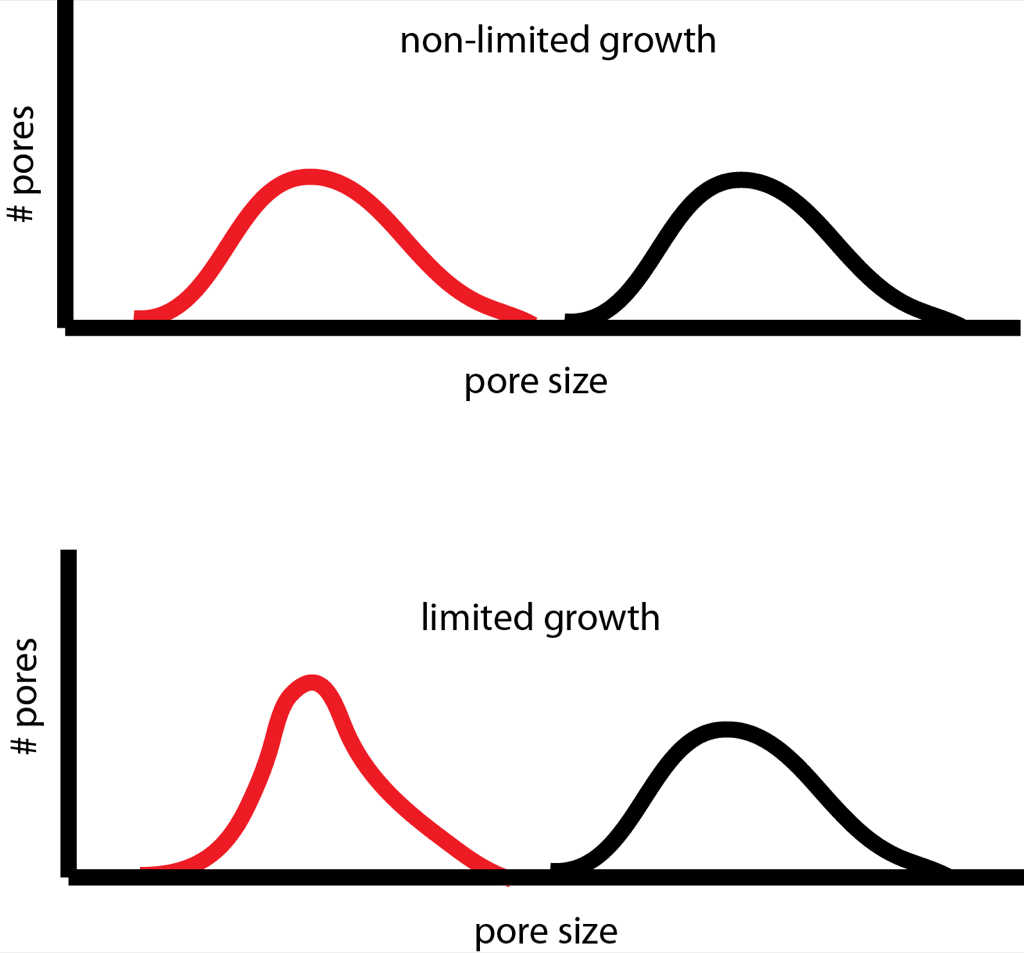
For non-limited growth, we expect a direct shift of the histogram with no change in shape as long as min(pore size) > ‘0’). In the case of a rate-limited growth process, the growth rate is variable depending on the curvature of the pores. The hypothesis is that growth occurs faster on smaller curvatures (i.e. larger pores) than it does on larger curvatures (i.e. smaller pores). Thus, we should expect to see an increase in density of smaller pores as growth on a rate-limiting material proceeds. Below is the real histogram of carbon growth on bare pnc-si and aluminum oxide.

Four membrane histograms are depicted. The lightest is an untreated membrane, followed by membranes carbonized for 1, 2, and 5 min. The histograms are superimposed on one another to demonstrate the change in form. Histograms of membranes that were carbonized on bare pnc-Si seem to retain the same general form. Another way of thinking about this is that the full-width half-maximum of the distributions remains constant.
This is in contrast to the alumina coated membranes that were carbonized. I believe there is a clear narrowing of the size distribution as the samples are carbonized for longer time periods. This would support the theory that carbonization on alumina is a growth limited.