Ozone and Contact Angles
The Ozone generator works very nicely. Dave is going to be providing an in-depth user manual for us, so I’ll be somewhat brief.
In this first picture, I compare an ozone treated sample against a control. Both ‘droplets’ are 3uL of DI water. The treatment protocol:
– 3 min of O2 at to fill main chamber, then turn off O2 tank.
– 3 min of 50C heat and UV in main chamber.
– 15min wait period to let ozone react with sample.
– Evacuate chamber by running vacuum for 2 minutes.
(the supplemental in-line ozone generator was not used) 
I tested samples a variety of times over 4 hours and always found a minimal contact angle. This picture was taken 4 hours after treatment. No visible wrinkling of the membrane by eye. The water spread so smoothly that it created almost a crescent shape on the left and seemed to be most affected by any silicon debris on the surface.
In this next image, the two membranes on the left are the same as above. The one on the right is a sample that was treated the same way as above, but I did not fill the chamber with O2 before turning on the lamp and heater, meaning ozone would have only been generated from atmospheric oxygen. This picture was taken 4 hours after treatment. The contact angle is slightly greater than the Ozone from O2 sample, but still very small.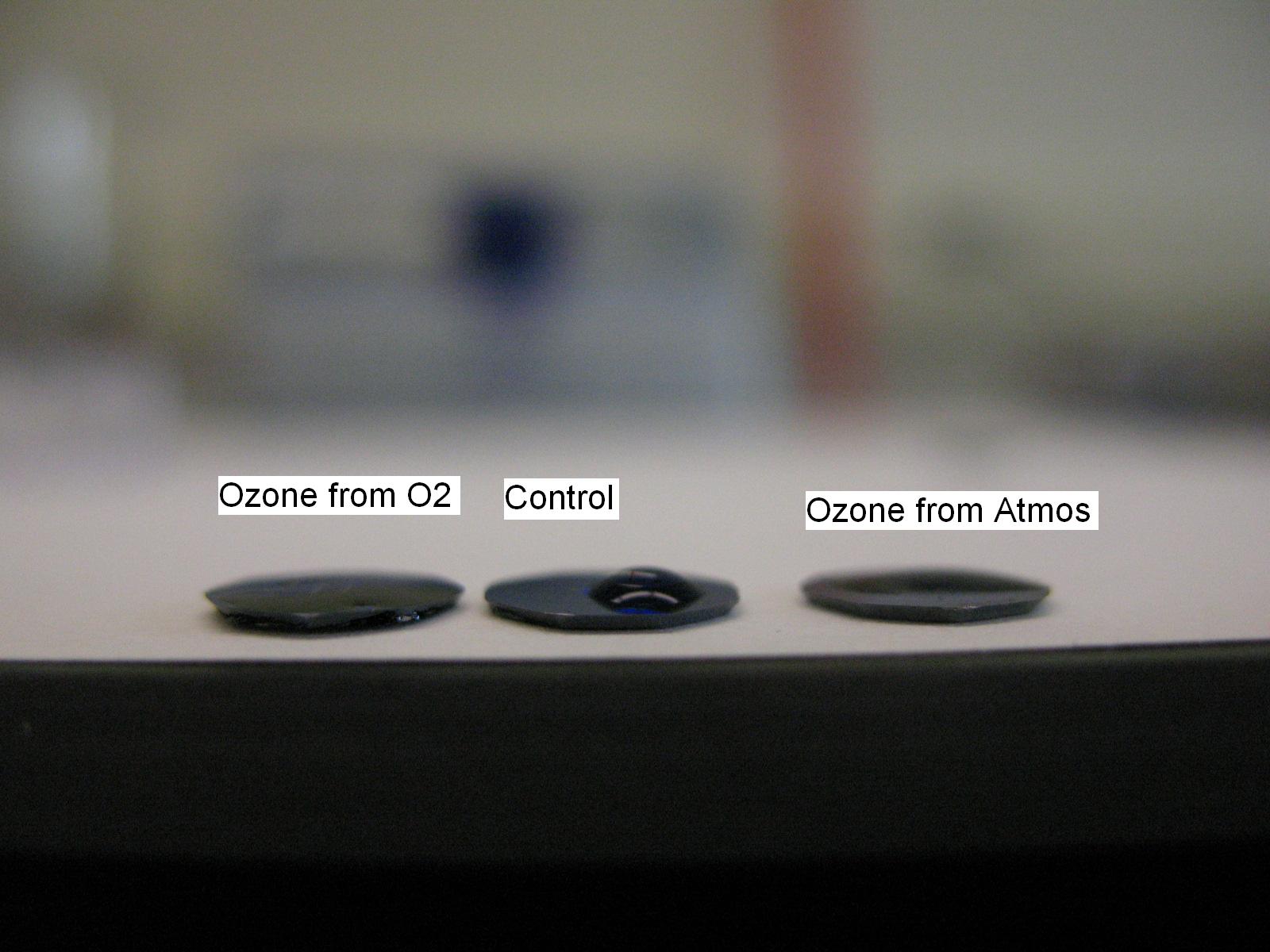 This result is in contrast to Lingyun’s result where it almost appeared that the contact angle increased when he treated the sample using ozone from atmosphere. I ran two samples and observed the same result at time 0, 1hr and 4 hrs after treatment.
This next picture is of the same three samples, but now after letting them sit on the benchtop for 24 hours (not in a gel box). You can see that the contact angle increases a little, but is still probably less than 15 degrees? It is more obvious here that pre-filling the chamber with O2 before turning on the lamp is significant and important (left sample).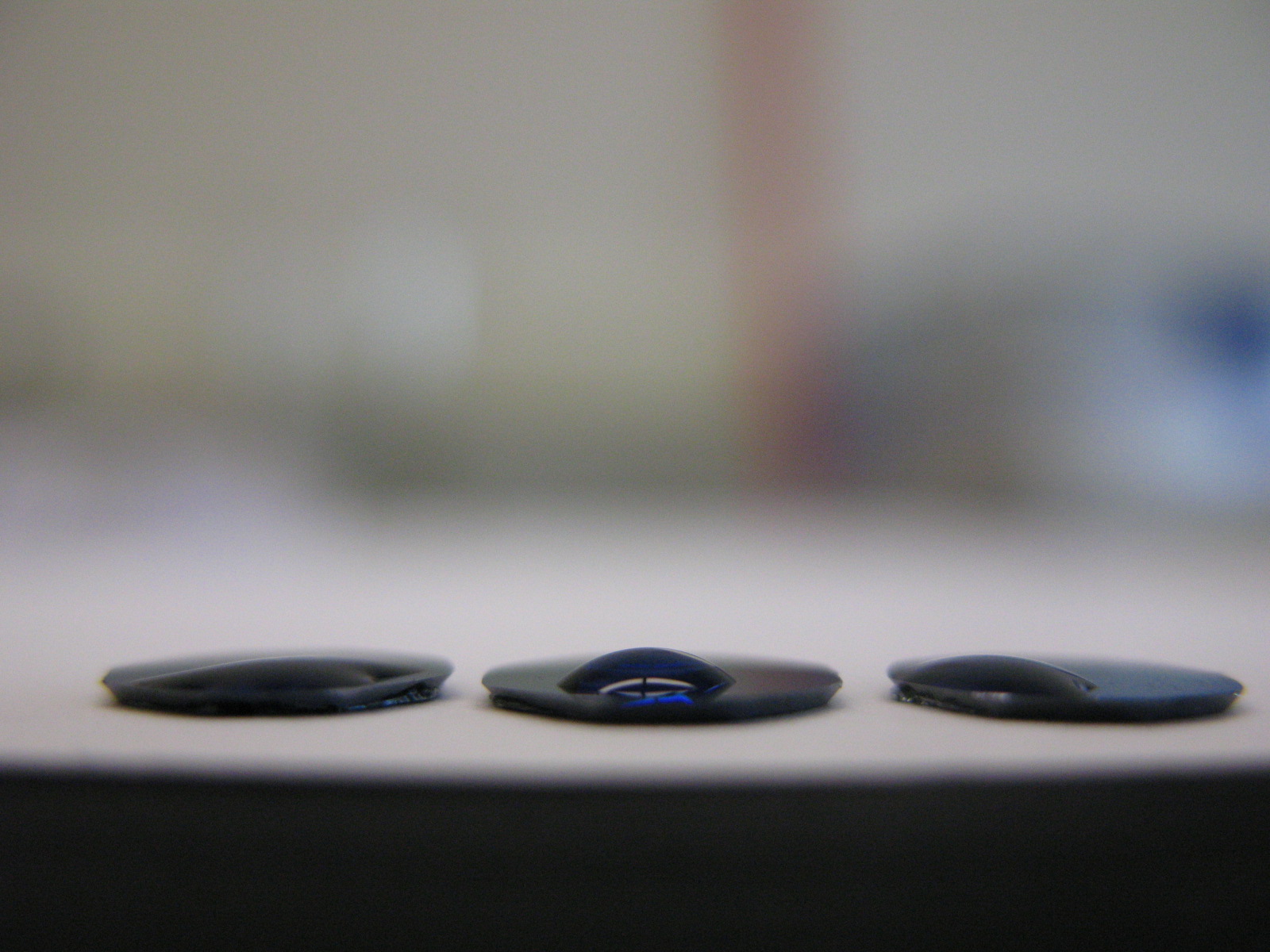
It’s interesting that the ozone treatment works so well, but I guess it’s not surprising, since it is done at atmosphere with 100,000X more oxygen around than the old plasma process. Did we ever experiment with longer times in the O2 plasma? It will be interesting to see how long this treatment will last and how it affects our process.
Can someone try this process with the membrane faced-down to see if the samples need to be flipped to treat both sides of the membrane? Any sign of water seeping through the membrane, like that reported for the carbon nanotube membranes?