Hemo-Dialysis Channel Flow Characterization
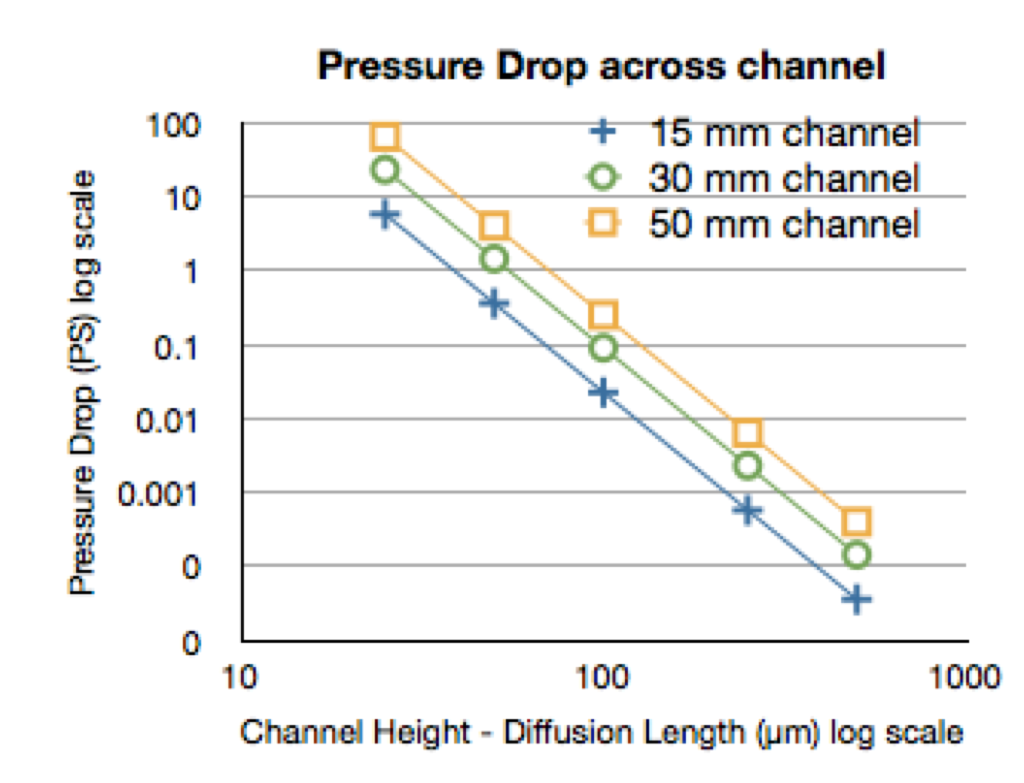
Dialysis Rate: 10 mL/min, Péclet Number: 1, Membrane Width: 700 µm, Channels per chip: 17
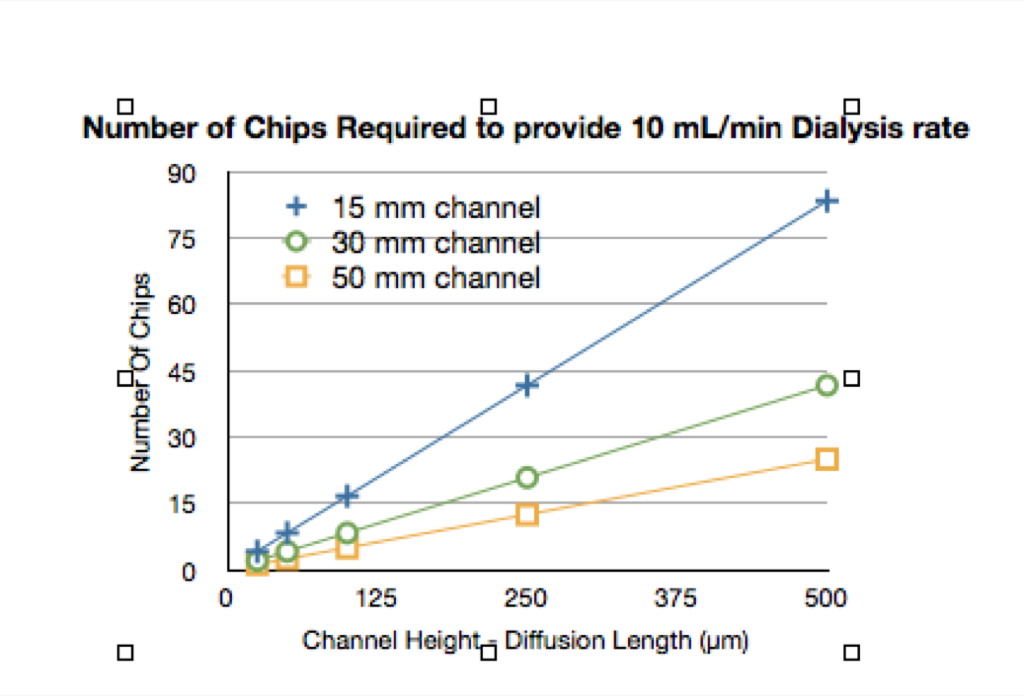

Péclet number
Pe ∝ H
Pe ∝ 1/L
Pressure Drop, P
P ∝ 1/H3
P ∝ L
Dialysis Rate: 10 mL/min, Péclet Number: 1, Membrane Width: 700 µm, Channels per chip: 17
Péclet number
Pe ∝ H
Pe ∝ 1/L
Pressure Drop, P
P ∝ 1/H3
P ∝ L
While I have been in Montreal with Albert Kamanzi and Sabrina Leslie, Albert mentioned to me a cleaning protocol that appears to strip off NPN. 5 mL of Hellmanex III in 100 mL of DI water Placed in heated water bath, covered with parafilm (setting 50C, actual 40C) for 2 hrs Delaminates NPN? The chips are mirror-like afterwards, indicating…
I’ve now made 18 pores in monolith devices, with only 1 real success, which was the first one that I report on already. All of the rest have failed for various reasons, mainly relating to the silicon nitride membrane in which the sensing pore is fabricated. The first issue is fabrication time. Fabricating a pore…
In a first attempt to reduce the electrostatic drag that might be slowing water transport, I ran an experiment with 1x PBS. The membranes were first ozone treated and then assembled into the SepCon inserts. From these first trials, it appears that PBS does pass through more quickly than DI water.
A study of membrane deflection has been conducted using the Veeco Wyco optical profiler. This is the first time the Veeco has been used to obtain quantitative data describing membrane deflection. This type of analysis will be useful for several reasons: –It will provide a numerical measure of maximum deflection and deflection vs. position for…
When we are trying to optimize the capture of exosomes in the tangential flow system, it is important to understand how particles are behaving in the flow. Initially, we tried to do this last summer by looking into the particle tracing package for COMSOL, but that required a complete overhaul of the software (a new…
In my previous post, there still appears to be a discrepency between the calculated pore statistcis and the experimental permeabilities. I explored what I could do with the pore processing to bring the experimental closer to the calculated permeabilities. I set the minimum pore cutoff higher (15nm) and tried to remove any pores that did…