Efficiency of EO
Jirchai summarized his data in this table …
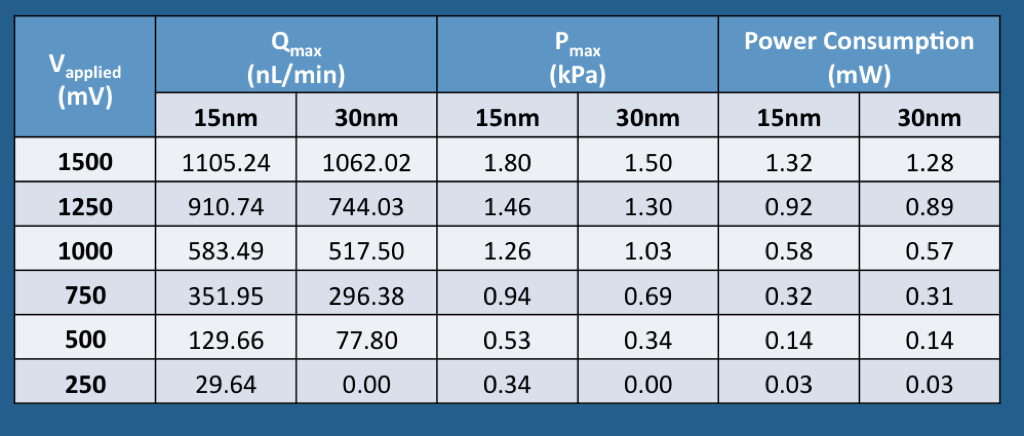
A question raised by a reviewer of our PNAS submission – and one that we’ve had for a long time – is what is the efficiency of the pump. The electrical power provided is calculated in the table for each configuration. As Chris mentioned in group meeting, much of the energy is wasted because the electrodes are deep into the solution when in principle they only need to be across the membrane to generate the same pressure. Indeed, Jess estimated that the effective transmembrane voltage in her experiments are only ~10 mV while the applied voltage is ~10V! So we should expect a rather miserable efficiency if we use applied voltage in the power calculation.
Analogous to V = IR in electrical circuits. Hydraulic flow through a channel can be expressed as …

where DP is the pressure drop across a channel, Q is the flow rate and R is the hydraulic resistance.
Similarly, the hydraulic analog to the electrical power equation … P = I•V is

The linear relationship between back pressure and flow rate indicates that the back pressure simply counteracts the EO generated pressure to determine the net pressure …

so that when the back pressure matches the EO generated pressure, the flow stops. This value of the back pressure is what Jircahi calls Pmax and what we’ve described as the ‘stall pressure.’ Thus …

at any particular voltage. Without any back pressure …

and without back pressure,

Thus the hydraulic power at any voltage can be calculated from

 If I’ve done the math correctly, our efficiency is vanishingly small! Even if we could gain three orders of magnitude by applying the electrodes to the membranes, we would still have less than 5% efficiency. This inefficiency may be inherent to the EO process.
That was Jirachai’s chart from his presentation, not mine.
A lot of people are reporting thermodynamic efficiency in their papers. They use some form of:
e=P*Q/(V*I)
I’m assuming that’s what you’re doing here?
These papers are all reporting high efficiencies being in the range of under 1% up to about 5%.
Indeed that is the formula I used.
Our efficiencies are really 1000 smaller than the others?
I just double checked your numbers and got lower efficiencies: 33 nW/1.32 mW = .000025
I wonder if efficiency is specific to the device dimensions (active area, pore size). Some of these will present compensating changes though, for instance increasing active area should increase flow rate but will also increase current.
We still fit in a niche for low voltage pumps with reasonable flow rates for microfluidics.
Oh, just realized your efficiencies were in percent, never mind we get the same answer.