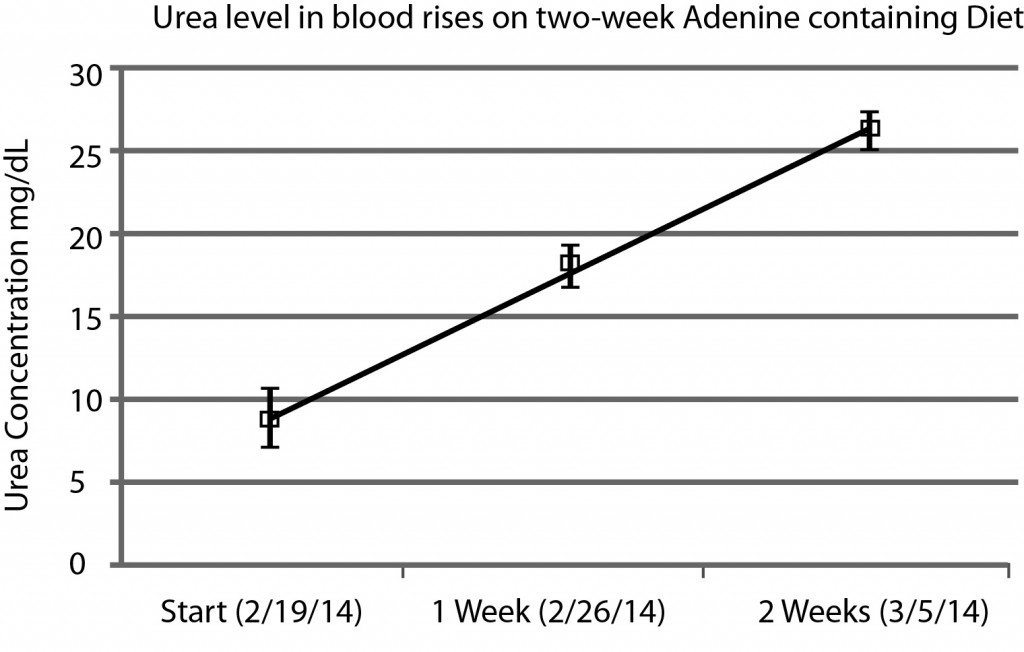
Effects of Adenine Containing Diet on Urea Levels in Serum Drawn from Rats
In order to test the efficacy of any dialysis treatment, we need induce uremia in our animal model. We choose to forgo the surgical approach of performing a 5/6 nephrectomy via ligation for the simpler diet based approach. Feeding the animals a diet containing adenine is meant to raise the level of urea in the blood. Since urea levels will be used to validate our device and compare its performance to commercial filter material, increasing the amount of urea in the blood will be a sufficient and effective model.
While the literature is rife with examples of this approach, we wanted to verify the effect on at least one animal before we begin the actual experiments. To this end, we planned to feed one rat, Larry, an adenine containing diet for three weeks taking blood samples each week. Blood samples (0.3 mL) were drawn from the carotid artery catheter (CAC) before starting the adenine containing diet, after one week on the diet, then after two weeks on the diet. This animal, unfortunately, chewed his CAC and bled out during the third week and no more samples were taken.
The blood was collected into gel separation tubes. After the blood is collected, the gel tubes should be inverted five times, allowed 30 minutes clotting time, and centrifuged for 10 minutes at 1000-1300 RCF. (RCF = 1.12 x Radius x (rpm/1000)2). The serum was then extracted and frozen. Once all the samples had been collected, separated, and frozen, the urea assay was performed (BioVision kit) on diluted samples (1/500 dilution). The dilution is needed to put the samples in the kits detection range.
The results below show the three-fold increase after two weeks. The literature reports normal urea levels in rats to be 15 gm/dL – 20 gm/dL. This difference may be due to the freezing of the serum, or the centrifugation, or other causes. The absolute value isn’t important, what is important is the relative values. For this rat, ~9 mg/dL is the basal level, he was obviously uremic (3x increase as well as a poor physical condition including ruffling of the fur) and we expect to be able to bring this level down during a four hour dialysis session.
We will be receiving one rat per week from Harlan, feeding each rat for two weeks, then performing one of the four experiments. (three animals total per experiment).
1. Mock dialysis (SiMPore non porous membrane)
2. Nanoporous membrane (SiMPore)
3. High flux synthetic membrane (Sartorius)
4. Low flux cellulosic membrane (Sartorius)