Shear Stress in a Rectangular Channel
As I am hoping to promote tighter junctions between endothelial cells in my device, I am trying to create an environment that produces shear stress on the endothelial cells. Shear stress up-regulates the pathways that promote tight junctions (Tzima et al 2005, Dejanna et al 2004). The value of the quantity is somewhere around 6 dynes/cm^2 for endothelial alignment to shear stress.
Knowledge post on Rectangular Channel Shear Stress Solution
Based on the starting assumption of a force-balance relationship
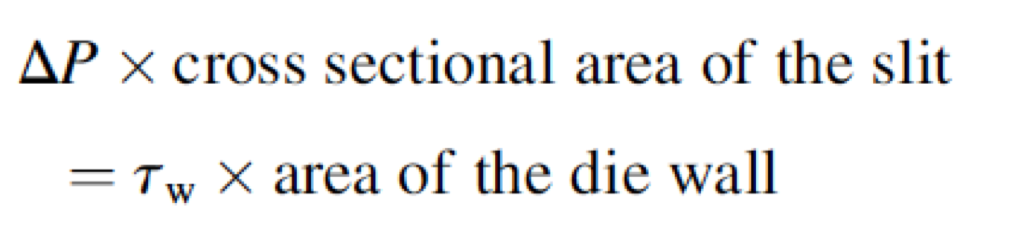
The shear formula of the boundary shear stress can be obtained


Where F*(x=H/W) is
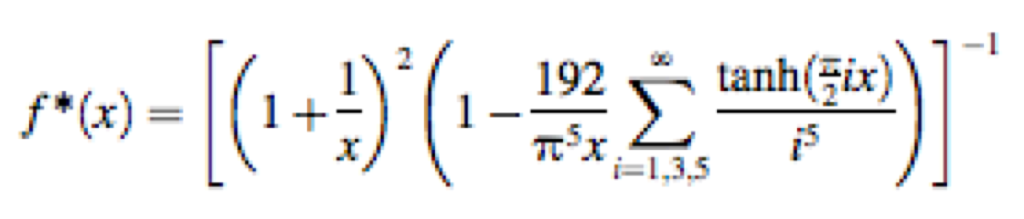

The specifics of the f* parameter can be observed in the lecture notes which I have attached. It is the result of the solution to a differential equation, by summing together the homogeneous and inhomogeneous parts of the solution to get the velocity field, then integrating to get the flow rate Q. The F*(1+H/W) portion is often omitted; for aspect ratios < 0.8 the error is sub-5%.
According to Bruus,

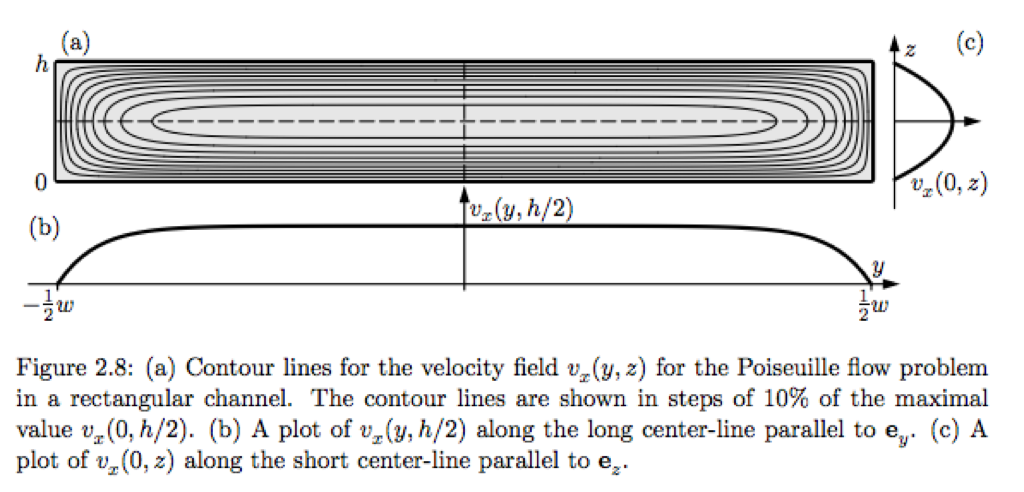

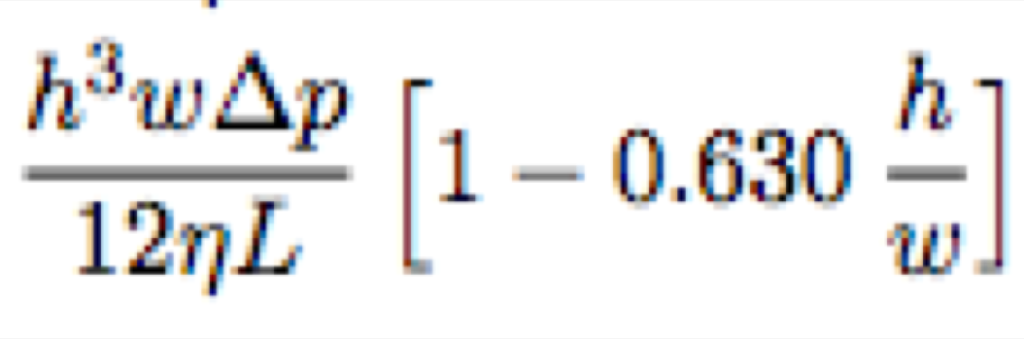
Substituting in various aspect ratios for the fluidic channel produces different flow and pressure requirements to generate the shear stress. Reducing the height of the channel is the way to most effectively generate more shear stress.
To generate a shear stress of 6 dynes/cm^2, for an aspect ratio of 0.3, Q=711 uL/min. For an aspect ratio of 0.1, Q = 77.5 uL/min. Not much pressure is used to drive these flows, hundredths of PSI.