For real this time: BSA-TRITC conjugation procedure works!
I made this post last week concerning testing this procedure to make sure that the resulting solution is in fact fluorescent BSA and not just a mixture of free BSA and free TRITC. Unfortunately, I exercised my right as a rookie to make silly mistakes and confused 5-TMRIA for 5-TRITC! The two particles are very similar in a lot of ways (both begin with “tetramethylrhodamine,” at least) but the former is not a good candidate for conjugation with BSA when compared to the latter. So, I’ve ordered some actual TRITC and run the same flow chamber tests. It’s worth noting that, unlike the apparently-colorless TMRIA conjugate I tested before, the TRITC conjugate retains its bright pink color after being subjected to roughly 20 hours of dialysis in a 50kDa MWCO membrane (TRITC is only a few hundred Daltons,) so I suspect that this flow chamber data is redundant.
Both the TRITC only and BSA conjugate cases saturated the fluorescence microscope when undiluted, so I diluted both to one tenth their stock concentrations. In theory the concentration should have no effect on the characteristic time-to-equilibrium, so I just needed to get both solutions to fluoresce at levels that the microscope can handle.
Fluorescence values are normalized such that “1” represents the final value that the fluorescence reached, and the first displayed data point was taken immediately after three minutes of photobleaching with the rhodamine lamp. The time it takes for the sample to reach the average between these two points is defined as the characteristic time, and by comparing characteristic times, a comparison can be made between the sizes of the units of fluorescence (that is, a TRITC molecule in the TRITC only case and a BSA molecule with TRITC particles bound to it in the BSA&TRITC case.)
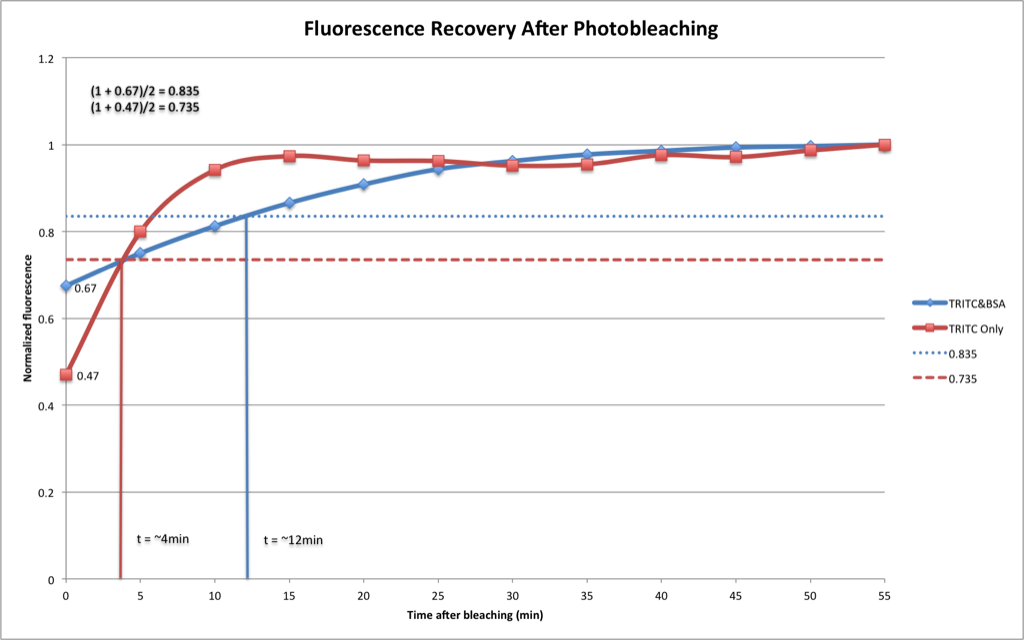
The TRITC only case recovers considerably faster than the BSA&TRITC case, suggesting that the TRITC in the BSA&TRITC case is conjugated with the BSA, just as hoped.
I’ve ordered some much larger dialysis membranes and plan to start making much larger quantities of 6mg/mL fluorescent BSA as soon as it comes in. I have enough TRITC to make roughly 150mL of the stuff, so there should be no shortage. I’ll make a batch and leave it labeled in the freezer for anyone who needs some to make use of.
Now that this is settled, I can proceed back to protein adsorption tests!
I’m a believer! Well done.