Changes in hydrophilicity of EA treated pncSi after storage in water
In my previous post, I mentioned that the EA treated chips showed decreasing contact angles after their storage in water in contrast to gel-pack or vacuum container. However the EA treatment was 4 days old, and I lacked adequate controls. So this time, I chose smaller time durations to understand if this phenomenon can be seen within 24 hours itself or if it requires more time. Freshly BOE pncSi was chosen as a control. EA treated chips were about 12 hours old. The time points were t = 0 mins, 15 mins, 1 hour, 8 hours, and 24 hours. I observed that untreated pncSi is hydrophobic initially due to oxide removal, but slowly gains its hydrophilicity after storage in DI water (no chip was used twice). Similar trend was seen with EA treated pncSi also. The rate of change in contact angles do differ for the two surfaces though. Whether this affects protein binding or not needs to be tested further.
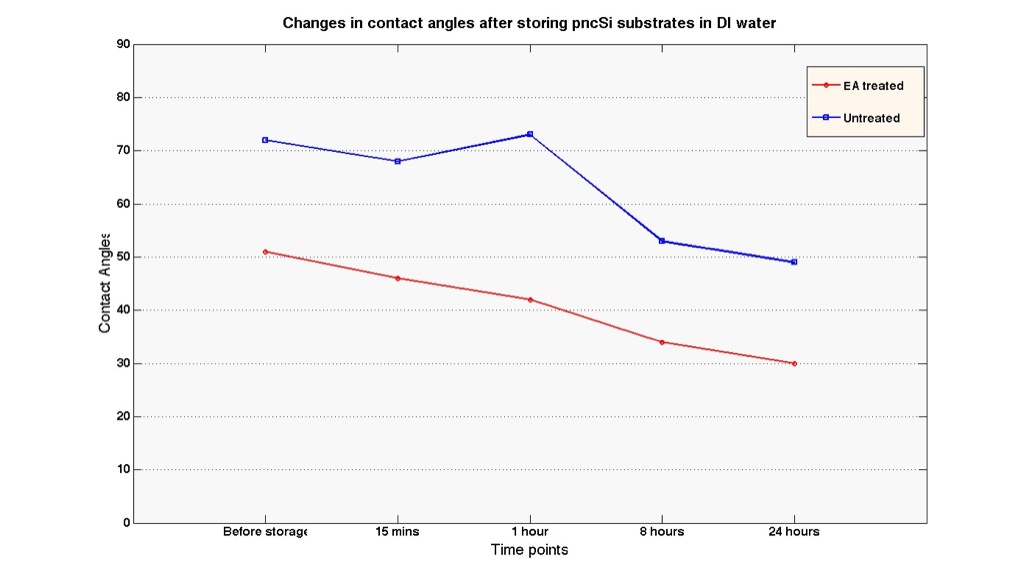
I don’t understand the decline in contact angle, but this was a study to examine the stability of the EA treatment in water and seems to point to the persistence of the coating.
Perhaps you can explain what you mean by hydrophobic vs hydrophilic and why. You are using non-standard definitions and may be confusing people.