Acoustic Based Separation of Nanoparticles
Separation of Nanoparticles using surface acoustic radiation force:
Surface acoustic waves (SAW) can be defined as mechanical waves which propagate on the surface of an elastic medium which most of its energy is concentrated in the surface. It’s been used in many different biological applications such as separation of cells, tumor cells, microvesicles, nano and microparticles in addition to particles focusing, and droplet manipulation.
By applying AC voltage on a pair of electrical transducers (IDTs) which are deposited on a piezoelectic substrate, a pair of surface acoustic waves would be generated with the same magnitude but opposite direction. SAWs will be interfere constructively with each other, causing a standing surface acoustic wave (SSAW). Formed SSAW has pressure nodes (minimum pressure) and pressure antinodes (Maximum pressure), which apply acoustic radiation force on particles in the system and push them towards nodes or antinodes depending on their acoustic contrast factor. Acoustic radiation factor depends on mechanical properties like density and compressibility.

ϕ>0 : Moving toward pressure nodes (solid particles in aqueous solutions e.g. biological particles)
ϕ<0 : Moving toward anti pressure nodes (gas bubbles and lipid particles)

Lee et. al., ACS Nano, 2015 ( Acoustic Purification of Extracellular Microvesicles):
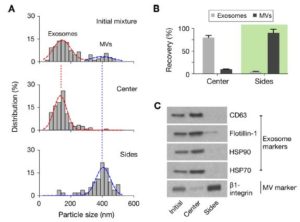
In this paper, they reported separation of microvesicles and exosomes using acoustophoresis. 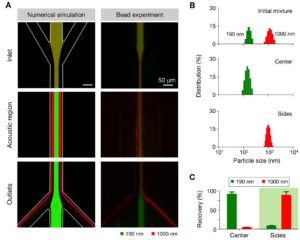
Wu et, al., Advanced functional Materials, 2017 (Acoustic separation of nanoparticles in a continuous flow):
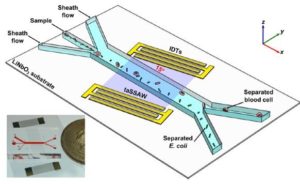
The applied a new idea in their design leading to a better separation efficiency compared to traditional designs which was tilted angle design. This design would help to have a better sensitivity because of 1. Larger lateral displacement 2. multiple pressure nodal lines:


Thank you