TEOS Membrane Co-Culture Devices
Over the past week Andrea and I designed a new co-culture support structure for use with SiMPore’s 5.5 mm square membranes. The devices are built for use in standard 24-well plates and should prove useful to anyone wanting to do basic co-culture with these membranes going forward.
The device is constructed of PDMS rings as follows:
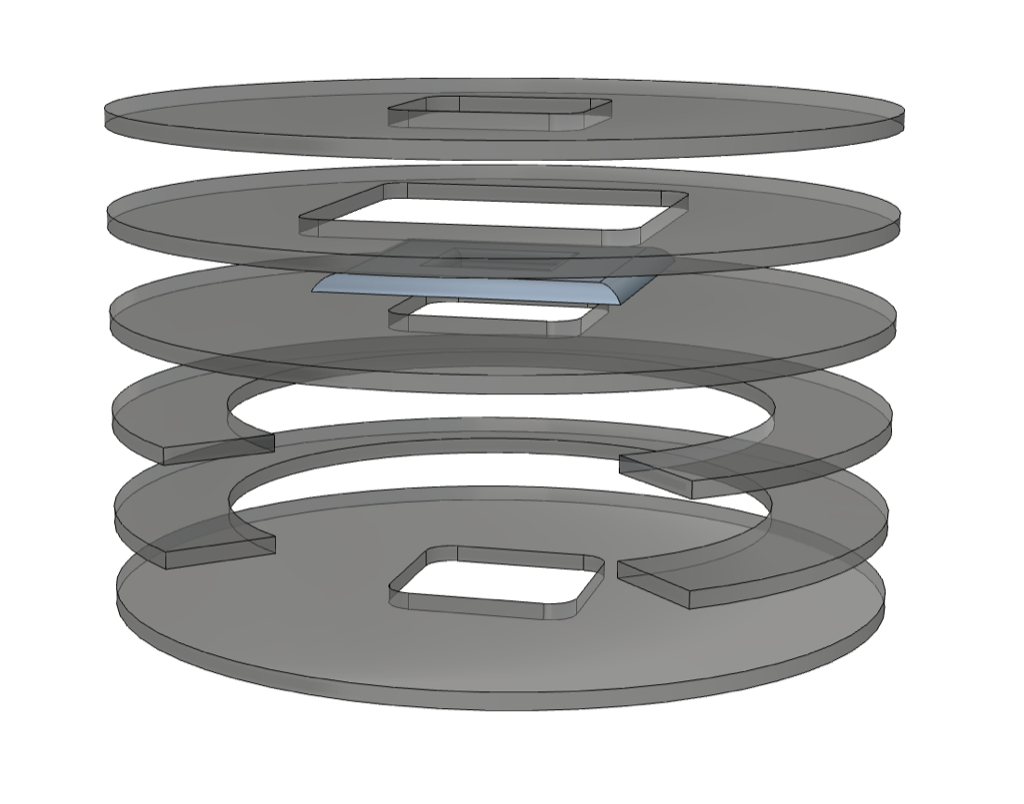 Each layer is 300 microns tall, meaning that the total height of the device is 1.8 mm while the distance from the bottom of the well to the membrane is 1.2 mm. This means that both sides of the membrane are comfortably within the focal range of the microscope. The open C layers allow for the diffusion of media from the underside of the membrane into the bulk media within the well.
To load the device, begin by placing it upside down in a 6-well plate and placing cells onto the membrane (using 5-10 uL of cells). Media will have to be added periodically to avoid evaporation, but should not be added all at once or it will wick the cells into the empty space in the C chambers – thereby modifying the intended seeding density. Once the cells have had time to attach, the C’s can be filled with media and the device can be transferred right-side-up to the 24-well plate.

Once in 24 well plates, the second set of cells can be added on top of the membrane. Once they have had time to attach the well can be flooded with media. As long as all of the air was driven out of the device by loading the C sections with media, the devices will stick to the bottom of the 24-well plate without fear of floatation.
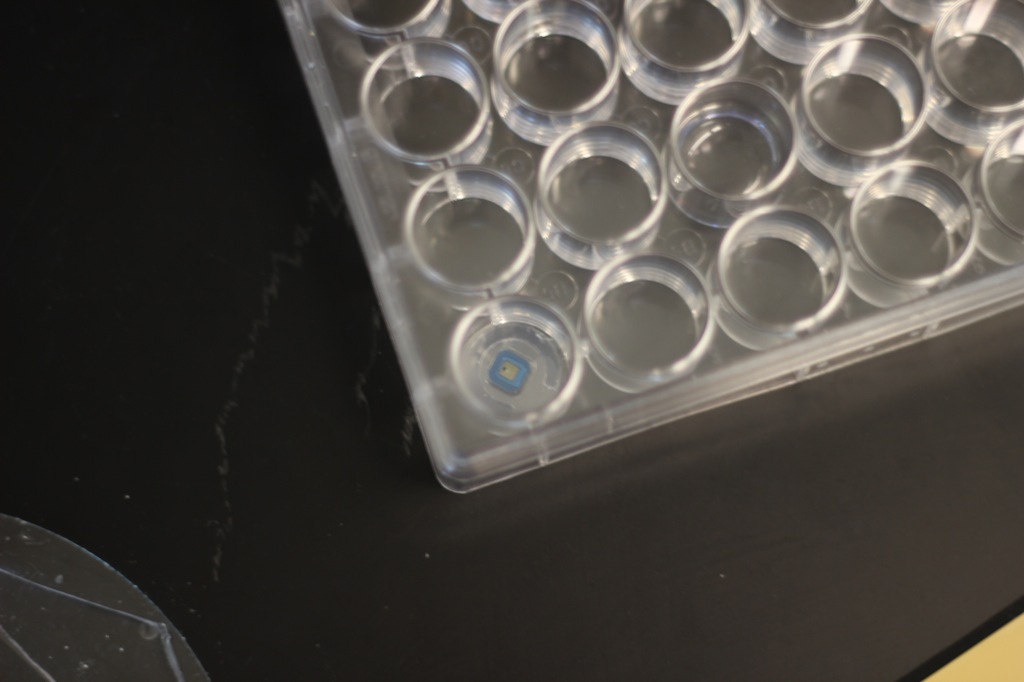
While initial tests failed due to rapid evaporation, all other aspects of the design seem well suited for cell culture and imaging. Given more frequent addition of media during the cell-attachment phase, evaporation should be sufficiently mitigated so as to make this design viable for future co-culture experiments.
We ran into similar problems before with similar design (problems = evaporation and the potential introduction bubbles during media change) ).
Instead of a C if you have a ( ) sometimes you alleviate the problem with trapping a bubble in the cell compartment.
Increasing the fluid volume of the system is one way to fight off the evaporation issue, but it’s not good if the media is expensive.
Closed system may be the way to go to reduce evaporation (less surface area for evaporation), but at the same time other problems are introduced…. i.e. need to aerate the media (with CO2) and maintain the physiological pH change.
I think closed system may still be better overall, because if the media dried out then it’s game over. The CO2 aeration and the exchange of nutrients and wastes may be solved with daily exchange of media for the time being.