Forward vs Reverse separations (continued)
We have previously tested the effects on filtrate volume after a given time as a function of concentration.
Moving forward we want to quantify the improvement in filtrate volume when using reverse centrifugation instead of forward centrifugation.
Initially, we attempted to create similar plots to those in the preceding post but got the following gobbledeegook:
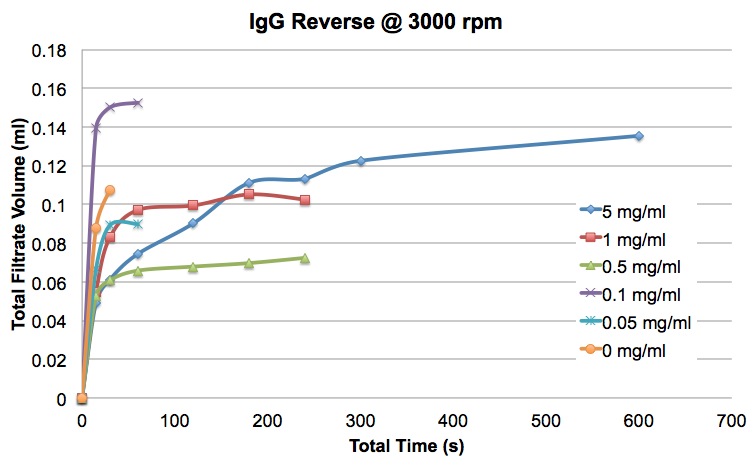
Although the plotted lines look similar to the forward centrifuge tests, the total volume flowed is somewhat uncorrelated to the concentration. This is most likely due to experimental error. In the forward configuration we measure the filtrate volume by weighing the centrifuge tube after removing the SEPCON. In the reverse configuration, we have to weigh the modified SEPCON. There is always some error because the outside of the modified SEPCON has solution adsorbed to it and this amount changes by several uL with each measurement. We have also tried weighing the centrifuge tube and inferred the filtrate volume from the mass loss. This fails sometimes as well because liquid escapes out of the tubes sometimes until an equilibrium level is reached between the fluid height and the modified SEPCON position.
In order to minimize the problems with successive measurements, we have decided to simply measure the total filtrate volume after 10-30 minutes. We also simplified by focussing on the higher concentrations where reverse centrifugation should have the most benefit. We take adjacent chips from a wafer (1085 in this case) and mount them in a forward and reverse centrifuge setup. Spin for a given time and compare filtrate volumes. In general we find the reverse configuration has a slight increase in total filtrate volume over the forward configuration. Here’s a plot with a little bit of everything regarding 20 nm NPs:
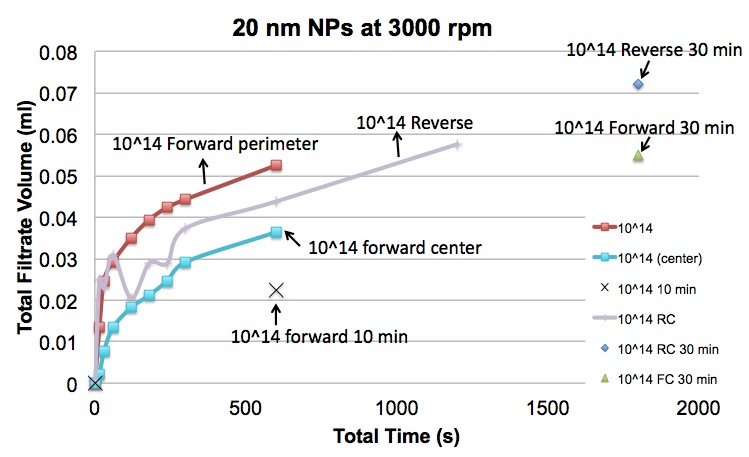
Reverse is an improvement, but only by ~30%. Next we looked at Forward vs. Reverse for IgG:
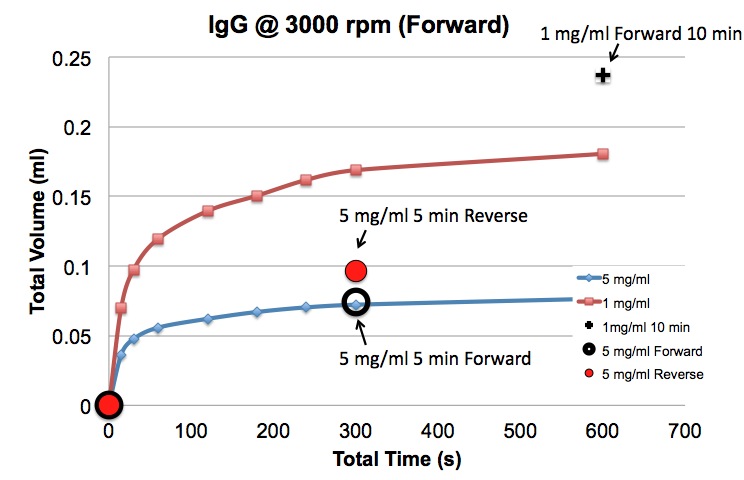
Again, about ~30% improvement. Finally, we attempted a comparison using a combination of NPs and IgG. The solution was 10^14 NPs and 1 mg/ml IgG in 1xPBS/0.1% Tween 20. After 30 minutes at 3000 rpm, Forward=41 ul and Reverse=52 ul. Better, but not great.
I put the samples back in for 30 more minutes, this time using 5000 rpm and this time Forward was better with 95 ul vs Reverses 80 ul.
At some point, we could not get a solution of NPs and IgG to filter through our membrane unless we switched to the reverse orientation. This was validated by collaborator. We were using smaller pores for the initial tests (wafer 1070, %, nm). Maybe that’s the difference?
Next we plot the the concentrations measured by the TECAN of the filtrate and retentate from both the forward and reverse conditions.
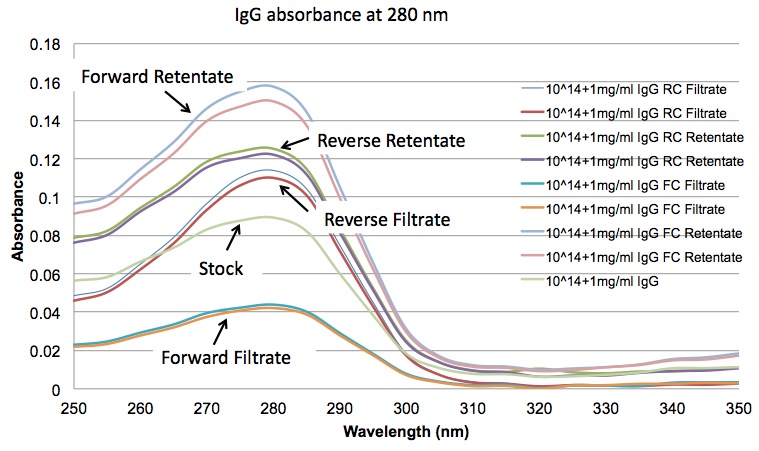
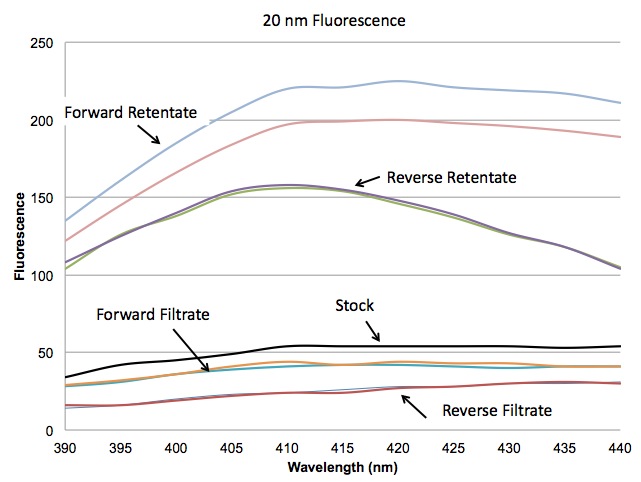
It looks like the reverse configuration is doing a better job of passing IgG while retaining NPs. (I think there is something off about the Stock fluorescence line. It should probably be higher)
In conclusion, the membranes continue to clean up NP + IgG combinations. The larger pores of wafer 1085 are letting more NPs through than when we used wafer 1070 which had smaller pores. We should try to use pores closer to 40 nm in the future.
While there are benefits to using the reverse centrifuge configuration, I’m not sure it’s always worth the additional effort. Perhaps going forward we should use the forward configuration until we run into a blockage problem?
Argh. The best laid plans … When can we get some smaller pores NPN? I think we need to test your hypothesis the pore size makes the difference.
The Abs280 looks like you’re getting better discrimination btw filtrate/retentate with the forward centrifugation. Analytically, its challenging to weigh small liquid changes without biasing the data due to hang up drops etc.
I wonder if you could add a co-solvent that would reduce surface tension to the IgG solutions…maybe ethanol? A google search showed water surf ten (~ 72 mN/m) and ethanol (40%)/H2O ~ 30 mN/m. PDMS would also reduce surf ten but its not very water soluble. Just a thought….
Mary Lee- I agree we seem to be getting a difference in discrimination between forward and reverse. I saw this again in a later post when I used membranes with smaller pores, so it seems to be more than a one-time fluke.