HUVEC alignment on SiN membrane under flow
Hi all,
A while back I have posted about my attempt to culture bEnd3 (mouse brain endothelial cell) underflow, which failed to maintain bEnd3 proliferation and did not promote alignment under flow. As an alternative/control, I switch the cell types to HUVEC (human umbilical cord endothelial cells), which is known to do well under flow.
To make a long story short, HUVEC is able to proliferate on the SiN membrane in the presence of flow and even align to some extend.
Below is a quick recap of the device set-up:
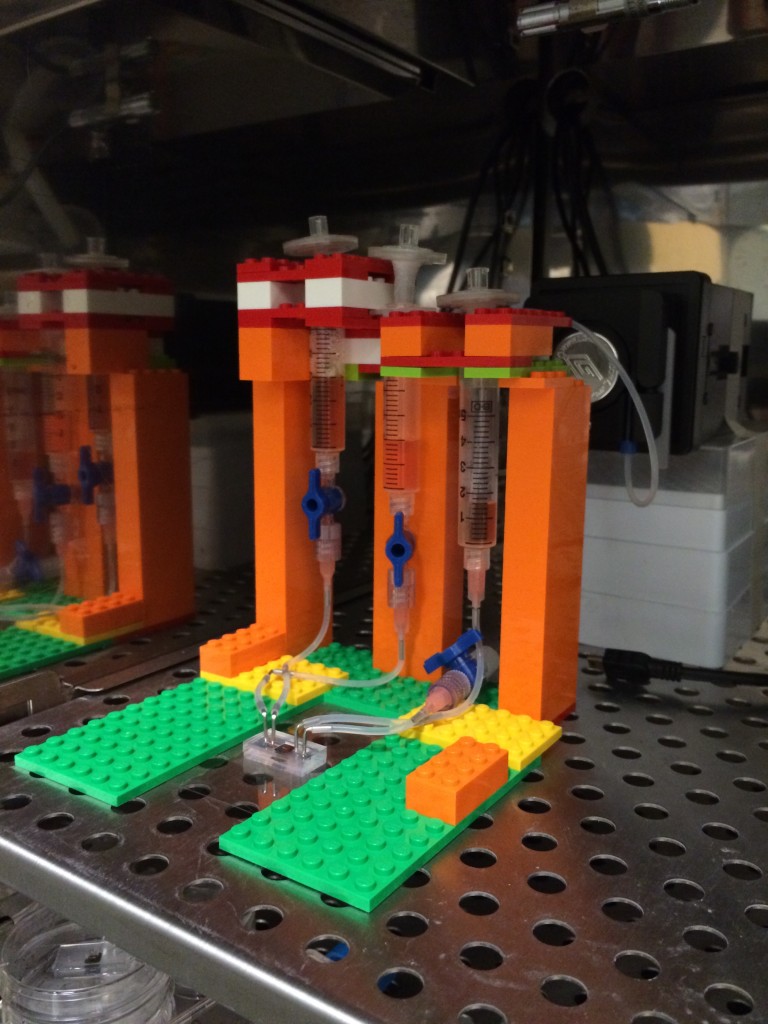
The fluid flow is driven by hydrostatic pressure, created through the differences in the heights of the fluid columns. The height differential between the left and the right syringe drives the flow on the top side of the membrane where the HUVEC were seeded. The middle syringe is connected to the bottom side of the membrane. Ideally, the height of the fluid column in the middle syringe should be an average of those in the left and the right syringe. In theory, such a fluid column height should create a back pressure that evens the total transmembrane pressure to zero.
Note that eventually the heights of the fluid columns would all be equal over time. To prevent this from happening, a peristaltic pump (behind the LEGO setup) is used to dump the fluid built-up in the right syringe back to the left syringe. Note that if the height differential creates a flow much faster than that enabled by the peristaltic pumping, the height differential would eventually reduces to match the peristalsis. The reason why we did not just use the peristaltic pump to drive the flow is due to periodic membrane deflection under peristalsis.
PS: The peristaltic pump that we use (actually scouted out by Greg Palis of the Waugh Lab) is the Langer Instrument BQ50-1J, which rated to operate in the incubator (37°C, humidity < 80%).
Zoomed-in view of the flow cell hosting the SiN membrane chip (FlowSiN):

Detailed assembly of the flow cell can be found in this post.
Alright, HUVEC experiments:
Before cell seeding, one FlowSiN is geltrex-coated while the other one receives no treatment at all (null). The geltrex protocol is given to me by Alan Man of Gaborski Lab. Essentially, solution of 1% geltrex (in PBS) is introduced to the top and bottom channel to coat for 30min, and then suctioned out and let dry in the incubator for at least 15 min. NOTE: geltrex is essentially a collection of basement membrane components isolated from murine Engelbreth-Holm-Swarm (EHS) tumors. Can be purchased from Life Technology (Cat No. A1413202).
I seeded at 5×10^6 cells/mL, which translate to ~15×10^6 cells/cm^2 in the 1cm x 1mm x 300 μm channel. I let the HUVEC attach for 2 hr in the FlowSiN in the incubator. To reduce media evaporation, the FlowSiN is placed in a petridish filled with plenty of sterile DiH2O.
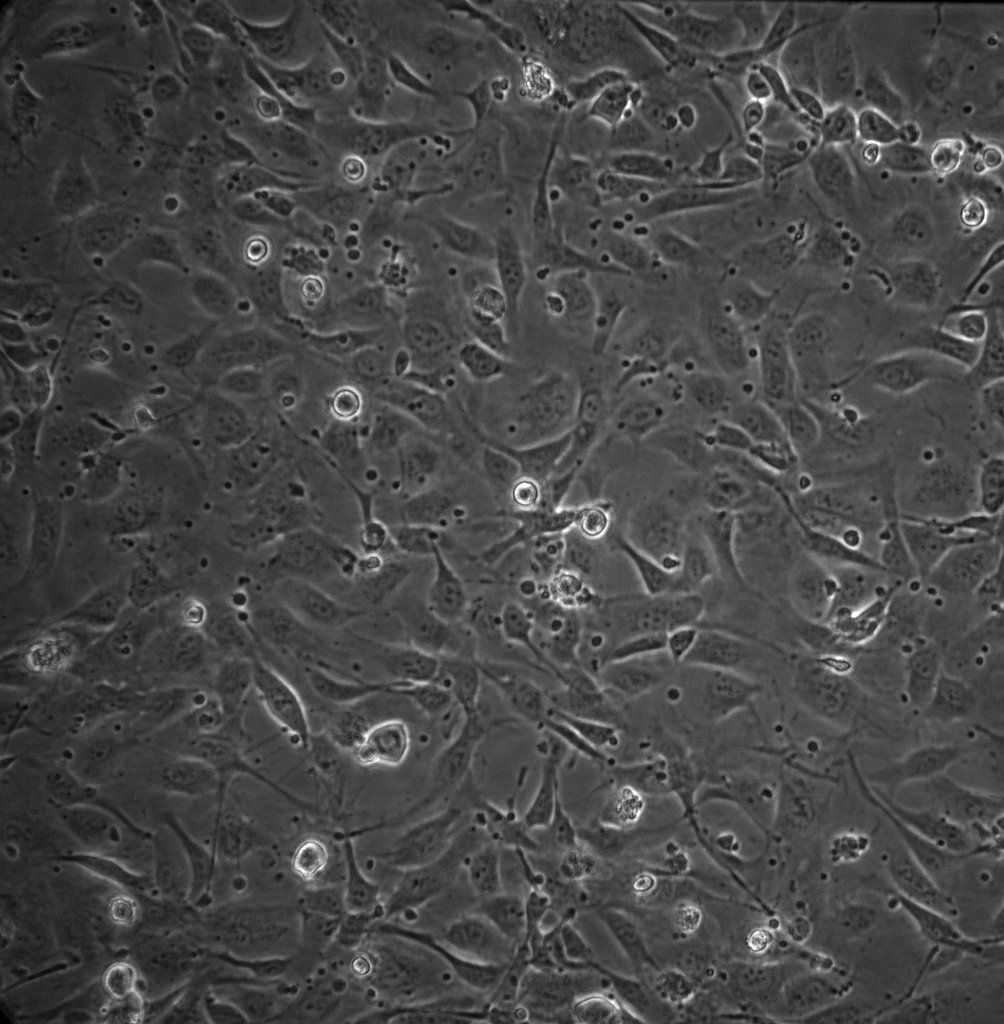
geltrex-coated sample:
null control:
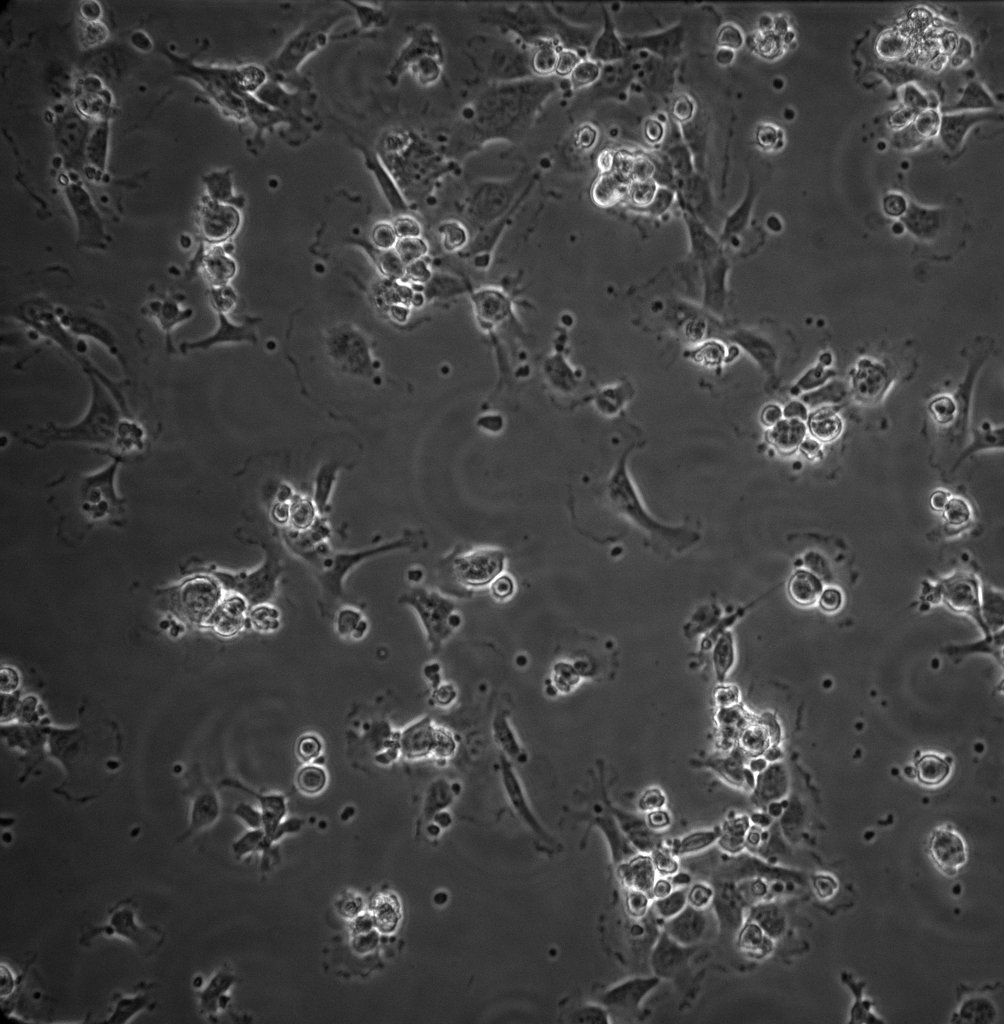
Clearly the HUVEC are a lot happier on geltrex. We are interested in seeing how the cells do on the bare SiN membrane because the SiN may be appropriately charged to promote cell adhesion (much like the plasma-treated tissue culture plastics). I have also tried coating the SiN membrane for 2hr with MCDB 131-based medium (that is supplemented with serum proteins and other proprietary reagents). These substrates also did not work as well as the geltrex. Essentially, some of the cells would do fine, while many failed to spread (remaining spherical).
Nevertheless, some HUVEC would eventually be fine and strive to confluency. For example:
null after 3 days (before wash):
null after 3 days (after wash):
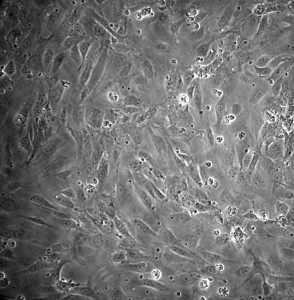
the sad cell blebs can be washed off. This data also showed that the cells are able to do proliferate in a small channel with < 20 μL of volume (with 2 cm of distance between the punched holes to allow CO2 exchange). I have other samples where the HUVEC are doing quite alright under similar setups.
Anyway, so now we introduce flow.
After I set up the device some of the HUVEC were stripped off. This is either due to flow or membrane deflection that occurred when I hook the FlowSiN to the height-based flow setup:

I tried to image at the same location near the center of the membrane. And start a 6.66 dyn/cm^2 flow.
Day2:
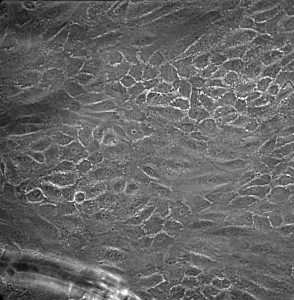
I was expecting a right-to-left alignment since that was the direction of flow. Instead there is some minor alignment toward the center. I suspect this may be due to the deflection of the membrane downward, or in the shape of a wave. The membrane deflection may produces stress and perhaps a local variation in flow stream that veers the cells toward the center. Since there is also a flow stalling (due to bubble formation in the tubing), I am not sure for how long were the HUVEC subjected to flow. I de-bubbled the system and resumed the 6.66 dyne/cm^2 flow.
Day 3:
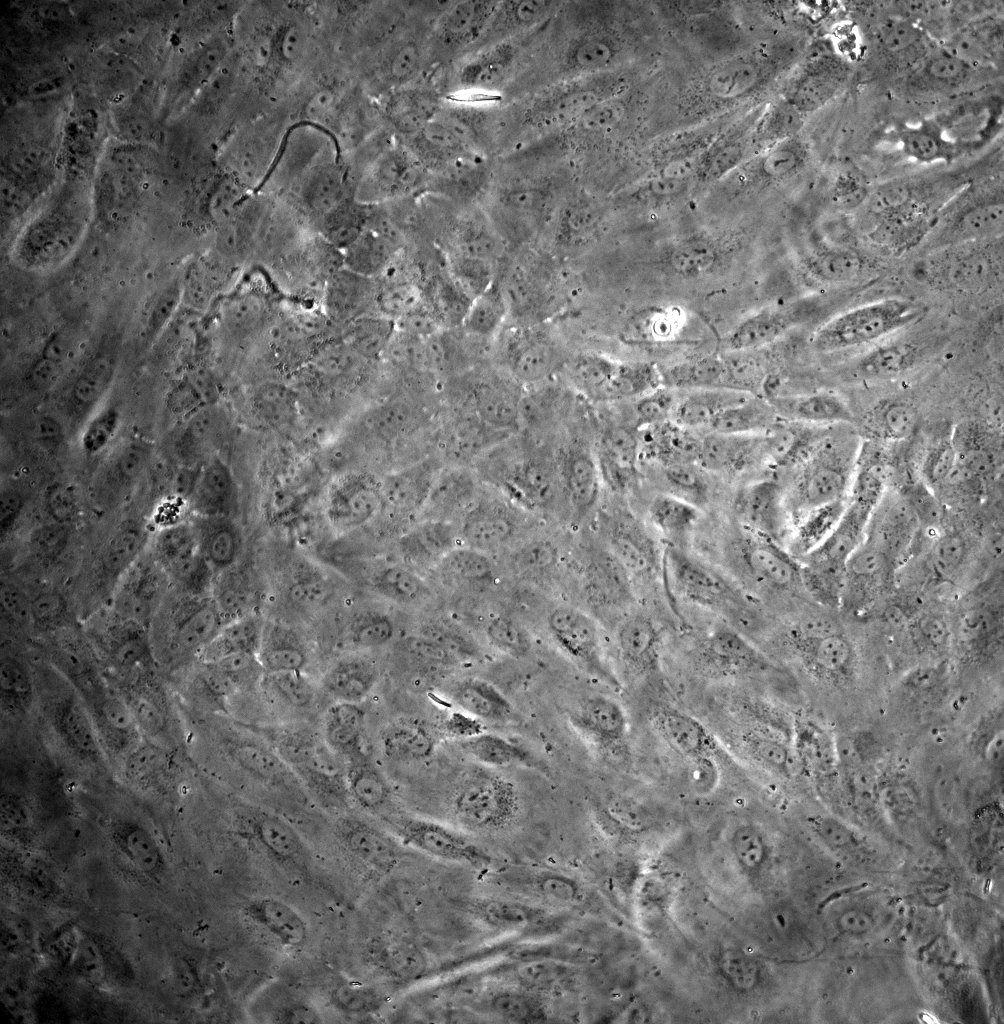
Still no pronounced alignment. I experienced more stall in flow. This usually doesn’t happen. But if it does it tend to happen again and again… Possibly due to bad tubing insertion.
I started another flow run. This time I varied a few parameters. After 30 min incubation w/ 1% geltrex I also performed a PBS wash (3 times) before letting the device dry in the oven for 15 min. I also seeded the cells at a lower density (~5×10^6 cells/cm^2), hoping that there is more space for the cells to align. The flow rate is also cranked up a bit (shear stress ~8.88 dyn/cm^2).
After seeding:

Day 2:
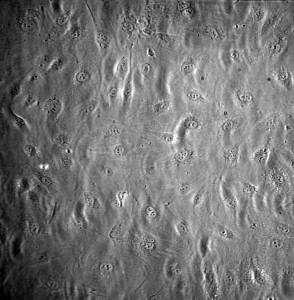
again, some moderate alignment toward the center, along with some proliferation.
Day3:
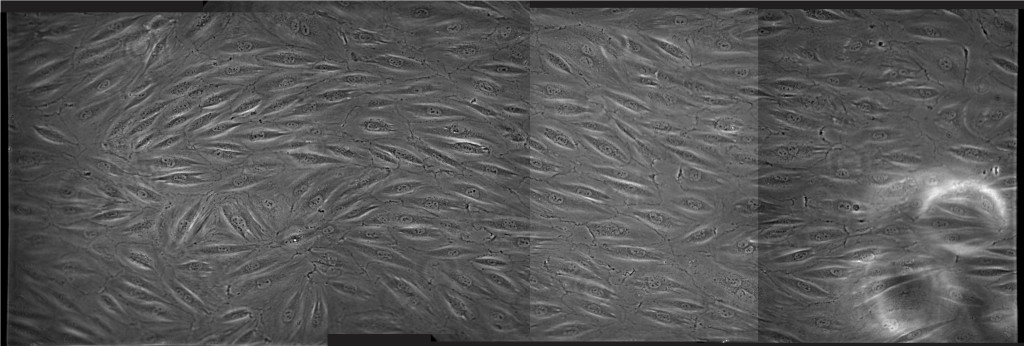
Prominent alignment. i made a collage of images spanning the entire membrane (2mm x 700μm; right to left = flow entrance to flow exit). In addition to right-to-left alignment, there also seems to be two epicenters in which the cells warped toward. This is consistent with the stress pattern on/flow pattern over a deflected SiN membrane. These are two possible scenarios:

The cell alignment appeared somewhat consistent with the pattern of membrane deflections. Again, too early to conclude. Will need to revisit.
I will update the posts again should I see more similar patterns…. the presented data are actually from the 2nd and the 3rd run that I tried with HUVEC. So far all three tries shows cell alignment that is not entirely right-to-left. I think I may try the geltrex coating for bEnd3 to see if that could do the trick.