ASDC Characterization on PDMS Substrates
Conventional tissue culture substrates do not accurately emulate in vivo surface conditions. This project involves the development and characterization of a polydimethylsiloxane (PDMS) substrate for cell culture.
PDMS is an important biomaterial due to its optical transparency, biocompatibility, and variable elastic modulus. ADSCs and HUVECs were used to analyze spreading and proliferation on PDMS-based substrates of varying surface topographies and stiffness. Silicone (Sylgard-184) was used to make microtopographical posts and dimples. Substrates of varying stiffness were made by tuning the ratio of two different silicone formulations.
Devices: As mentioned in prior NRG post, preliminary experiments were conducted to analyze the effect of Corona ozone treatment experiments on PDMS substrates over 72 hours. These experiments concluded that after 24 hours, the surface energy of all treated surfaces were comparable. All PDMS experimental substrates are bonded to a custom cut silicone retention ring. Devices were bonded to bottom of 24-well plate, UV sterilized, and pre-treated with a 1% Geltrex solution.
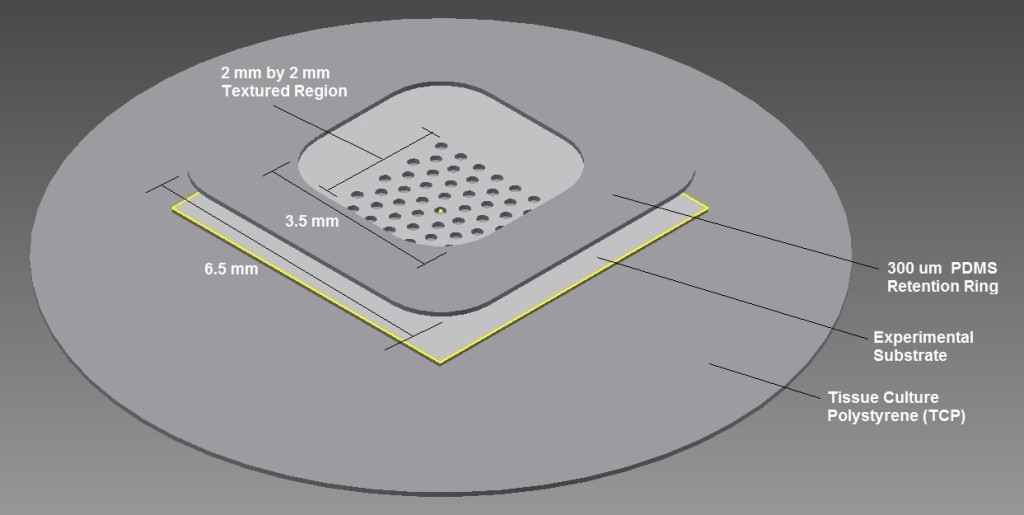
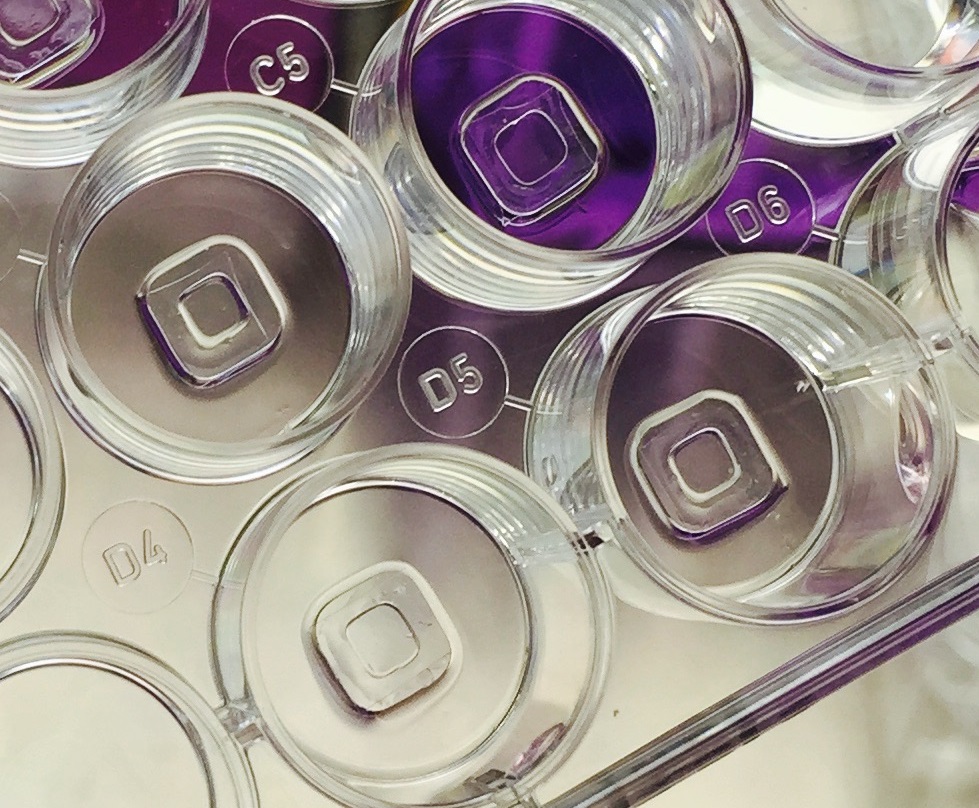
Experimental Substrates:
The process for the fabrication of the substrates is discussed in the PDMS Posts post as well as the post by Spencer on HUVEC spreading. However, changes in stiffness were achieved by mixing Sylgard-527 and 184 in different ratios to alter the stiffness over three orders of magnitude (5.05 kPa- 1.72 MPa). The materials were degassed separately, mixed well, degassed, and allowed to cure at 70C overnight. The substrates we used for each experiment are as follows:
- TCP
- Stiffness: Sylgard-184 100%, Sylgard-184 75%, Sylgard-184 50%, Sylgard-184 25%, Sylgard-527
- Topography: Smooth PDMS, 3-um dimpled PDMS, 8-um dimpled PDMS, 8-um posts PDMS
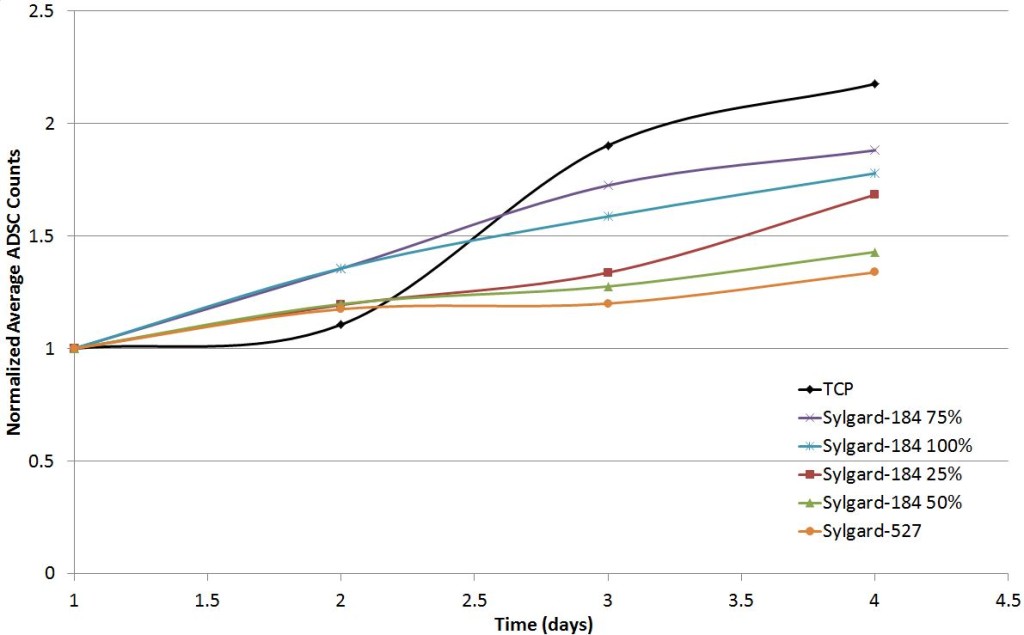
ADSCs on PDMS of Varying Stiffness: Proliferation experiments show that cells grew on all substrates over 4 days. Each cell count was normalized to day 1, and then averaged. Due in part to high variability among substrates, there was no statistical difference between substrates of varying stiffness. Spreading was assessed by ANOVA (p-value <0.01). The top 75% of data was kept to exclude dead and dividing cells. Only TCP was found to be statistically different from the other substrates. All PDMS substrates had similar spread area. These results suggest that substrates within the tested stiffness range did not affect proliferation or mean spread area.

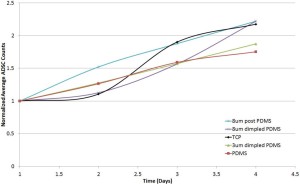
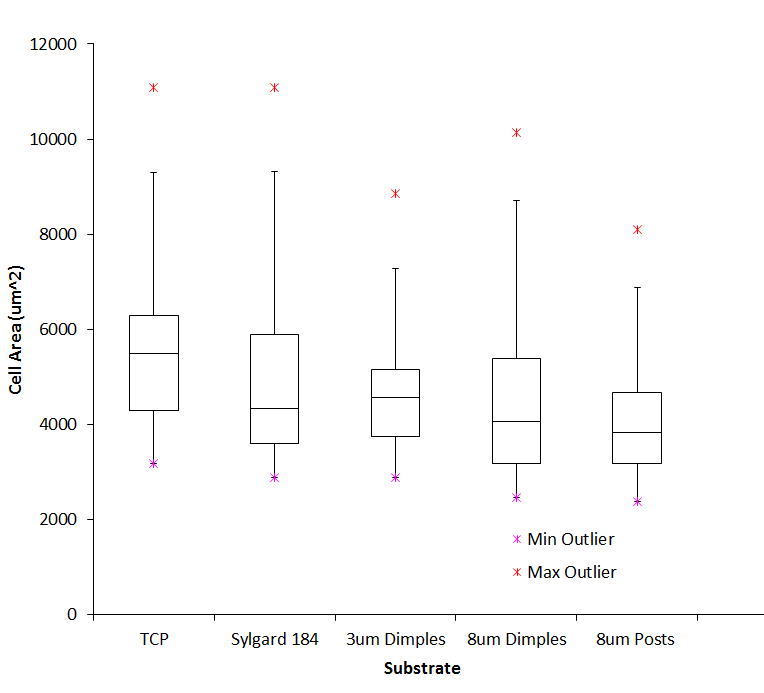
ADSCs on PDMS of Varying Topography: Proliferation experiments show that cells grew on all substrates over 4 days. Each cell count was normalized to day 1, and then averaged. The was also no statistical difference amongst substrates of varying topography, however 8-um post, 8-um dimples, and TCP appear to have similar growth rates. Spreading was assessed by ANOVA (p-value <0.01). The top 75% of data was kept to exclude dead and dividing cells. Only TCP was found to be statistically different from the other substrates. These results suggest that although surface topography may affect cell spreading, it does not appear to affect proliferation rates. However, with increasing feature size, cells had smaller mean spread areas.