HUVEC Spreading on Various Substrates
To continue our spreading and proliferation experiments on various topographical features and stiffness, I repeated the HUVEC experiments I had done before due to a possible artificial bias that we think is a result of high seeding. To enusre accuracy, I repeated the experiment and added another plate to test the HUVECs on substrates of different stiffness as well. The substrates were made as they were in the prior experiments and the 527/184 procedure is also described in prior posts.
Again, I ran four wells with each condition, each condition being
- 100% 527
- 25% 184/75% 527
- 50% 184/ 50% 527
- 75% 184/ 25% 527
- 100% 184
The plates were seeded at 110 cells/mm^2 and fixed with 3.7% formaldehyde. They were stained for nuclei and F-Actin. 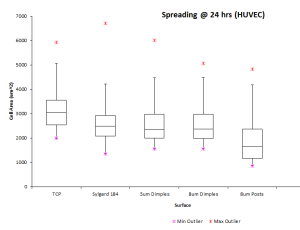 This time around, we can see a similar trend to the ADSCs. The posts produce the smallest spread area, while the other Sylgard substrates are relatively indistinguishable from each other. Again, TCP remains at the top (producing the greatest spread area). It seems like somehow the dimples or posts are impeding the cells from spreading, their mean spread areas being less than that of any other Sylgard substrate we tested. As with the ADSCs, the posts produced the least mean spread area, but this time they were statistically different. TCP was statistically different from the others by our cutoff of .01, but Sylgard, 3um dimples, and 8um dimples were not statistically different from eachother. Again, we can’t really see a conclusive trend other than the fact that microtopographic posts and dimples seem to impede the spreading process.
This time around, we can see a similar trend to the ADSCs. The posts produce the smallest spread area, while the other Sylgard substrates are relatively indistinguishable from each other. Again, TCP remains at the top (producing the greatest spread area). It seems like somehow the dimples or posts are impeding the cells from spreading, their mean spread areas being less than that of any other Sylgard substrate we tested. As with the ADSCs, the posts produced the least mean spread area, but this time they were statistically different. TCP was statistically different from the others by our cutoff of .01, but Sylgard, 3um dimples, and 8um dimples were not statistically different from eachother. Again, we can’t really see a conclusive trend other than the fact that microtopographic posts and dimples seem to impede the spreading process.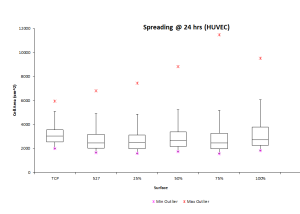 With the various stiffnesses, we again see no real trend other than that all of the Sylgard substrates seem to produce similar spread areas. Interestingly enough 100% 184 (the stiffest substrate) produced larger spread areas than any of the other Sylgard formulations but after an ANOVA test, the p-value wasn’t below .01 but it was below .05. Our cutoff for these experiments was .01 but it did have a lower p-value than any of the other substrates did with each other. TCP was statistically different from the other substrates but the p-value with 100% 184 was higher than with the other substrates. There seems to be no conclusive trend between spreading and stiffness, possibly the spread area was increasing if the mean values were examined, but it would be a loose trend nonetheless.