Update in Microdialysis Research
So in the past couple of months, I have focused on wrapping up the microdialysis project that was initiated by Alec. Just as a recap, this experiment utilizes a modified SepCon that features an open bottom to allow for separation of albumin and cytochrome c via diffusion. 50 uL of 1 mg/mL BSA and cytochrome c ‘serum’ was placed in each SepCon containing 75 nm NPN, PEGylated 75 nm NPN, windowless 4645 chips, or pegylated 4645 chips. These were floated in a beaker containing PBS, and via a magnetic stir bar, the beaker was slightly agitated to allow for more optimum diffusion (Figure 1). After 24 hours, the remaining fluid was sampled and assayed for albumin and cytochrome c concentrations. Main issues that delayed data collection through out this project were pressure and evaporation. To try to alleviate pressure effects on seperation, the fluid levels (in the SepCon and the beaker) were matched as best as possible and to prevent evaporation, the SepCon was covered with parafilm.
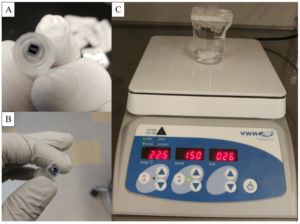
Figure 1. Experiment setup for microdialysis.

As is seen in Figure 2, there is more cytochrome c loss than albumin loss but what is interesting is that there is significantly more albumin loss for the PEGylated membranes compared to the nonPEGylated membranes, the opposite of what was expected to happen. This could be due to the fact that evaporation was not taken into account for the nonPEGylated experiments and as a result, the remaining sample appeared to have less loss due to it being more concentrated. Also important to note is the following table of losses for all membranes used.
| Cyto C | BSA | |
| PEG 75 nm NPN | 0.67 | 0.42 |
| Non-PEG 75 nm NPN | 0.6 | 0.35 |
| Nonporous 4645 | 0.06 | 0.26 |
| Nonporous PEG 4645 | 0.2 | 0.03 |
When pegylated, the windowless chips had more cyto c and less albumin loss to the SepCon than the nonpegylated windowless chips. Additionally, the loss of the analytes remained roughly the same for the pegylated and nonpegylated 75 nm NPN membranes with slightly improved cyto c loss and less improved albumin loss when pegylated. Again, this could be explained by evaporation not being taken into account for the nonpegylated experiment so it seems like there is less loss.
In order to show the main mechanism of separation was diffusion and the membranes were indeed filtering, the microdialysis experiments were performed using 50 uL of 1x PBS suspended in a beaker of DI water. The conductivity of the initial solution and after 24 hours of microdialysis was measured using a conductivity probe. Figure 3 shows the results of those experiments.
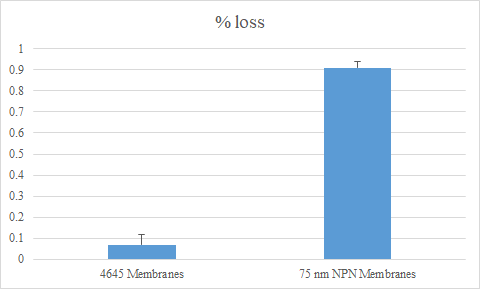
I think it is worth noting that during the conductivity experiments, there were volume changes in the SepCon after 24 hours. This can be explained by osmotic pressure. However, this does not change the accuracy of the final concentration because water and salt ions are permeable across the membrane (ultrafiltration).
To conclude, I think it would be worth performing the nonpegylated 75 nm NPN microdialysis again while accounting for evaporation just to see if this changes the results any, but the data does show the membranes are capable of filtering out more cytochrome c than albumin for both the pegylated and nonpegylated membranes.
