NSF STTR Goals
- Phase II submission August 1, 2016 or January 30, 2017
- UR Tasks – Biocompatibility by Feb. 1 2016
- Channel design optimization by November 2015
Recently I did some further research on the agglomeration in SiO2+Si layers. On my first post about agglomeration,I found that after annealing at 1000ºC for 1 min without susceptor, 15nm thick Si layer agglomerated and the average diameter of agglomeration islands is around 200nm. This time, I deposited three different thickness of top Si layers…
Before starting my transport project with the use of the Tecan, it was important to see how the Tecan worked with the sepcon and transwell kept in the well plate. The goals from this experiment were to: 1. Test for fluorescence from the plastic. 2. See if fluorescence from the apical side has an affect…
This is more work that Randi did looking at ADSCs migrating towards HUVEC networks. Motivation: To demonstrate the migration of ADSC toward pre-formed HUVEC networks when ADSC are seeded 4 hours after HUVEC. Method: Monday – Coat 4 wells of a 96 well plate with 100% Geltrex, place in incubator. Seed 20,000 HUVEC cells in…
The group in the attached paper have found a way to form pnc-Si using PECVD. They use a 300-15-300 nm OSO stack with a 850 C (50 C/s, 30 s) RTP to form ~13 nm pores. SiMPore attempted this in the past, but was not able to form pores. Using PECVD would be faster than our…
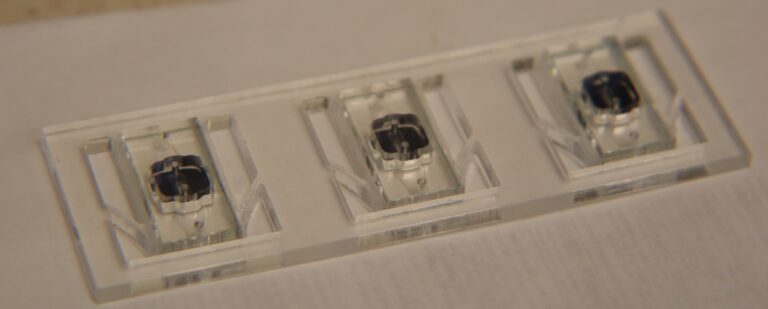
Introduction The Slide Body (Figure 1) has been used for a long time to image μSiM devices. This slide body has the same footprint as a traditional microscope slide but is designed to hold up to 2 μSim devices for imaging. The device has an open center with thin ledges where the edges of the…
Since we’ve been noticing slower discoloration in the Sepcon format, I looked at the 2 components of Sepcons – the plastic and the O-ring. Specifically, I cut pieces from w622 and incubated them in FBS-DMEM/F12 either alone, with the Sepcon plastic or with an O-ring. This was in the oven, and the chips were membrane…