Micromixing with nanomembranes “in chipo”
The idea here is to use nano membranes that have been integrated in a chip with the intention to mix otherwise laminar flow streams. It was suggested at one of the meetings that I should superimpose the streams, then have one of them come through the membrane into the other stream. The idea is great, in my opinion, it is just hard to implement with the current membrane set up. The chip that holds the membrane, and in particular the “cavity” or pocket that holds it, its pretty big. It creates a “dump” site for liquid that induces mixing by itself. I tried to get around it by laminating small entry and exit windows into the chip (to make the pocket part of the channel, in a way). The device then has common channel where streams run together and then the channel is divided again into two channels, so one can visualize if, in the negative control, the streams are displaying laminar, un mixed flow when there is no membrane. In other words, the hard part of this is creating a device with a chip in it that DOES NOT mix the streams in the absence of a membrane. The device is about 12 layers thick, the chip integrates perfectly but still mixes the streams by itself. So no negative control yet. A way to overcome the chip dimensions is to deposit the membrane directly on a window on the layer of PET…. But the currently available membranes are to narrow to efficiently cover the smallest window I can cut with the silhouette. I wonder if using the same kind of set up (membrane set up) that exists in Henry’s shear-free devices would be an easier way to demonstrate nano membrane-aided micro-mixing “in chipo”.
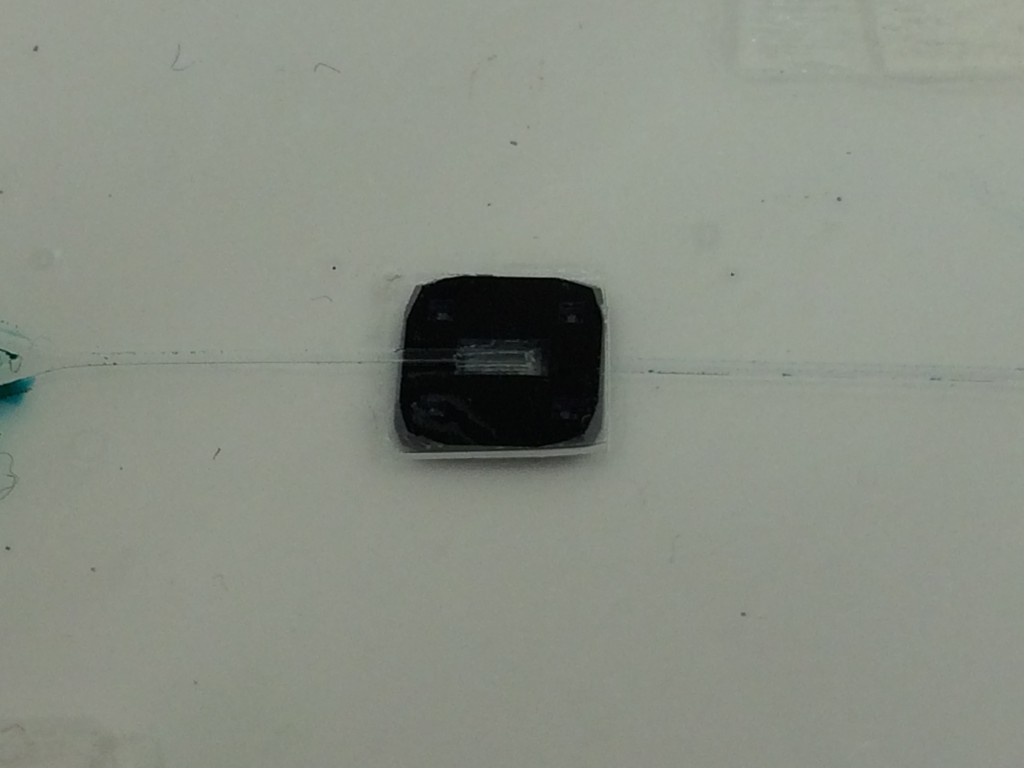
The first picture shows a simple PETL in which there is superimposed laminar flow, the streams almost completely separating after spending time in the same channel. The second pic shows the “chip in petl” design to try to join the streams and then separate them to demonstrate laminar flow after the chip. The third pic is just to show how well the chip goes into the laminated layers, no leakage found. The last one is the actual device. You can see how even when the streams are in separate, superimposed channels you cannot distinguish them as separate, is already looks green before coming in contact. Therefore the need for separating streams down the road. However, separation really did not occur, the streams mix close to the chip, and exit through only one channel….


If you tilt the device can you still see the stacked channels coming out of the mixer? I think I can see yellow below green in your last image. In fact it looks like the yellow channel just stops before the split. But then I cannot imagine why the remaining stream is green.