Contributions to membrane resistance
In the soon to be submitted paper on diffusion models, we list two contributions to membrane resistance. The first is due to the steric and frictional hindrance a molecule encounters as it enters and diffuses through a pore (Renkin, Deen). The second is due to the time that it takes for the molecule to diffuse around on the surface to locate a pore (Amemiya). Most people only consider the first contribution, but we suggest that for thin membranes the second pore discovery part is just as important.
In this post I will show how steric/frictional resistance compares to pore discovery resistance for both thick and thin membranes. In both cases the membrane has 5% porosity and 30 nm pores. I show the resistance for molecules up to 10 nm for scaling purposes.
Thin membrane
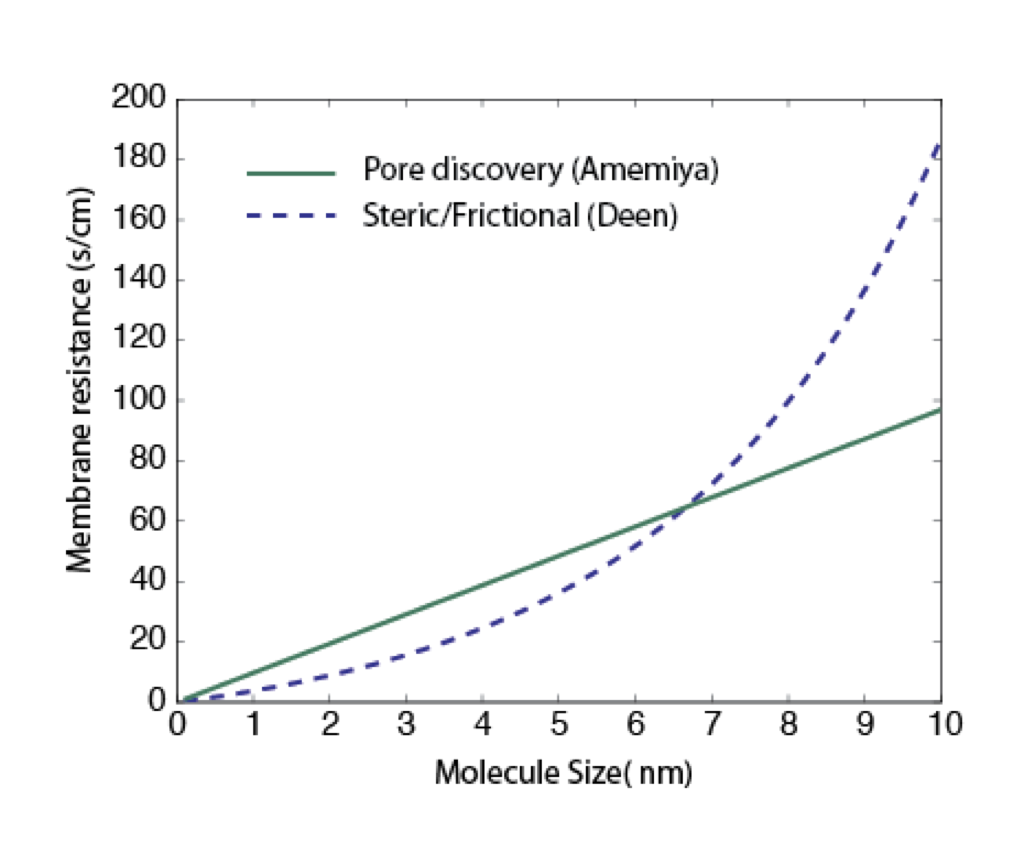
If the length of pores in a thin membrane is on the same order as the distance between the pores, the pore discovery term becomes important in describing the resistance. Above I’ve plotted the steric/frictional and pore discovery resistances for a 15 nm thick membrane. The pore discovery term is greater than the steric/frictional term for molecules under 7 nm. Since we combine these two terms together in our model, pore discovery is also a significant contribution for molecules > 7 nm.
Thick membrane
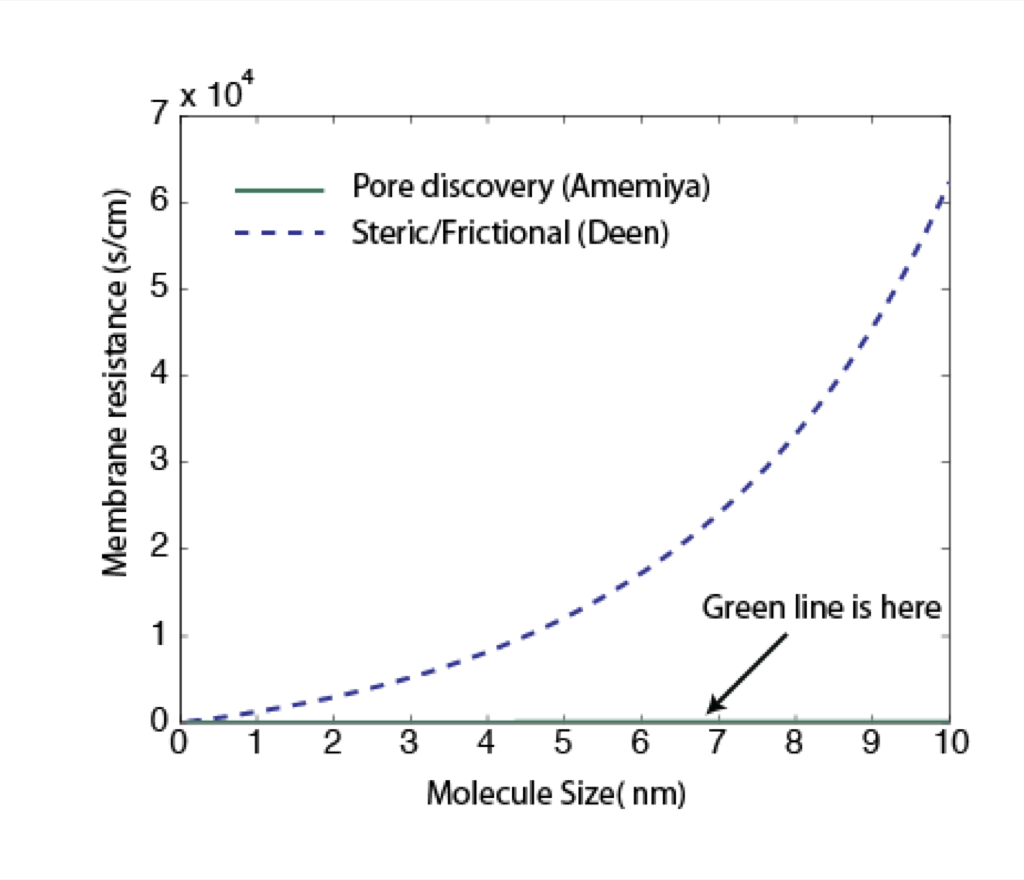
Molecules diffuse slowly through the entire length of a thick membrane. This is such a dominant hindrance that the time it takes to find a pore is negligible. In the figure above you can see that the steric/frictional resistance increases dramatically as the molecules get larger and the pore discovery term is very small. The overall resistance is also much higher than the thin membrane case.
Can you also do this for a low porosity membrane say 0.1%. I’m curious how the relative influence of these resistances shift.