Film stress in free standing films of MgF2
The process to create free standing films of MgF2 requires the film stack to survive a few different kinds of stresses. First, there is thermal stress from the mismatched coefficients of expansion (MgF2 expands about 5-10x more than silicon/silicon nitride), the stress of deposition (adatoms not finding their lowest energy position), and other mechanical stesses (particulate defects, film inhomogeneities). If the film exceeds a certain level, the film will buckle and crack.
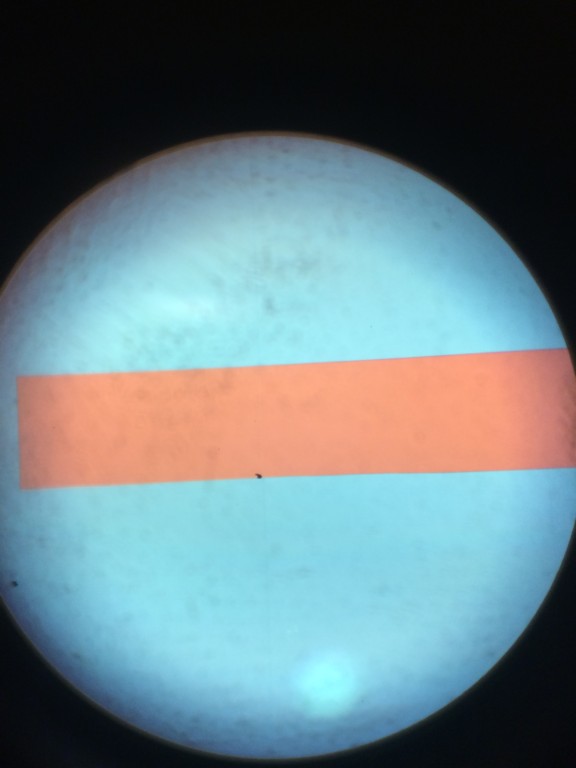
When I created the first microporous MgF2, at 250 C, 3-8 Angstroms/sec, and 200 nm thick, some film stress modes appeared.
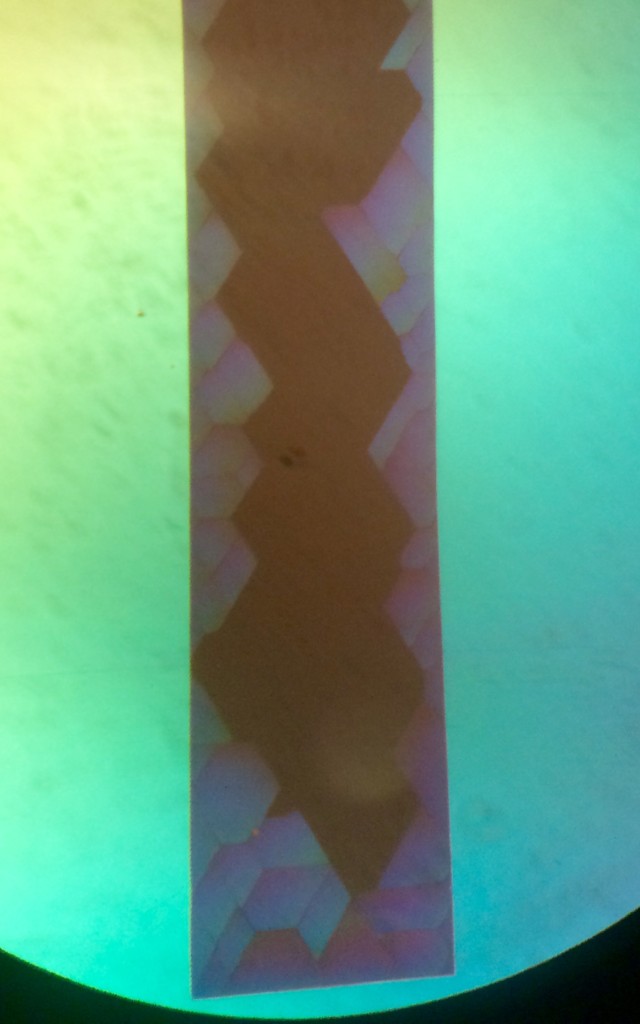
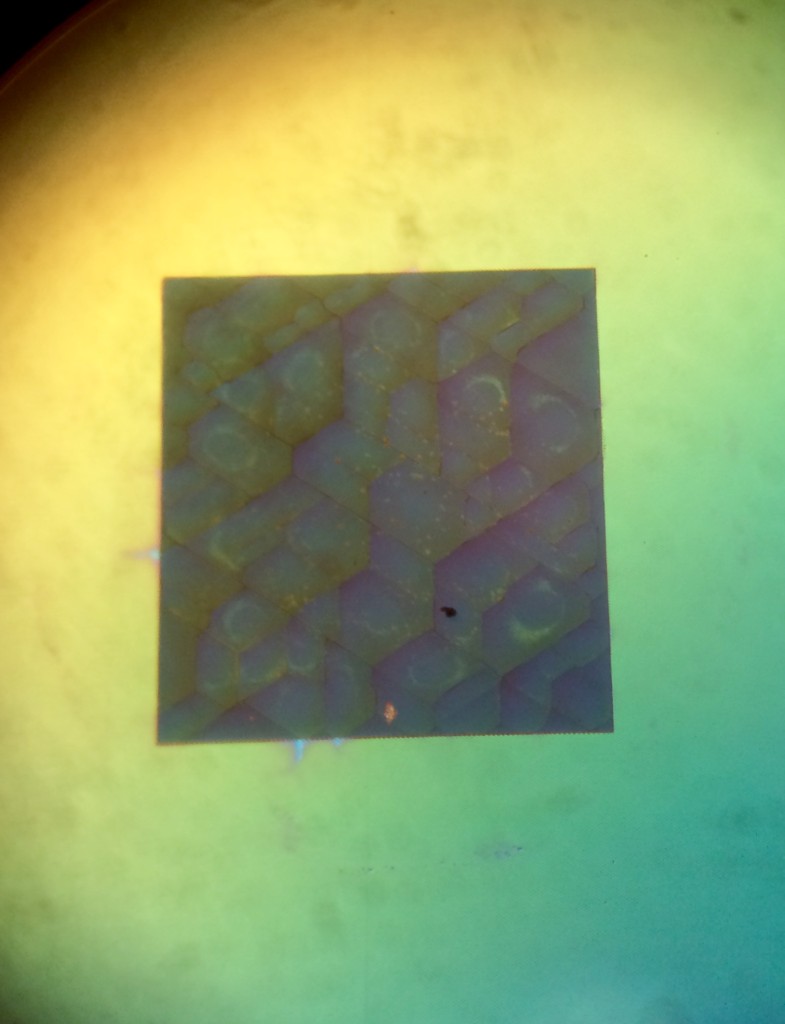
I found a paper that concerns MgF2 depositions in this regime: “Microstructure of magnesium fluoride films deposited by boat evaporation at 193 nm Ming-Chung Liu, Cheng-Chung Lee, Masaaki Kaneko, Kazuhide Nakahira, and Yuuichi Takano”

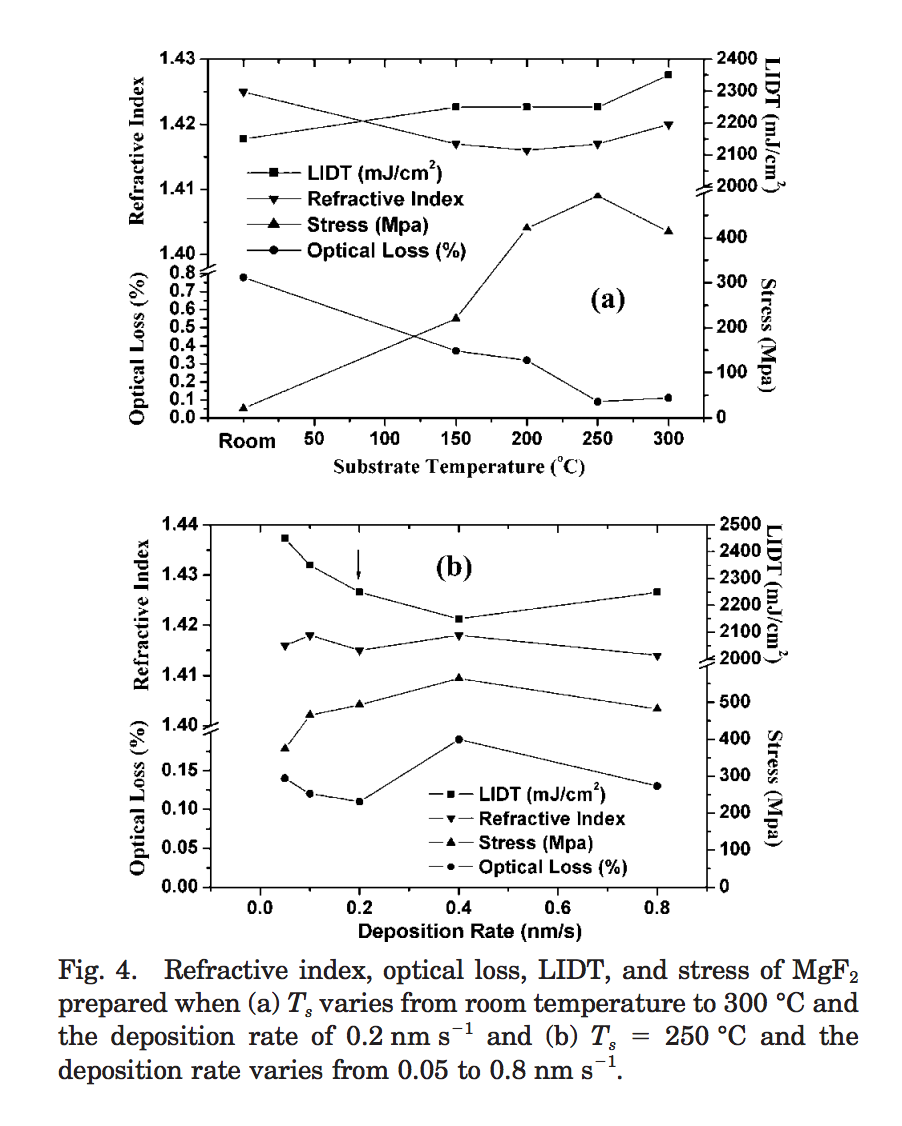
In order to minimize stresses, you should have thinner films (1 um), deposit slowly ( < 2-3 Angstroms/sec), and at higher temperature. The images I show have a definite defect mode. I have believed that some of my yield issues stem from stressed films spontaneous breaking; the ones that survive have balanced film stresses. In order to create a film with even lower stress, you can anneal, which gives the film enough energy to reorganize (however this will probably eliminate any particular nanofeatures that you are interested in).
Based on this information, I modified the microporous MgF2 deposition, from 250C to 350 C and deposition at 1-2 angstroms/sec. Overall, the film stress seems to have been improved.
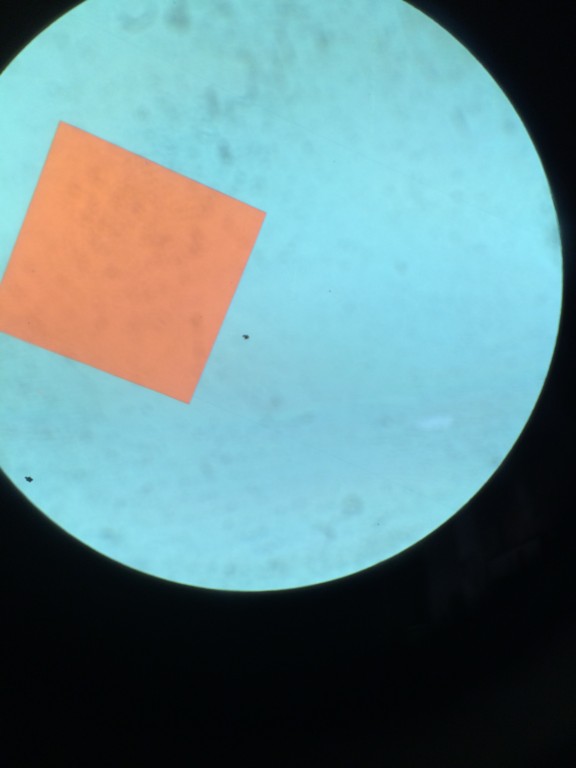
It would be nice to get quantitative measures of this property, especially if it is impacting yield, but I’m not sure we have the equipment. It’s possible that the surface profilometer in URnano has the capability, but we will have to see.