Benchtop dialysis schematic and associated information
Hello All,
My name is Dan Steiner and I am a rotation student that has been working with Dean on designing a modular benchtop apparatus to study in vivo blood dialysis.
The purpose of this project is to create a dialysis system with the ability to scale up previous ultrathin silicon membrane dialysis experiments to whole organisms, with the eventual goal of more effective human dialysis treatment (Johnson et al. 2013). Initially we will use a PBS buffer solution containing markers to measure diffusive clearance of the system, then move to animal models. These markers may include urea, creatinine, cytochrome-c and fluorescent labeled BSA.
The link below is a proposed schematic for the system.
Currently, I have drawn the system, researched different peristaltic pump options and looked into potential in-line methods for measuring markers. I have researched two different pump models for our system. The first being used in similar benchtop experiments (Kim et al. 2016). The model and specifications are listed below:
Masterflex L/S Digital Drive Peristaltic Pump (MK-07551-00, Cole Parmer, Vernon Hills, IL
MK-07551-00 is discontinued. MK-07551-20 is the item.
This pump will be able to accommodate our various needs. Although it is expensive, it will be able to provide flow rates for the types of organisms we wish to study, and it has capacity for two pump heads, that will facilitate multiple pump rates by varying tubing sizes, and is integrated for computer control.
Min: 0.006 mL/min
Max: 3400 mL/min
Pump heads: 2
RPM: 0.1-600
Computer Controlled: Yes
Price: 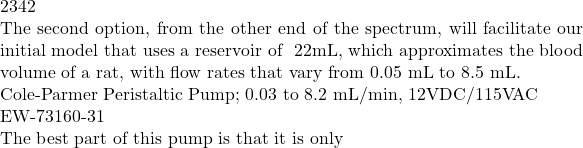 250. If we are trying to produce an initial apparatus that is meant to be modular this may be the best, cost effective option. The cons of using this pump is that it is manually controlled, has 1 pump head, and will only facilitate a rat model due to limited max flow rate. If purchased and this pump does not meet our needs as a primary pump, we should be able to use it as a dialysate or mixing pump (if we decide that we want those).
Silicone tube set included covers the following range (tubing ID): 1/50″, 1/16″, 3/32″, 3/16″, and 1/4″
Min: 0.03 mL/min
Max: 8.2 mL/min
Pump heads: 1
Computer Controlled: No
Price: $246
Another aspect of the system that I have been researching is metrology for in-line diffusive clearance by utilizing surface plasmon resonance, or electrode stimulated conductance potentiometers. However, initially I believe it will be best to collect fractions at predetermined times and assay them as is the current methodology.
All questions and advice are welcome.
Dan